
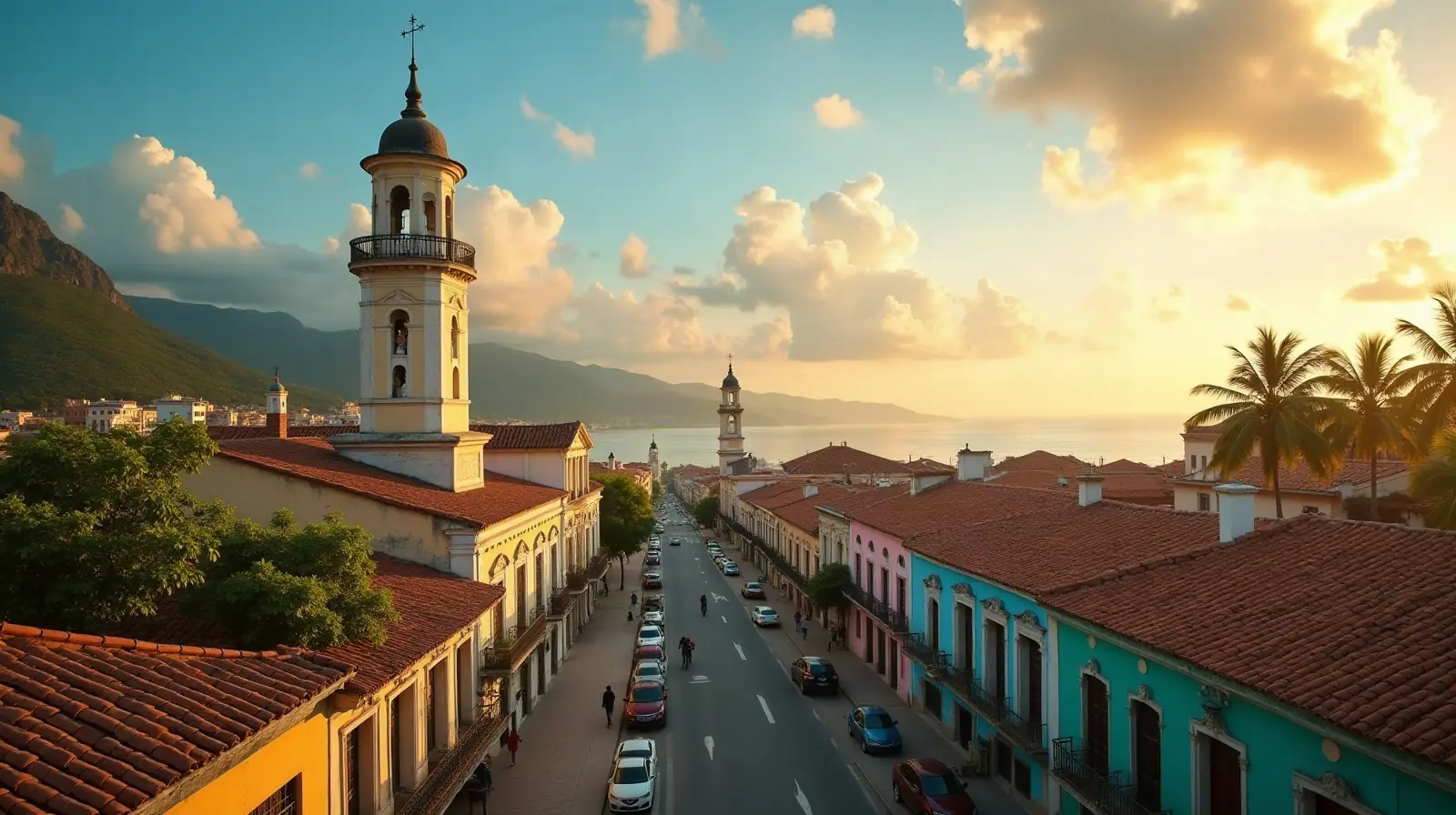
Caribbean · UN member

Cuba: Travel Guide & Requirements
Republic of Cuba
Cuba is a country in Caribbean with its capital in Havana. It has a population of 10.9 million (#87 in the world) and covers 110,860 km². The official language is Spanish. The currency is the Cuban convertible peso (CUC, $).
Where is Cuba? Map of Cuba
Caribbean, island between the Caribbean Sea and the North Atlantic Ocean, 150 km south of Key West, Florida.
- Region
- Caribbean
- Coordinates
- 21.5° N, 80° W
- Neighbours
- none (no land borders)
- Coastline
- 3,735 km
- Cuba
- Capital
- Largest cities
Map of Cuba showing Havana (capital) and the largest cities: Santiago de Cuba, Camagüey, Holguín, Guantánamo, Santa Clara, Las Tunas, Bayamo and Pinar del Río.
Travel requirements
What you need to travel to Cuba
- Passport
The UK Foreign Office says your passport must have an expiry date at least 6 months after the date you arrive in Cuba and 3 months after your planned departure date.
- Visa or eTA
Depends on your passport: of 198 passports, 20 need no visa, 160 need an eVisa, 18 need a visa from an embassy. Check yours or see Cuba entry requirements for every passport.
- Return or onward ticket
The UK government tells British visitors they must also show proof of onward or return travel.
- Proof of funds
No official requirement. The UK government advises bringing enough cash for your entire stay and for emergencies, because international cards such as Visa and Mastercard are no longer accepted, and says US dollars and euros are widely accepted.
- Travel insurance
Canada's travel advice says you must be able to show proof of medical insurance on entry to Cuba, and that if you have none, or the Cuban immigration authorities are not satisfied with the proof you show, you may have t…
- Vaccinations
WHO lists Cuba as requiring proof of yellow fever vaccination from travellers aged 9 months or over arriving from countries at risk of yellow fever transmission, including travellers who transited more than 12 hours thr…
- Arrival card
Cuba's D'Viajeros site says it is mandatory for each passenger to complete the advance traveller information, truthfully, for the Immigration and Foreigners Directorate, the General Customs of the Republic and the Minis…
- Customs allowance
The UK government says to declare foreign currency you take into Cuba if its value is more than 5,000 US dollars, that the Cuban national peso cannot be exchanged outside Cuba, and that it is illegal to exchange money a…
- Travel advice
High risk — US and UK advice.
Entry rules: TravelRequirements.info — Entry Requirements Dataset (CC BY 4.0), each rule cited to an official government source. Always confirm with the airline and the official source before you travel.
Before you go
10 things to know before you travel to Cuba
- Safety: Travel to Cuba carries a high risk: the US State Department rates Cuba Level 2 (“Exercise Increased Caution”), and the UK Foreign Office advises against all but essential travel to the whole country.
- Best time to go: December to March — when daytime highs in Havana are around 27–29°C.
- Money: the Cuban convertible peso (CUC) — 1 US dollar is about 1.0001 CUC.
- Plugs: type A, B, C and L, 110 V, 60 Hz — low-voltage country: devices made only for 220–240 V need a voltage converter. Phone and laptop chargers (100–240 V) only need a plug adapter.
- Emergency numbers: Police 106, Ambulance 104, Fire 105.
- Language: Spanish is official.
- Driving: on the right — speed limits are 50 km/h in built-up areas, 90 km/h outside built-up areas and 100 km/h on motorways.
- Time zone: UTC-5 in Havana.
- Capital: Havana. About 10.9 million people live in Cuba.
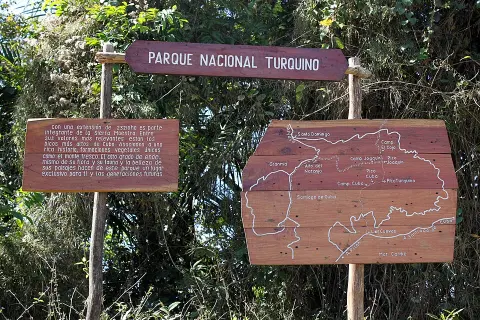
- Outdoors: 14 national parks.
Key facts
Cuba at a glance
Languages spoken: Spanish (official)
Geography & history
About Cuba
The native Amerindian population of Cuba began to decline after the arrival of Christopher COLUMBUS in 1492, as the country was developed as a Spanish colony during the next several centuries. Large numbers of African slaves were imported to work the coffee and sugar plantations, and Havana became the launching point for the annual treasure fleets bound for Spain from Mexico and Peru. Spanish rule eventually provoked an independence movement, and occasional rebellions were harshly suppressed. US intervention during the Spanish-American War in 1898 assisted the Cubans in overthrowing Spanish rule. The Treaty of Paris established Cuban independence from Spain in 1898, and after three-and-a-ha…
Read the full history
The native Amerindian population of Cuba began to decline after the arrival of Christopher COLUMBUS in 1492, as the country was developed as a Spanish colony during the next several centuries. Large numbers of African slaves were imported to work the coffee and sugar plantations, and Havana became the launching point for the annual treasure fleets bound for Spain from Mexico and Peru. Spanish rule eventually provoked an independence movement, and occasional rebellions were harshly suppressed. US intervention during the Spanish-American War in 1898 assisted the Cubans in overthrowing Spanish rule. The Treaty of Paris established Cuban independence from Spain in 1898, and after three-and-a-half years of subsequent US military rule, Cuba became an independent republic in 1902. Cuba then experienced a string of governments mostly dominated by the military and corrupt politicians. Fidel CASTRO led a rebel army to victory in 1959; his authoritarian rule held the subsequent regime together for nearly five decades. He handed off the presidency to his younger brother Raul CASTRO in 2008. Cuba's communist revolution, with Soviet support, was exported throughout Latin America and Africa during the 1960s, 1970s, and 1980s. Miguel DIAZ-CANEL Bermudez, hand-picked by Raul CASTRO to succeed him, was approved as president by the National Assembly and took office in 2018. DIAZ-CANEL was appointed First Secretary of the Communist Party in 2021 after the retirement of Raul CASTRO and continues to serve as both president and first secretary. Cuba traditionally and consistently portrays the US embargo, in place since 1961, as the source of its socioeconomic difficulties. As a result of efforts begun in 2014 to reestablish diplomatic relations, the US and Cuba reopened embassies in their respective countries in 2015. The embargo remains in place, however, and the relationship between the US and Cuba remains tense. Illicit migration of Cuban nationals to the US via maritime and overland routes has been a longstanding challenge. In 2017, the US and Cuba signed a Joint Statement ending the so-called "wet-foot, dry-foot" policy, by which Cuban nationals who reached US soil were permitted to stay. Irregular Cuban maritime migration has dropped significantly since 2016, when migrant interdictions at sea topped 5,000, but land border crossings continue.
Location
Caribbean, island between the Caribbean Sea and the North Atlantic Ocean, 150 km south of Key West, Florida
Climate
tropical; moderated by trade winds; dry season (November to April); rainy season (May to October)
Terrain
mostly flat to rolling plains, with rugged hills and mountains in the southeast
Highest point
Pico Turquino 1,974 m
Natural resources
cobalt, nickel, iron ore, chromium, copper, salt, timber, silica, petroleum, arable land
Natural hazards
the east coast is subject to hurricanes from August to November (in general, the country averages about one hurricane every other year); droughts are common
National symbols
royal palm
Driving
Speed limits & road rules in Cuba
The default speed limits in Cuba are 50 km/h in built-up areas, 90 km/h outside built-up areas and 100 km/h on motorways. The legal alcohol limit for drivers is 0.1‰. Posted signs always take priority over these defaults.
- 5050 km/hBuilt-up areasTowns and cities
- 9090 km/hOutside built-up areasCountry roadsWith a trailer: 70 km/h
- 100100 km/hMotorwaysMotorways / freewaysWith a trailer: 80 km/h
- International Driving PermitRecognised: 1968 Vienna, 1949 Geneva, 1926 ParisCarry the IDP together with your national licence
- Driving sideDrive on the rightOvertake on the left
- Alcohol limit0.1‰ blood alcohol (0.01% BAC)Zero tolerance for young / novice drivers
- Seat beltsRequired by law
- Child seatsNo national child-restraint law
- Motorcycle helmetsRequired for riders
- Road deaths (2021)5.4 per 100,000 peopleSafer than most countries (median 12.4)
Speed limits: OpenStreetMap wiki — Default speed limits (CC BY-SA 2.0). Road-safety laws: WHO Global Health Observatory. Compare speed limits and alcohol limits by country. Defaults for cars; local signs, weather and vehicle type can lower them.
Safety
Is Cuba safe to visit?
Travel to Cuba carries a high risk: the US State Department rates Cuba Level 2 (“Exercise Increased Caution”), and the UK Foreign Office advises against all but essential travel to the whole country.
 US State Department
 UK Foreign Office (FCDO)
Latest update: This travel advice has been reviewed for accuracy with changes made throughout, including protests in Cuba, power outages and fuel and water shortages, travel disruption, international card transactions, travel insurance, visa requirements, travelling to the USA from Cuba, taking money into Cuba, cr
Updated 25 Sep 2026 · Full travel advice
Sources: US Department of State travel advisories (public domain) and UK FCDO foreign travel advice (contains public sector information licensed under the Open Government Licence v3.0). Checked daily. Advice can change quickly — always read the official page before you travel.
Weather
Best time to visit Cuba
The best time to visit Cuba is December to March, when daytime highs in Havana are around 27–29°C. April and November are also a good time to go. July is the warmest month (33°C by day), January the coldest (18°C at night), and June the wettest with about 108 mm of rain.
- Jan27°C18°C
- Feb28°C19°C
- Mar29°C20°C
- Apr31°C22°C
- May32°C24°C
- Jun32°C25°C
- Jul33°C25°C
- Aug33°C26°C
- Sep32°C25°C
- Oct30°C24°C
- Nov28°C21°C
- Dec27°C20°C
Best time Good Less ideal
Before you go
Plugs, voltage & emergency numbers in Cuba
Plugs & sockets
- Type Atwo flat parallel pins
- Type Btwo flat parallel pins and a round earth pin
- Type C (Europlug)two round pins
- Type Lthree round pins in a row
110 V, 60 Hz · Low-voltage country: devices made only for 220–240 V need a voltage converter. Phone and laptop chargers (100–240 V) only need a plug adapter.
Emergency numbers
Save the local numbers before you travel — 112 or 911 may not connect here. All countries →
Sources: Wikipedia — Mains electricity by country and List of emergency telephone numbers (CC BY-SA 4.0).
National parks
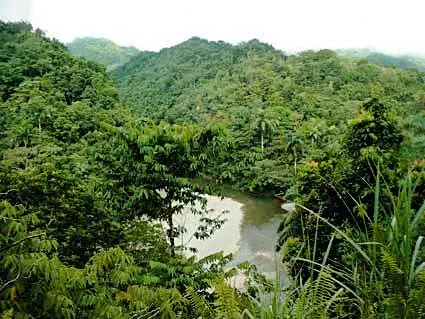
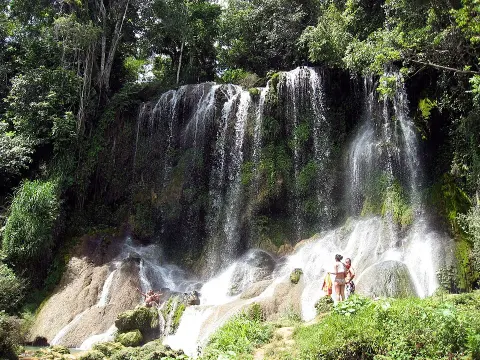
14 national parks in Cuba
- 4,582 km² protected
- oldest from 1930
Largest: Jardines de la Reina National Park · Alexander von Humboldt National Park · parc national de Guanahacabibes
Currency · 26 October 2026
Cuban convertible peso exchange rates today
Cuba uses the Cuban convertible peso (CUC, $). One US dollar buys 1.0001 CUC; over the last 30 days the CUC has lost 0.0% against the dollar.
What other currencies cost in CUC
Currency converter
Daily reference rates from the open-source currency-api (CC0), 26 Oct 2026. Banks and exchange offices add a margin.
World rankings
Where Cuba ranks
How Cuba compares with the rest of the world — open any card for the full ranking.
Airports
Airports in Cuba
124 airports and airfields — 6 large, 19 medium and 95 small, plus 4 heliports. 15 have scheduled passenger flights.
Borders
No land borders
Cuba has no land borders with other countries. Coastline: 3,735 km.
Military
Cuban armed forces
Cuba ranks #66 of 145 in the Global Firepower military strength ranking.
People
Population & society
Religion
Largest cities: Havana (2.1 million)
Economy
Economy
Main industries
petroleum, nickel, cobalt, pharmaceuticals, tobacco, construction, steel, cement, agricultural machinery, sugar
Export partners
China 34%, Spain 12%, Germany 6%, Switzerland 5%, Hong Kong 4% (2023)
Top exports
tobacco, nickel, liquor, zinc ore, precious metal ore (2023)
Travel tools
Handy before every trip to Cuba
Next public holiday
Christmas Day — Friday, 25 December 2026. Then Triumph of the Revolution (1 Jan).
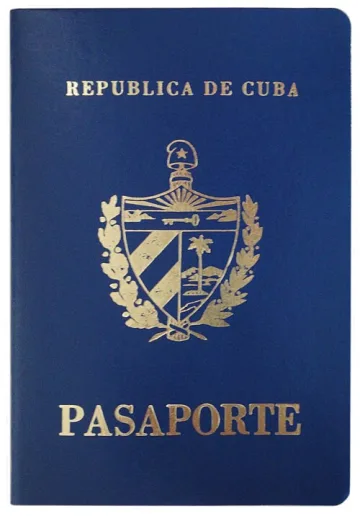
Cuban passport
Ranked #145: 29 countries visa-free, 30 with visa on arrival, 2 with an eTA and 43 with an eVisa.
Cuban passport photo
Exact size, head position and background for Cuba's passport and visa photos — make one free with AI checks.
Calling Cuba
Dial +53 before the local number. Internet domain .cu.
Climate footprint
24.4 million tonnes of CO₂ in 2024 — 2.23 t per person.
Entry requirements
Visa rules for every passport visiting Cuba: visa-free stays, eVisas, visas on arrival and documents to bring.
News
Latest travel news about Cuba
Cuba-born traveler must surrender U.S. passports after citizenship revoked
A federal judge in Miami revoked the U.S. citizenship of a Cuba-born woman, retroactive to her 2015 naturalisation, after she concealed a money-laund…
Travellers to Pacific islands urged to avoid mosquito bites after Maui dengue case
Hawaii's Department of Health has confirmed a tenth travel-related dengue case of 2026, on Maui. All 10 cases this year involved travel to Pacific Is…
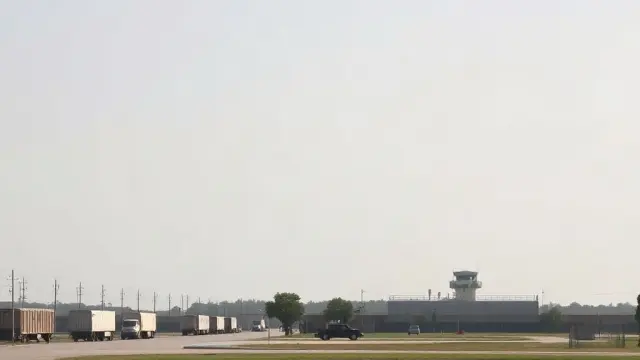
Burundi-bound US removal flights may depart Florida this week
US Immigration and Customs Enforcement may deport seriously ill detainees from two Florida centres to Burundi and the Central African Republic, with …
Frequently asked questions about Cuba
What do I need to travel to Cuba?
How long must my passport be valid for Cuba?
Where is Cuba?
What is Cuba known for?
What is the capital of Cuba?
What language is spoken in Cuba?
What currency does Cuba use?
What is the calling code of Cuba?
Does Cuba have land borders?
How strong is the Cuban passport?
What is the speed limit in Cuba?
Is Cuba safe to visit?
When is the best time to visit Cuba?
What plug type does Cuba use?
How many airports does Cuba have?
Sources: CIA World Factbook (public domain); World Bank Open Data (CC BY 4.0); names, languages and currencies: mledoze/countries (ODbL); flag: flag-icons (MIT); coat of arms: Wikimedia Commons (file page); exchange rates: Daily reference rates from the open-source currency-api (CC0); airports: OurAirports.