
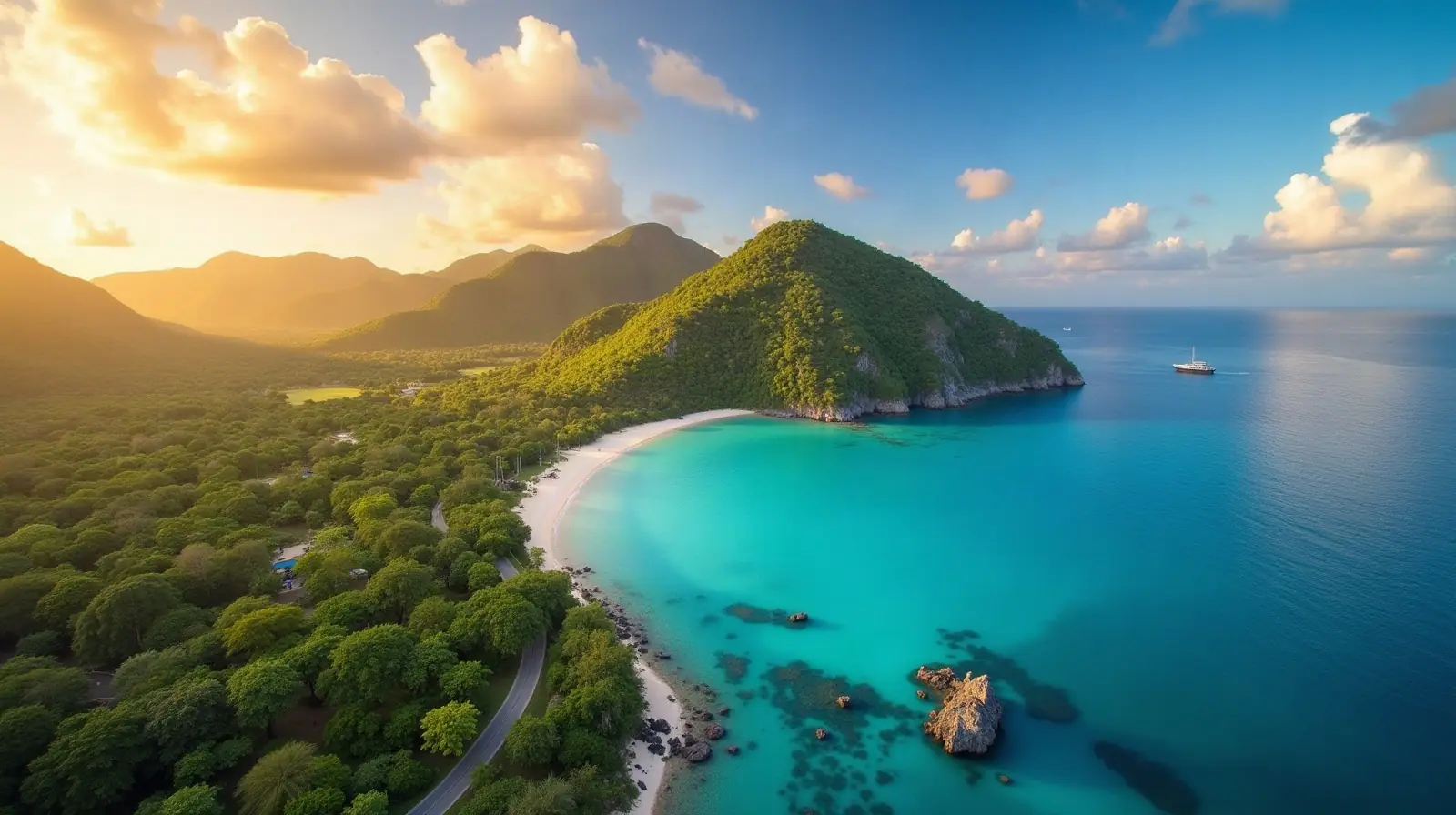
Micronesia · UN member

Palau: Travel Guide & Requirements
Republic of Palau · Beluu er a Belau
Palau is a country in Micronesia with its capital in Ngerulmud. It has a population of 17,663 (#214 in the world) and covers 459 km². The official languages are English and Palauan. The currency is the United States dollar (USD, $).
Where is Palau? Map of Palau
Oceania, group of islands in the North Pacific Ocean, southeast of the Philippines.
- Region
- Micronesia
- Coordinates
- 7.5° N, 134.5° E
- Neighbours
- none (no land borders)
- Coastline
- 1,519 km
- Palau
- Capital
Travel requirements
What you need to travel to Palau
- Passport
Palau's Division of Immigration says your passport should be valid for at least six months at the time of entry into Palau.
- Visa or eTA
Depends on your passport: of 198 passports, 34 need no visa, 162 get a visa on arrival, 2 need a visa from an embassy. Check yours or see Palau entry requirements for every passport.
- Return or onward ticket
The Division of Immigration says tourist visa holders must possess a return ticket unless exempt.
- Proof of funds
The Division of Immigration says all visitors must provide proof of sufficient support for the length of the visit and that they shall not become a public charge, for example a letter of credit or other evidence accepta…
- Travel insurance
No official requirement. The UK government says emergency treatment or treatment for serious conditions is limited so may require medical evacuation, and advises adequate travel health insurance and accessible funds to cover medical treatment a…
- Arrival card
The Division of Immigration says every visitor coming to Palau is assessed a USD 100 environmental fee, and every international airline is required to include the fee in the price of the ticket into Palau.
- Customs allowance
The UK government says to declare, on the Palau entry form, cash or travellers cheques if the value is 10,000 US dollars or more.
- Travel advice
Safe to visit — US and UK advice.
Entry rules: TravelRequirements.info — Entry Requirements Dataset (CC BY 4.0), each rule cited to an official government source. Always confirm with the airline and the official source before you travel.
Before you go
9 things to know before you travel to Palau
- Safety: Yes — Palau is generally safe to visit: the US State Department rates Palau Level 1 (“Exercise Normal Precautions”), and the UK Foreign Office has no warnings against travel there.
- Best time to go: January to December — when daytime highs in Ngerulmud are around 28–29°C.
- Money: the United States dollar (USD) — 1 euro is about 1.1222 USD.
- Plugs: type A and B, 120 V, 60 Hz — low-voltage country: devices made only for 220–240 V need a voltage converter. Phone and laptop chargers (100–240 V) only need a plug adapter.
- Emergency numbers: Police 911, Ambulance 911, Fire 911.
- Language: English and Palauan are official.
- Driving: on the right.
- Time zone: UTC+9 in Ngerulmud.
- Capital: Ngerulmud. About 17,663 people live in Palau.
Key facts
Palau at a glance
Languages spoken: Palauan (official on most islands) 65.2%, other Micronesian 1.9%, English (official) 19.1%, Filipino 9.9%, Chinese 1.2%, other 2.8% (2015 est.)
Geography & history
About Palau
Humans arrived in the Palauan archipelago from Southeast Asia around 1000 B.C. and developed a complex, highly organized matrilineal society where high-ranking women picked the chiefs. The islands were the westernmost part of the widely scattered Pacific islands north of New Guinea that Spanish explorers named the Caroline Islands in the 17th century. The 18th and 19th centuries saw occasional visits of whalers and traders as Spain gained some influence in the islands and administered it from the Philippines. Spain sold Palau to Germany in 1899 after losing the Philippines in the Spanish-American War. Japan seized Palau in 1914, was granted a League of Nations mandate to administer the isla…
Read the full history
Humans arrived in the Palauan archipelago from Southeast Asia around 1000 B.C. and developed a complex, highly organized matrilineal society where high-ranking women picked the chiefs. The islands were the westernmost part of the widely scattered Pacific islands north of New Guinea that Spanish explorers named the Caroline Islands in the 17th century. The 18th and 19th centuries saw occasional visits of whalers and traders as Spain gained some influence in the islands and administered it from the Philippines. Spain sold Palau to Germany in 1899 after losing the Philippines in the Spanish-American War. Japan seized Palau in 1914, was granted a League of Nations mandate to administer the islands in 1920, and made Koror the capital of its South Seas Mandate in 1922. By the outbreak of World War II, there were four times as many Japanese living in Koror as Palauans. In 1944, the US invasion of the island of Peleliu was one of the bloodiest island fights of the Pacific War. After the war, Palau became part of the US-administered Trust Territory of the Pacific Islands. Palau voted against joining the Federated States of Micronesia in 1978 and adopted its own constitution in 1981, which stated that Palau was a nuclear-free country. In 1982, Palau signed a Compact of Free Association (COFA) with the US, which granted Palau financial assistance and access to many US domestic programs in exchange for exclusive US military access and defense responsibilities. However, many Palauans saw the COFA as incompatible with the Palauan Constitution because of the US military’s nuclear arsenal, and seven referenda failed to achieve ratification. Following a constitutional amendment and eighth referendum in 1993, the COFA was ratified and entered into force in 1994 when the islands gained their independence. Its funding was renewed in 2010. Palau has been on the frontlines of combatting climate change and protecting marine resources. In 2011, Palau banned commercial shark fishing and created the world’s first shark sanctuary. In 2017, Palau began stamping the Palau Pledge into passports, reminding visitors to act in ecologically and culturally responsible ways. In 2020, Palau banned coral reef-toxic sunscreens and expanded its fishing prohibition to include 80% of its exclusive economic zone.
Location
Oceania, group of islands in the North Pacific Ocean, southeast of the Philippines
Climate
tropical; hot and humid; wet season May to November
Terrain
varying topography from the high, mountainous main island of Babelthuap to low, coral islands usually fringed by large barrier reefs
Highest point
Mount Ngerchelchuus 242 m
Natural resources
forests, minerals (especially gold), marine products, deep-seabed minerals
Natural hazards
typhoons (June to December)
National symbols
bai (native meeting house)
Safety
Is Palau safe to visit?
Yes — Palau is generally safe to visit: the US State Department rates Palau Level 1 (“Exercise Normal Precautions”), and the UK Foreign Office has no warnings against travel there.
 US State Department
 UK Foreign Office (FCDO)
Latest update: New information about dual nationals returning to the UK (‘Entry requirements’ page).
Updated 10 Dec 2025 · Full travel advice
Sources: US Department of State travel advisories (public domain) and UK FCDO foreign travel advice (contains public sector information licensed under the Open Government Licence v3.0). Checked daily. Advice can change quickly — always read the official page before you travel.
Weather
Best time to visit Palau
The best time to visit Palau is January to December, when daytime highs in Ngerulmud are around 28–29°C. April is the warmest month (29°C by day), February the coldest (27°C at night), and July the wettest with about 375 mm of rain.
- Jan29°C27°C
- Feb28°C27°C
- Mar29°C27°C
- Apr29°C28°C
- May29°C28°C
- Jun29°C28°C
- Jul28°C27°C
- Aug28°C27°C
- Sep28°C27°C
- Oct29°C28°C
- Nov29°C28°C
- Dec29°C28°C
Best time Good Less ideal
Before you go
Plugs, voltage & emergency numbers in Palau
Plugs & sockets
120 V, 60 Hz · Low-voltage country: devices made only for 220–240 V need a voltage converter. Phone and laptop chargers (100–240 V) only need a plug adapter.
Emergency numbers
Save the local numbers before you travel — 112 or 911 may not connect here. All countries →
Sources: Wikipedia — Mains electricity by country and List of emergency telephone numbers (CC BY-SA 4.0).
Currency · 26 October 2026
United States dollar exchange rates today
Palau uses the United States dollar (USD, $).
What other currencies cost in USD
Currency converter
Daily reference rates from the open-source currency-api (CC0), 26 Oct 2026. Banks and exchange offices add a margin.
World rankings
Where Palau ranks
How Palau compares with the rest of the world — open any card for the full ranking.
Airports
Airports in Palau
3 airports and airfields — 1 large, 0 medium and 2 small, plus 0 heliports. 1 have scheduled passenger flights.
Borders
No land borders
Palau has no land borders with other countries. Coastline: 1,519 km.
People
Population & society
Religion
Largest cities: Ngerulmud (277)
Economy
Economy
Main industries
tourism, fishing, subsistence agriculture
Export partners
India 41%, Turkey 26%, Taiwan 10%, USA 9%, Japan 5% (2023)
Top exports
ships, refined petroleum (2023)
Travel tools
Handy before every trip to Palau
Next public holiday
Thanksgiving Day — Thursday, 26 November 2026. Then Family Day (27 Nov).
Palauan passport
Ranked #94: 69 countries visa-free, 36 with visa on arrival, 4 with an eTA and 43 with an eVisa.
Palauan passport photo
Exact size, head position and background for Palau's passport and visa photos — make one free with AI checks.
Calling Palau
Dial +680 before the local number. Internet domain .pw.
Climate footprint
0.2 million tonnes of CO₂ in 2024 — 12.76 t per person.
Entry requirements
Visa rules for every passport visiting Palau: visa-free stays, eVisas, visas on arrival and documents to bring.
News
Latest travel news about Palau

Nauruans Applying to Study in Australia Now Pay Less for Student Visas
Australia's Department of Home Affairs has confirmed a reduced Student visa (subclass 500) application charge for eligible citizens of 23 Pacific Isl…
Travellers to Pacific islands urged to avoid mosquito bites after Maui dengue case
Hawaii's Department of Health has confirmed a tenth travel-related dengue case of 2026, on Maui. All 10 cases this year involved travel to Pacific Is…
Nauru passport holders cut Student visa cost if they apply using their Nauru document
Australia's Department of Home Affairs says citizens of 23 Pacific Island, Timor-Leste and ASEAN countries can pay a reduced Student visa (subclass 5…
Frequently asked questions about Palau
What do I need to travel to Palau?
How long must my passport be valid for Palau?
Where is Palau?
What is the capital of Palau?
What language is spoken in Palau?
What currency does Palau use?
What is the calling code of Palau?
Does Palau have land borders?
How strong is the Palauan passport?
Is Palau safe to visit?
When is the best time to visit Palau?
What plug type does Palau use?
How many airports does Palau have?
Sources: CIA World Factbook (public domain); World Bank Open Data (CC BY 4.0); names, languages and currencies: mledoze/countries (ODbL); flag: flag-icons (MIT); coat of arms: Wikimedia Commons (file page); exchange rates: Daily reference rates from the open-source currency-api (CC0); airports: OurAirports.