
Western Africa · UN member

Ghana: Travel Guide & Requirements
Republic of Ghana
Ghana is a country in Western Africa with its capital in Accra. It has a population of 35.1 million (#47 in the world) and covers 238,533 km². The official language is English. The currency is the Ghanaian cedi (GHS, ₵).
Where is Ghana? Map of Ghana
Western Africa, bordering the Gulf of Guinea, between Cote d'Ivoire and Togo.
- Region
- Western Africa
- Coordinates
- 8° N, 2° W
- Neighbours
- 3 — see list
- Coastline
- 539 km
- Ghana
- Neighbours
- Capital
- Largest cities
Map of Ghana showing Accra (capital) and the largest cities: Kumasi, Tamale, Takoradi, Cape Coast, Obuase, Koforidua, Ho and Twifu Praso.
Travel requirements
What you need to travel to Ghana
- Passport
Ghana's eVisa applicant guide says the passport must be valid for at least 6 months from the applicant's intended date of departure from Ghana and must have at least 3 blank pages.
- Visa or eTA
Depends on your passport: of 198 passports, 23 need no visa, 39 need an eTA, 111 need an eVisa, 25 need a visa from an embassy. Check yours or see Ghana entry requirements for every passport.
- Return or onward ticket
Ghana's eVisa applicant guide lists a confirmed return or onward travel ticket among the requirements for Tourist (B2) and Business (B1) visas, and requires proof of accommodation covering the full duration of the inten…
- Proof of funds
Ghana's eVisa applicant guide lists proof of sufficient funds, such as a bank statement or credit card statement covering the last 3 months, among the Tourist Visa (B2) requirements.
- Travel insurance
No official requirement.
- Vaccinations
A valid yellow fever vaccination certificate or card is required for entry into Ghana and may be checked at the port of entry.
- Customs allowance
The UK government says you must declare all hard currency using the declaration form provided on arrival, that you can bring in up to a maximum Ghanaian cedi equivalent of USD 10,000, and that you should not carry more …
- Travel advice
Some caution needed — US and UK advice.
Entry rules: TravelRequirements.info — Entry Requirements Dataset (CC BY 4.0), each rule cited to an official government source. Always confirm with the airline and the official source before you travel.
Before you go
10 things to know before you travel to Ghana
- Safety: Ghana is generally safe for travellers, but some caution is needed: the US State Department rates Ghana Level 2 (“Exercise Increased Caution”), and the UK Foreign Office advises against all but essential travel to parts of the country.
- Best time to go: July to August — when daytime highs in Accra are around 26°C.
- Money: the Ghanaian cedi (GHS) — 1 US dollar is about 11.6280 GHS.
- Plugs: type D and G, 230 V, 50 Hz — standard 220–240 V: devices from the US or Japan (110–120 V) need a converter unless they are dual voltage (100–240 V).
- Emergency numbers: Police 112, Ambulance 112, Fire 112.
- Language: English is official.
- Driving: on the right — speed limits are 50 km/h in built-up areas, 90 km/h outside built-up areas and 100 km/h on motorways.
- Time zone: UTC0 in Accra.
- Capital: Accra; the largest city is Kumasi. About 35.1 million people live in Ghana.
- Outdoors: 7 national parks.
Key facts
Ghana at a glance
Languages spoken: Asante 16%, Ewe 14%, Fante 11.6%, Boron (Brong) 4.9%, Dagomba 4.4%, Dangme 4.2%, Dagarte (Dagaba) 3.9%, Kokomba 3.5%, Akyem 3.2%, Ga 3.1%, other 31.2% (2010 est.)
Geography & history
About Ghana
Ghana is a multiethnic country rich in natural resources and is one of the most stable and democratic countries in West Africa. Ghana has been inhabited for at least several thousand years, but little is known about its early inhabitants. By the 12th century, the gold trade started to boom in Bono (Bonoman) state in what is today southern Ghana, and it became the genesis of the Akan people's power and wealth in the region. Beginning in the 15th century, the Portuguese, followed by other European powers, arrived and competed for trading rights. Numerous kingdoms and empires emerged in the area, among the most powerful were the Kingdom of Dagbon in the north and the Asante (Ashanti) Empire in…
Read the full history
Ghana is a multiethnic country rich in natural resources and is one of the most stable and democratic countries in West Africa. Ghana has been inhabited for at least several thousand years, but little is known about its early inhabitants. By the 12th century, the gold trade started to boom in Bono (Bonoman) state in what is today southern Ghana, and it became the genesis of the Akan people's power and wealth in the region. Beginning in the 15th century, the Portuguese, followed by other European powers, arrived and competed for trading rights. Numerous kingdoms and empires emerged in the area, among the most powerful were the Kingdom of Dagbon in the north and the Asante (Ashanti) Empire in the south. By the mid-18th century, Asante was a highly organized state with immense wealth; it provided enslaved people for the Atlantic slave trade, and in return received firearms that facilitated its territorial expansion. The Asante resisted increasing British influence in the coastal areas, engaging in a series of wars during the 19th century before ultimately falling under British control. Formed from the merger of the British colony of the Gold Coast and the Togoland trust territory, Ghana in 1957 became the first Sub-Saharan country in colonial Africa to gain its independence, with Kwame NKRUMAH as its first leader. Ghana endured a series of coups before Lt. Jerry RAWLINGS took power in 1981 and banned political parties. After approving a new constitution and restoring multiparty politics in 1992, RAWLINGS won presidential elections in 1992 and 1996 but was constitutionally prevented from running for a third term in 2000. John KUFUOR of the opposition New Patriotic Party (NPP) succeeded him and was reelected in 2004. John Atta MILLS of the National Democratic Congress won the 2008 presidential election and took over as head of state. MILLS died in 2012 and was constitutionally succeeded by his vice president, John Dramani MAHAMA, who subsequently won the 2012 presidential election. In 2016, Nana Addo Dankwa AKUFO-ADDO of the NPP defeated MAHAMA, marking the third time that Ghana’s presidency had changed parties since the return to democracy. AKUFO-ADDO was reelected in 2020. In recent years, Ghana has taken an active role in promoting regional stability and is highly integrated in international affairs.
Location
Western Africa, bordering the Gulf of Guinea, between Cote d'Ivoire and Togo
Climate
tropical; warm and comparatively dry along southeast coast; hot and humid in southwest; hot and dry in north
Terrain
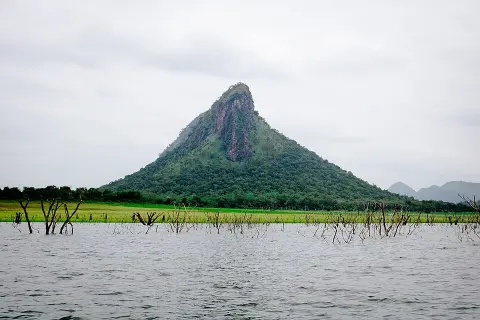
mostly low plains with dissected plateau in south-central area
Highest point
Mount Afadjato 885 m
Natural resources
gold, timber, industrial diamonds, bauxite, manganese, fish, rubber, hydropower, petroleum, silver, salt, limestone
Natural hazards
dry, dusty, northeastern harmattan winds from January to March; droughts
National symbols
black star, golden eagle
Driving
Speed limits & road rules in Ghana
The default speed limits in Ghana are 50 km/h in built-up areas, 90 km/h outside built-up areas and 100 km/h on motorways. The legal alcohol limit for drivers is 0.8‰. Posted signs always take priority over these defaults.
- 5050 km/hBuilt-up areasTowns and cities
- 9090 km/hOutside built-up areasCountry roads
- 100100 km/hMotorwaysMotorways / freeways
- International Driving PermitRecognised: 1968 Vienna, 1949 GenevaCarry the IDP together with your national licence
- Driving sideDrive on the rightOvertake on the left
- Alcohol limit0.8‰ blood alcohol (0.08% BAC)
- Seat beltsRequired by law
- Child seatsNo national child-restraint law
- Motorcycle helmetsRequired for riders
- Road deaths (2021)25.9 per 100,000 peopleHigher than most countries (median 12.4)
Speed limits: OpenStreetMap wiki — Default speed limits (CC BY-SA 2.0). Road-safety laws: WHO Global Health Observatory. Compare speed limits and alcohol limits by country. Defaults for cars; local signs, weather and vehicle type can lower them.
Safety
Is Ghana safe to visit?
Ghana is generally safe for travellers, but some caution is needed: the US State Department rates Ghana Level 2 (“Exercise Increased Caution”), and the UK Foreign Office advises against all but essential travel to parts of the country.
 US State Department
 UK Foreign Office (FCDO)
Latest update: Removal of information about flooding in parts of Ghana, including Accra and surrounding areas (‘Warnings and insurance’ page).
Updated 2 Jul 2026 · Full travel advice
Sources: US Department of State travel advisories (public domain) and UK FCDO foreign travel advice (contains public sector information licensed under the Open Government Licence v3.0). Checked daily. Advice can change quickly — always read the official page before you travel.
Weather
Best time to visit Ghana
The best time to visit Ghana is July to August, when daytime highs in Accra are around 26°C. November to February and September are also a good time to go. February is the warmest month (30°C by day), August the coldest (23°C at night), and June the wettest with about 197 mm of rain.
- Jan30°C25°C
- Feb30°C26°C
- Mar30°C26°C
- Apr29°C26°C
- May29°C26°C
- Jun27°C25°C
- Jul26°C23°C
- Aug26°C23°C
- Sep27°C23°C
- Oct28°C25°C
- Nov29°C25°C
- Dec30°C25°C
Best time Good Less ideal
Before you go
Plugs, voltage & emergency numbers in Ghana
Plugs & sockets
230 V, 50 Hz · Standard 220–240 V: devices from the US or Japan (110–120 V) need a converter unless they are dual voltage (100–240 V).
Emergency numbers
112 works from any mobile phone, even without a SIM card in most networks. All countries →
Sources: Wikipedia — Mains electricity by country and List of emergency telephone numbers (CC BY-SA 4.0).
National parks
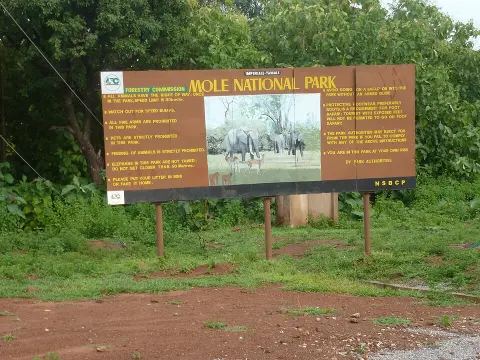
7 national parks in Ghana
- 11,774 km² protected
- oldest from 1971
Largest: Mole National Park · Digya National Park · Bui National Park
Currency · 26 October 2026
Ghanaian cedi exchange rates today
Ghana uses the Ghanaian cedi (GHS, ₵). One US dollar buys 11.6280 GHS; over the last 30 days the GHS has lost 0.1% against the dollar.
What other currencies cost in GHS
Currency converter
Daily reference rates from the open-source currency-api (CC0), 26 Oct 2026. Banks and exchange offices add a margin.
World rankings
Where Ghana ranks
How Ghana compares with the rest of the world — open any card for the full ranking.
Airports
Airports in Ghana
18 airports and airfields — 3 large, 3 medium and 5 small, plus 7 heliports. 6 have scheduled passenger flights.
Borders
Neighbouring countries
Ghana borders 3 countries along 2,420 km of land borders. Coastline: 539 km.


Military
Ghanaian armed forces
Ghana ranks #109 of 145 in the Global Firepower military strength ranking, with a defence budget of $507 million (2025).
People
Population & society
Religion
Largest cities: Kumasi (3.8 million), Accra (2.7 million), Sekondi Takoradi (1.1 million)
Economy
Economy
Main industries
mining, lumbering, light manufacturing, aluminum smelting, food processing, cement, small commercial ship building, petroleum
Export partners
Switzerland 24%, UAE 18%, India 8%, South Africa 7%, China 7% (2023)
Top exports
gold, crude petroleum, cocoa beans, manganese ore, cocoa paste (2023)
Travel tools
Handy before every trip to Ghana
Next public holiday
Farmers' Day — Friday, 4 December 2026. Then Christmas Day (25 Dec).

Ghanaian passport
Ranked #120: 42 countries visa-free, 22 with visa on arrival, 2 with an eTA and 38 with an eVisa.
Ghanaian passport photo
Exact size, head position and background for Ghana's passport and visa photos — make one free with AI checks.
Calling Ghana
Dial +233 before the local number. Internet domain .gh.
Climate footprint
21.0 million tonnes of CO₂ in 2024 — 0.61 t per person.
Entry requirements
Visa rules for every passport visiting Ghana: visa-free stays, eVisas, visas on arrival and documents to bring.
News
Latest travel news about Ghana
More intra-African flights, but visas and fares still deter travellers
Seats on intra-African tourism routes rose 10.5% year-on-year in August 2026, yet visas, high fares and indirect connections still hold back regional…
UK student visa squeeze and £925 levy planned for 2028: what applicants face
British universities say tighter UK immigration rules are cutting international student numbers, putting a £925 annual levy planned for August 2028 a…
Japan drops visa application fees for travellers from 63 countries
Japan has published a list of 63 countries and regions whose nationals do not pay the visa application fee. Honduras is among the American countries …
Frequently asked questions about Ghana
What do I need to travel to Ghana?
How long must my passport be valid for Ghana?
Where is Ghana?
What is Ghana known for?
What is the capital of Ghana?
What language is spoken in Ghana?
What currency does Ghana use?
What is the calling code of Ghana?
Which countries border Ghana?
How strong is the Ghanaian passport?
What is the speed limit in Ghana?
Is Ghana safe to visit?
When is the best time to visit Ghana?
What plug type does Ghana use?
How many airports does Ghana have?
Sources: CIA World Factbook (public domain); World Bank Open Data (CC BY 4.0); names, languages and currencies: mledoze/countries (ODbL); flag: flag-icons (MIT); coat of arms: Wikimedia Commons (file page); exchange rates: Daily reference rates from the open-source currency-api (CC0); airports: OurAirports.