
Eastern Asia · UN member

North Korea: Travel Guide & Requirements
Democratic People's Republic of Korea · 조선민주주의인민공화국
North Korea is a country in Eastern Asia with its capital in Pyongyang. It has a population of 26.6 million (#56 in the world) and covers 120,538 km². The official language is Korean. The currency is the North Korean won (KPW, ₩).
Where is North Korea? Map of North Korea
Eastern Asia, northern half of the Korean Peninsula bordering the Korea Bay and the Sea of Japan, between China and South Korea.
- Region
- Eastern Asia
- Coordinates
- 40° N, 127° E
- Neighbours
- 3 — see list
- Coastline
- 2,495 km
- North Korea
- Neighbours
- Capital
- Largest cities
Map of North Korea showing Pyongyang (capital) and the largest cities: Hamhŭng, Sunch’ŏn, Kaesŏng, Wŏnsan, Chongjin, Sariwŏn-si, Sinŭiju and Tŏkch’ŏn.
Travel requirements
What you need to travel to North Korea
- Passport
The UK government says your passport should be valid for the proposed duration of your stay, and to check with your travel provider that your passport and other travel documents meet requirements, including for China if…
- Visa or eTA
Depends on your passport: of 198 passports, 197 need a visa from an embassy. Check yours or see North Korea entry requirements for every passport.
- Return or onward ticket
No official requirement. The UK government says tourists can normally travel to North Korea only as part of an organised tour, and that independent travellers need a sponsor and permission from the Ministry for Foreign Affairs.
- Proof of funds
No official requirement. The UK government says credit cards and international mobile payments are not accepted, and that some hotels may insist on full cash payment in advance when you check in.
- Travel insurance
No official requirement. Canada's travel advice says to get travel insurance that includes coverage for medical evacuation and hospital stays, and that medical services and facilities are poor.
- Vaccinations
WHO's country list marks North Korea as requiring proof of yellow fever vaccination from travellers aged one year and over arriving from countries at risk of yellow fever transmission; the UK government says you need th…
- Arrival card
The UK government says foreign currency must be declared at customs, foreign mobile phones must be registered at the border, and GPS devices must be left with customs until you leave.
- Customs allowance
The UK government says there are no restrictions on importing and exporting foreign currency, but you must declare it at customs, and that importing or exporting North Korean won is illegal.
- Travel advice
Avoid travel — US and UK advice.
Entry rules: TravelRequirements.info — Entry Requirements Dataset (CC BY 4.0), each rule cited to an official government source. Always confirm with the airline and the official source before you travel.
Before you go
10 things to know before you travel to North Korea
- Safety: Governments advise against travel to North Korea: the US State Department rates North Korea Level 4 (“Do Not Travel”), and the UK Foreign Office advises against all but essential travel to the whole country.
- Best time to go: May to June and September — when daytime highs in Pyongyang are around 23–28°C.
- Money: the North Korean won (KPW) — 1 US dollar is about 900.0796 KPW.
- Plugs: type C and F, 220 V, 50 Hz — standard 220–240 V: devices from the US or Japan (110–120 V) need a converter unless they are dual voltage (100–240 V).
- Emergency numbers: Fire 110 / 8119.
- Language: Korean is official.
- Driving: on the right.
- Time zone: UTC+9 in Pyongyang.
- Capital: Pyongyang. About 26.6 million people live in North Korea.
- Outdoors: 2 ski areas.
Key facts
North Korea at a glance
Languages spoken: Korean
Geography & history
About North Korea
The first recorded kingdom (Choson) on the Korean Peninsula dates from approximately 2300 B.C. Over the subsequent centuries, three main kingdoms -- Kogoryo, Paekche, and Silla -- were established on the Peninsula. By the 5th century A.D., Kogoryo emerged as the most powerful, with control over much of the Peninsula and part of Manchuria (modern-day northeast China). However, Silla allied with the Chinese to create the first unified Korean state in 688. Following the collapse of Silla in the 9th century, Korea was unified under the Koryo (Goryeo; 918-1392) and the Chosen (Joseon; 1392-1910) dynasties. Korea became the object of intense imperialistic rivalry among the Chinese (its traditiona…
Read the full history
The first recorded kingdom (Choson) on the Korean Peninsula dates from approximately 2300 B.C. Over the subsequent centuries, three main kingdoms -- Kogoryo, Paekche, and Silla -- were established on the Peninsula. By the 5th century A.D., Kogoryo emerged as the most powerful, with control over much of the Peninsula and part of Manchuria (modern-day northeast China). However, Silla allied with the Chinese to create the first unified Korean state in 688. Following the collapse of Silla in the 9th century, Korea was unified under the Koryo (Goryeo; 918-1392) and the Chosen (Joseon; 1392-1910) dynasties. Korea became the object of intense imperialistic rivalry among the Chinese (its traditional benefactor), Japanese, and Russian empires in the latter half of the 19th and early 20th centuries. After the Sino-Japanese War (1894-95) and the Russo-Japanese War (1904-05), Korea was occupied by Imperial Japan. In 1910, Japan formally annexed the entire peninsula. After World War II, the northern half came under Soviet-sponsored communist control. In 1948, North Korea (formally known as the Democratic People's Republic of Korea or DPRK) was founded under President KIM Il Sung, who consolidated power and cemented autocratic one-party rule under the Korean Worker's Party (KWP). North Korea failed to conquer UN-backed South Korea (formally the Republic of Korea or ROK) during the Korean War (1950-53), after which a demilitarized zone separated the two Koreas. KIM's authoritarian rule included tight control over North Korean citizens and the demonization of the US as the central threat to North Korea's political and social system. In addition, he molded the country's economic, military, and political policies around the core objective of unifying Korea under Pyongyang's control. North Korea also declared a central ideology of juche ("self-reliance") as a check against outside influence, while continuing to rely heavily on China and the Soviet Union for economic support. KIM Il Sung's son, KIM Jong Il, was officially designated as his father's successor in 1980, and he assumed a growing political and managerial role until the elder KIM's death in 1994. Under KIM Jong Il's reign, North Korea continued developing nuclear weapons and ballistic missiles. KIM Jong Un was publicly unveiled as his father's successor in 2010. Following KIM Jong Il's death in 2011, KIM Jong Un quickly assumed power and has since occupied the regime's highest political and military posts. After the end of Soviet aid in 1991, North Korea faced serious economic setbacks that exacerbated decades of economic mismanagement and resource misallocation. Since the mid-1990s, North Korea has faced chronic food shortages and economic stagnation. In recent years, the North's domestic agricultural production has improved but still falls far short of producing sufficient food for its population. Starting in 2002, North Korea began to tolerate semi-private markets but has made few other efforts to meet its goal of improving the overall standard of living. New economic development plans in the 2010s failed to meet government-mandated goals for key industrial sectors, food production, or overall economic performance. At the onset of the COVID-19 pandemic in 2020, North Korea instituted a nationwide lockdown that severely restricted its economy and international engagement. Since then, KIM has repeatedly expressed concerns with the regime's economic failures and food problems, but in 2021, he vowed to continue "self-reliant" policies and has reinvigorated his pursuit of greater regime control of the economy. As of 2024, despite slowly renewing cross-border trade with China, North Korea remained one of the world's most isolated countries and one of Asia's poorest. In 2024, Pyongyang announced it was ending all economic cooperation with South Korea. The move followed earlier proclamations that it was scrapping a 2018 military pact with South Korea to de-escalate tensions along their militarized border, abandoning the country’s decades-long pursuit of peaceful unification with South Korea, and designating the South as North Korea’s “principal enemy.”
Location
Eastern Asia, northern half of the Korean Peninsula bordering the Korea Bay and the Sea of Japan, between China and South Korea
Climate
temperate, with rainfall concentrated in summer; long, bitter winters
Terrain
mostly hills and mountains separated by deep, narrow valleys; wide coastal plains in west, discontinuous in east
Highest point
Paektu-san 2,744 m
Natural resources
coal, iron ore, limestone, magnesite, graphite, copper, zinc, lead, precious metals, hydropower
Natural hazards
late spring droughts often followed by severe flooding; occasional typhoons during the early fall volcanism: P'aektu-san (2,744 m) (also known as Baitoushan, Baegdu, or Changbaishan), on the Chinese border, is considered historically active
National symbols
red star, chollima (winged horse)
Safety
Is North Korea safe to visit?
Governments advise against travel to North Korea: the US State Department rates North Korea Level 4 (“Do Not Travel”), and the UK Foreign Office advises against all but essential travel to the whole country.
 US State Department
 UK Foreign Office (FCDO)
Latest update: New information about dual nationals returning to the UK (‘Entry requirements’ page).
Updated 10 Dec 2025 · Full travel advice
Sources: US Department of State travel advisories (public domain) and UK FCDO foreign travel advice (contains public sector information licensed under the Open Government Licence v3.0). Checked daily. Advice can change quickly — always read the official page before you travel.
Weather
Best time to visit North Korea
The best time to visit North Korea is May to June and September, when daytime highs in Pyongyang are around 23–28°C. October is also a good time to go. July is the warmest month (29°C by day), January the coldest (-10°C at night), and July the wettest with about 281 mm of rain.
- Jan-2°C-10°C
- Feb2°C-8°C
- Mar8°C-3°C
- Apr16°C3°C
- May23°C10°C
- Jun28°C16°C
- Jul29°C20°C
- Aug28°C20°C
- Sep24°C15°C
- Oct18°C7°C
- Nov9°C-0°C
- Dec0°C-7°C
Best time Good Less ideal
Before you go
Plugs, voltage & emergency numbers in North Korea
Plugs & sockets
220 V, 50 Hz · Standard 220–240 V: devices from the US or Japan (110–120 V) need a converter unless they are dual voltage (100–240 V).
Emergency numbers
Save the local numbers before you travel — 112 or 911 may not connect here. All countries →
Sources: Wikipedia — Mains electricity by country and List of emergency telephone numbers (CC BY-SA 4.0).
Ski resorts
2 ski resorts in North Korea
- 14 km of slopes
- 8 lifts
- up to 1,358 m
Biggest: Masik Ryong (Masik Pass) · Kanggye Ski Resort
Currency · 26 October 2026
North Korean won exchange rates today
North Korea uses the North Korean won (KPW, ₩). One US dollar buys 900.0796 KPW; over the last 30 days the KPW has lost 0.0% against the dollar.
What other currencies cost in KPW
Currency converter
Daily reference rates from the open-source currency-api (CC0), 26 Oct 2026. Banks and exchange offices add a margin.
World rankings
Where North Korea ranks
How North Korea compares with the rest of the world — open any card for the full ranking.
Airports
Airports in North Korea
87 airports and airfields — 1 large, 16 medium and 62 small, plus 8 heliports. 4 have scheduled passenger flights.
Borders
Neighbouring countries
North Korea borders 3 countries along 1,607 km of land borders. Coastline: 2,495 km.


Military
Korean armed forces
North Korea ranks #34 of 145 in the Global Firepower military strength ranking.
People
Population & society
Largest cities: Pyongyang (3.2 million)
Economy
Economy
Main industries
military products; machine building, electric power, chemicals; mining (coal, iron ore, limestone, magnesite, graphite, copper, zinc, lead, and precious metals), metallurgy; textiles, food processing; tourism
Export partners
China 74%, Poland 3%, Senegal 3%, Angola 3%, Austria 3% (2023)
Top exports
fake hair, iron alloys, tungsten ore, electricity, cars (2023)
Travel tools
Handy before every trip to North Korea
Next public holiday
Mother's Day — Monday, 16 November 2026. Then Socialist Constitution Day (27 Dec).

Korean passport
Ranked #195: 9 countries visa-free, 29 with visa on arrival, 3 with an eTA and 47 with an eVisa.
Korean passport photo
Exact size, head position and background for North Korea's passport and visa photos — make one free with AI checks.
Calling North Korea
Dial +850 before the local number. Internet domain .kp.
Climate footprint
62.6 million tonnes of CO₂ in 2024 — 2.36 t per person.
Entry requirements
Visa rules for every passport visiting North Korea: visa-free stays, eVisas, visas on arrival and documents to bring.
News
Latest travel news about North Korea
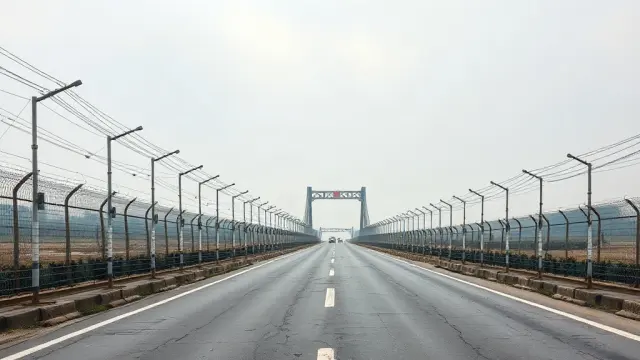
Travellers to Korea's border await clarity as Seoul proposes military talks
South Korea has proposed military talks with North Korea to confirm the Military Demarcation Line and restore communication lines as both sides reinf…
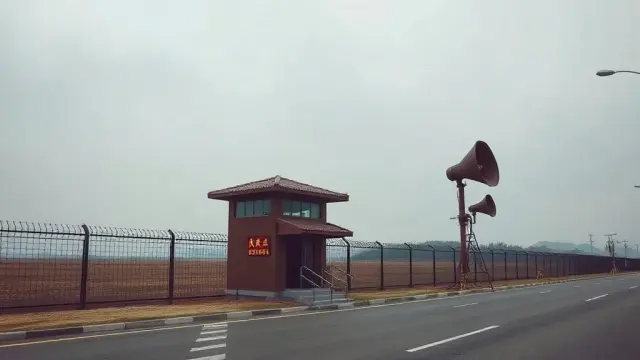
Travellers to South Korea: Pyongyang restarts border propaganda, Seoul urges talks
North Korea says it will install loudspeakers along the entire border with South Korea and resume anti-Seoul propaganda broadcasts. South Korea's mil…
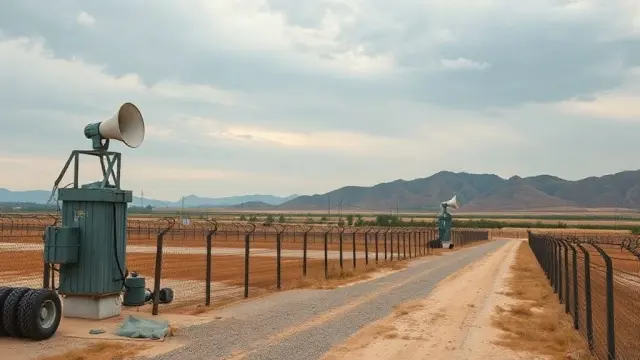
Mine blasts and returning border loudspeakers heighten risk for North Korea travel
North Korea says propaganda loudspeakers along the entire border with South Korea will be operating within October, reviving psychological warfare af…
Frequently asked questions about North Korea
What do I need to travel to North Korea?
How long must my passport be valid for North Korea?
Where is North Korea?
What is the capital of North Korea?
What language is spoken in North Korea?
What currency does North Korea use?
What is the calling code of North Korea?
Which countries border North Korea?
How strong is the Korean passport?
Is North Korea safe to visit?
When is the best time to visit North Korea?
What plug type does North Korea use?
How many airports does North Korea have?
Sources: CIA World Factbook (public domain); World Bank Open Data (CC BY 4.0); names, languages and currencies: mledoze/countries (ODbL); flag: flag-icons (MIT); coat of arms: Wikimedia Commons (file page); exchange rates: Daily reference rates from the open-source currency-api (CC0); airports: OurAirports.