
Western Asia · UN member

Georgia: Travel Guide & Requirements
· საქართველო
Georgia is a country in Western Asia with its capital in Tbilisi. It has a population of 3.9 million (#129 in the world) and covers 69,700 km². The official language is Georgian. The currency is the lari (GEL, ₾).
Where is Georgia? Map of Georgia
Southwestern Asia, bordering the Black Sea, between Turkey and Russia, with a sliver of land north of the Caucasus extending into Europe; note - Georgia views itself as part of Europe; geopolitically, it can be classified as falling within Europe, the Middle East, or both.
- Region
- Western Asia
- Coordinates
- 42° N, 43.5° E
- Neighbours
- 4 — see list
- Coastline
- 310 km
- Georgia
- Neighbours
- Capital
- Largest cities
Map of Georgia showing Tbilisi (capital) and the largest cities: Batumi, Kutaisi, Sokhumi, Gori, P’ot’i, Telavi and Akhaltsikhe.
Travel requirements
What you need to travel to Georgia
- Passport
Georgia's e-Visa portal says the travel document must be valid for at least 3 months after the validity period of the requested Georgian visa, have at least 2 free pages, not be damaged and have been issued within the p…
- Visa or eTA
Depends on your passport: of 198 passports, 103 need no visa, 32 need an eVisa, 62 need a visa from an embassy. Check yours or see Georgia entry requirements for every passport.
- Return or onward ticket
No official requirement. Georgia's e-Visa portal lists the documents visa holders must carry at the border (passport, proof of the purpose of travel, accommodation, insurance and funds) without a ticket.
- Proof of funds
Georgia's e-Visa portal says visa holders crossing the border should carry a document proving sufficient financial means, such as a bank statement for the past three months, a reference from the employer stating positio…
- Travel insurance
Since 1 January 2026 all tourists entering Georgia must hold health and accident insurance covering the whole stay, including the arrival and departure dates, with a sum insured of at least GEL 30,000, issued by a Georg…
- Customs allowance
Canada's travel advice says you must declare to customs if you have more than GEL 30,000 or its equivalent in cash, traveller's cheques or any other type of financial instrument, and that failure to comply could result …
- Travel advice
High risk — US and UK advice.
Entry rules: TravelRequirements.info — Entry Requirements Dataset (CC BY 4.0), each rule cited to an official government source. Always confirm with the airline and the official source before you travel.
Before you go
10 things to know before you travel to Georgia
- Safety: Travel to Georgia carries a high risk: the US State Department rates Georgia Level 1 (“Exercise Normal Precautions”), and the UK Foreign Office advises against all travel to parts of the country.
- Best time to go: May and September — when daytime highs in Tbilisi are around 24–27°C.
- Money: the lari (GEL) — 1 US dollar is about 2.5885 GEL.
- Plugs: type C and F, 220 V, 50 Hz — standard 220–240 V: devices from the US or Japan (110–120 V) need a converter unless they are dual voltage (100–240 V).
- Emergency numbers: Police 112, Ambulance 112, Fire 112.
- Language: Georgian is official.
- Driving: on the right — speed limits are 60 km/h in built-up areas, 90 km/h outside built-up areas and 110 km/h on motorways.
- Time zone: UTC+4 in Tbilisi.
- Capital: Tbilisi. About 3.9 million people live in Georgia.
- Outdoors: 13 national parks and 8 ski areas.
Key facts
Georgia at a glance
Languages spoken: Georgian (official) 87.6%, Azeri 6.2%, Armenian 3.9%, Russian 1.2%, other 1% (including Abkhaz, the official language in Abkhazia) (2014 est.)
Geography & history
About Georgia
The region of present-day Georgia once contained the ancient kingdoms of Colchis (known as Egrisi locally) and Kartli-Iberia. The area came under Roman influence in the first centuries A.D., and Christianity became the state religion in the 330s. Persian, Arab, and Turk domination was followed by a Georgian golden age (11th-13th centuries) that was cut short when the Mongols invaded in 1236. Subsequently, the Ottoman and Persian empires competed for influence in the region. Georgia was absorbed into the Russian Empire in the 19th century. Independent for three years (1918-1921) following the Russian revolution, it was forcibly incorporated into the USSR in 1921 and regained its independence…
Read the full history
The region of present-day Georgia once contained the ancient kingdoms of Colchis (known as Egrisi locally) and Kartli-Iberia. The area came under Roman influence in the first centuries A.D., and Christianity became the state religion in the 330s. Persian, Arab, and Turk domination was followed by a Georgian golden age (11th-13th centuries) that was cut short when the Mongols invaded in 1236. Subsequently, the Ottoman and Persian empires competed for influence in the region. Georgia was absorbed into the Russian Empire in the 19th century. Independent for three years (1918-1921) following the Russian revolution, it was forcibly incorporated into the USSR in 1921 and regained its independence when the Soviet Union dissolved in 1991. In 2003, mounting public discontent over rampant corruption, ineffective government services, and a government attempt to manipulate parliamentary elections touched off widespread protests that led to the resignation of Eduard SHEVARDNADZE, who had been president since 1995. In the aftermath of this "Rose Revolution," new elections in 2004 swept Mikheil SAAKASHVILI and his United National Movement (UNM) party into power. SAAKASHVILI made progress on market reforms and governance, but he faced accusations of abuse of office. Progress was further complicated when Russian support for the separatist regions of Abkhazia and South Ossetia led to a five-day conflict between Russia and Georgia in August 2008, which included Russia invading large portions of Georgian territory. Russia initially pledged to pull back from most Georgian territory but then unilaterally recognized the independence of Abkhazia and South Ossetia, and Russian military forces have remained in those regions. Billionaire Bidzina IVANISHVILI's unexpected entry into politics in 2011 brought the divided opposition together under his Georgian Dream coalition, which won a majority of seats in the 2012 parliamentary elections and removed UNM from power. Conceding defeat, SAAKASHVILI named IVANISHVILI as prime minister and left the country after his presidential term ended in 2013. IVANISHVILI voluntarily resigned from office after the presidential succession, and in the years since, the prime minister position has seen frequent turnover. In 2021, SAAKASHVILI returned to Georgia, where he was immediately arrested to serve six years in prison on outstanding abuse-of-office convictions. Popular support for integration with the West is high in Georgia. Joining the EU and NATO are among the country's top foreign policy goals, and Georgia applied for EU membership in 2022, becoming a candidate country in December 2023. Georgia and the EU have a Deep and Comprehensive Free Trade Agreement, and since 2017, Georgian citizens have been able to travel to the Schengen area without a visa.
Location
Southwestern Asia, bordering the Black Sea, between Turkey and Russia, with a sliver of land north of the Caucasus extending into Europe; note - Georgia views itself as part of Europe; geopolitically, it can be classified as falling within Europe, the Middle …
Climate
warm and pleasant; Mediterranean-like on Black Sea coast
Terrain
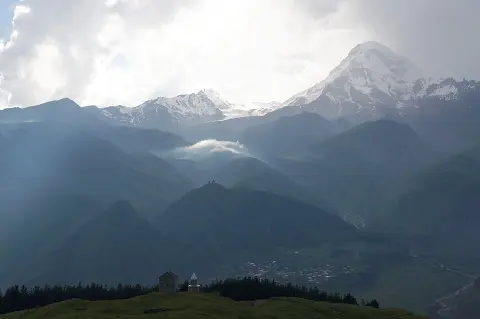
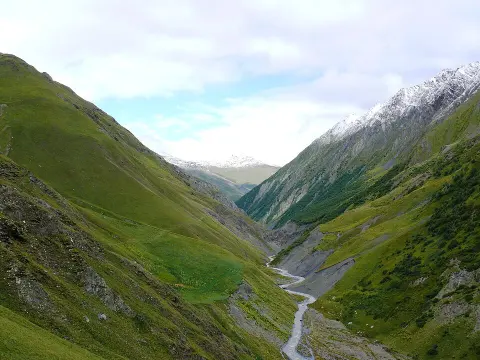
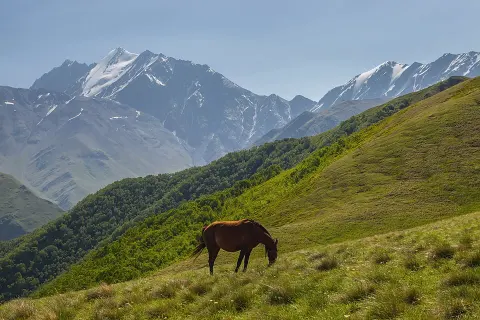
largely mountainous with Great Caucasus Mountains in the north and Lesser Caucasus Mountains in the south; Kolkhet'is Dablobi (Kolkhida Lowland) opens to the Black Sea in the west; Mtkvari River Basin in the east; fertile soils in river valley flood plains an…
Highest point
Mt'a Shkhara 5,193 m
Natural resources
timber, hydropower, manganese deposits, iron ore, copper, minor coal and oil deposits; coastal climate and soils allow for important tea and citrus growth
Natural hazards
earthquakes
National symbols
Saint George, lion
Driving
Speed limits & road rules in Georgia
The default speed limits in Georgia are 60 km/h in built-up areas, 90 km/h outside built-up areas and 110 km/h on motorways. The legal alcohol limit for drivers is 0.3‰. Posted signs always take priority over these defaults.
- 2020 km/hResidential zonesLiving streets & residential areas
- 6060 km/hBuilt-up areasTowns and citiesWith a trailer: 80 km/h
- 9090 km/hOutside built-up areasCountry roadsWith a trailer: 80 km/h
- 110110 km/hMotorwaysMotorways / freewaysWith a trailer: 80 km/h
- International Driving PermitRecognised: 1968 Vienna, 1949 GenevaCarry the IDP together with your national licence
- Driving sideDrive on the rightOvertake on the left
- Alcohol limit0.3‰ blood alcohol (0.03% BAC)
- Seat beltsRequired by law
- Child seatsNo national child-restraint law
- Motorcycle helmetsRequired for riders
- Road deaths (2021)12.7 per 100,000 peopleClose to the world median (12.4)
Speed limits: OpenStreetMap wiki — Default speed limits (CC BY-SA 2.0). Road-safety laws: WHO Global Health Observatory. Compare speed limits and alcohol limits by country. Defaults for cars; local signs, weather and vehicle type can lower them.
Safety
Is Georgia safe to visit?
Travel to Georgia carries a high risk: the US State Department rates Georgia Level 1 (“Exercise Normal Precautions”), and the UK Foreign Office advises against all travel to parts of the country.
 US State Department
 UK Foreign Office (FCDO)
Latest update: Updated information about the political situation and driving conditions ('Safety and security' page).
Updated 15 Sep 2026 · Full travel advice
Sources: US Department of State travel advisories (public domain) and UK FCDO foreign travel advice (contains public sector information licensed under the Open Government Licence v3.0). Checked daily. Advice can change quickly — always read the official page before you travel.
Weather
Best time to visit Georgia
The best time to visit Georgia is May and September, when daytime highs in Tbilisi are around 24–27°C. June and October are also a good time to go. July is the warmest month (33°C by day), January the coldest (-4°C at night).
- Jan6°C-4°C
- Feb8°C-3°C
- Mar14°C1°C
- Apr18°C5°C
- May24°C11°C
- Jun30°C16°C
- Jul33°C19°C
- Aug32°C19°C
- Sep27°C14°C
- Oct20°C8°C
- Nov12°C2°C
- Dec7°C-3°C
Best time Good Less ideal
Before you go
Plugs, voltage & emergency numbers in Georgia
Plugs & sockets
220 V, 50 Hz · Standard 220–240 V: devices from the US or Japan (110–120 V) need a converter unless they are dual voltage (100–240 V).
Emergency numbers
112 works from any mobile phone, even without a SIM card in most networks. All countries →
Sources: Wikipedia — Mains electricity by country and List of emergency telephone numbers (CC BY-SA 4.0).
Ski resorts
8 ski resorts in Georgia
- 113 km of slopes
- 44 lifts
- up to 3,246 m
Biggest: გუდაური · Tetnuldi · Kokhta - Mitarbi
National parks
13 national parks in Georgia
- 5,562 km² protected
- oldest from 1912
Largest: Kazbegi National Park · Tusheti National Park · Pshav-Khevsureti National Park
Currency · 26 October 2026
lari exchange rates today
Georgia uses the lari (GEL, ₾). One US dollar buys 2.5885 GEL; over the last 30 days the GEL has gained 0.6% against the dollar.
What other currencies cost in GEL
Currency converter
Daily reference rates from the open-source currency-api (CC0), 26 Oct 2026. Banks and exchange offices add a margin.
World rankings
Where Georgia ranks
How Georgia compares with the rest of the world — open any card for the full ranking.
Airports
Airports in Georgia
44 airports and airfields — 4 large, 8 medium and 8 small, plus 24 heliports. 7 have scheduled passenger flights.
Borders
Neighbouring countries
Georgia borders 4 countries along 1,814 km of land borders. Coastline: 310 km.


Military
Georgian armed forces
Georgia ranks #85 of 145 in the Global Firepower military strength ranking, with a defence budget of $658 million (2025).
People
Population & society
Religion
Largest cities: Tbilisi (1.1 million)
Economy
Economy
Main industries
steel, machine tools, electrical appliances, mining (manganese, copper, gold), chemicals, wood products, wine
Export partners
Azerbaijan 13%, Turkey 11%, Armenia 11%, Russia 10%, Kyrgyzstan 8% (2023)
Top exports
cars, copper ore, electricity, garments, wine (2023)
Travel tools
Handy before every trip to Georgia
Next public holiday
Saint George's Day — Monday, 23 November 2026. Then New Year's Day (1 Jan).

Georgian passport
Ranked #81: 80 countries visa-free, 39 with visa on arrival, 3 with an eTA and 30 with an eVisa.
Georgian passport photo
Exact size, head position and background for Georgia's passport and visa photos — make one free with AI checks.
Calling Georgia
Dial +995 before the local number. Internet domain .ge.
Climate footprint
11.8 million tonnes of CO₂ in 2024 — 3.10 t per person.
Entry requirements
Visa rules for every passport visiting Georgia: visa-free stays, eVisas, visas on arrival and documents to bring.
News
Latest travel news about Georgia
Azerbaijani passport ranks 76th for visa-free travel worldwide
Azerbaijan shares 76th place with the Philippines in a global passport ranking by Swiss company Henley & Partners, with Azerbaijani citizens able to …
Armenian passport offers visa-free entry to 63 destinations, ranking 78th
Henley & Partners' Passport Index places Armenia 78th, with visa-free access to 63 destinations. Georgia, Turkey and Azerbaijan rank higher, while Ir…
Bosnia and Herzegovina workers: Czech work visa route stays open through 2028
The Czech government has extended its special work visa scheme for workers from Ukraine, Georgia, Bosnia and Herzegovina, Moldova and North Macedonia…
Frequently asked questions about Georgia
What do I need to travel to Georgia?
How long must my passport be valid for Georgia?
Where is Georgia?
What is Georgia known for?
What is the capital of Georgia?
What language is spoken in Georgia?
What currency does Georgia use?
What is the calling code of Georgia?
Which countries border Georgia?
How strong is the Georgian passport?
What is the speed limit in Georgia?
Is Georgia safe to visit?
When is the best time to visit Georgia?
What plug type does Georgia use?
How many airports does Georgia have?
Sources: CIA World Factbook (public domain); World Bank Open Data (CC BY 4.0); names, languages and currencies: mledoze/countries (ODbL); flag: flag-icons (MIT); coat of arms: Wikimedia Commons (file page); exchange rates: Daily reference rates from the open-source currency-api (CC0); airports: OurAirports.