
Australia and New Zealand · UN member

Australia: Travel Guide & Requirements
Commonwealth of Australia
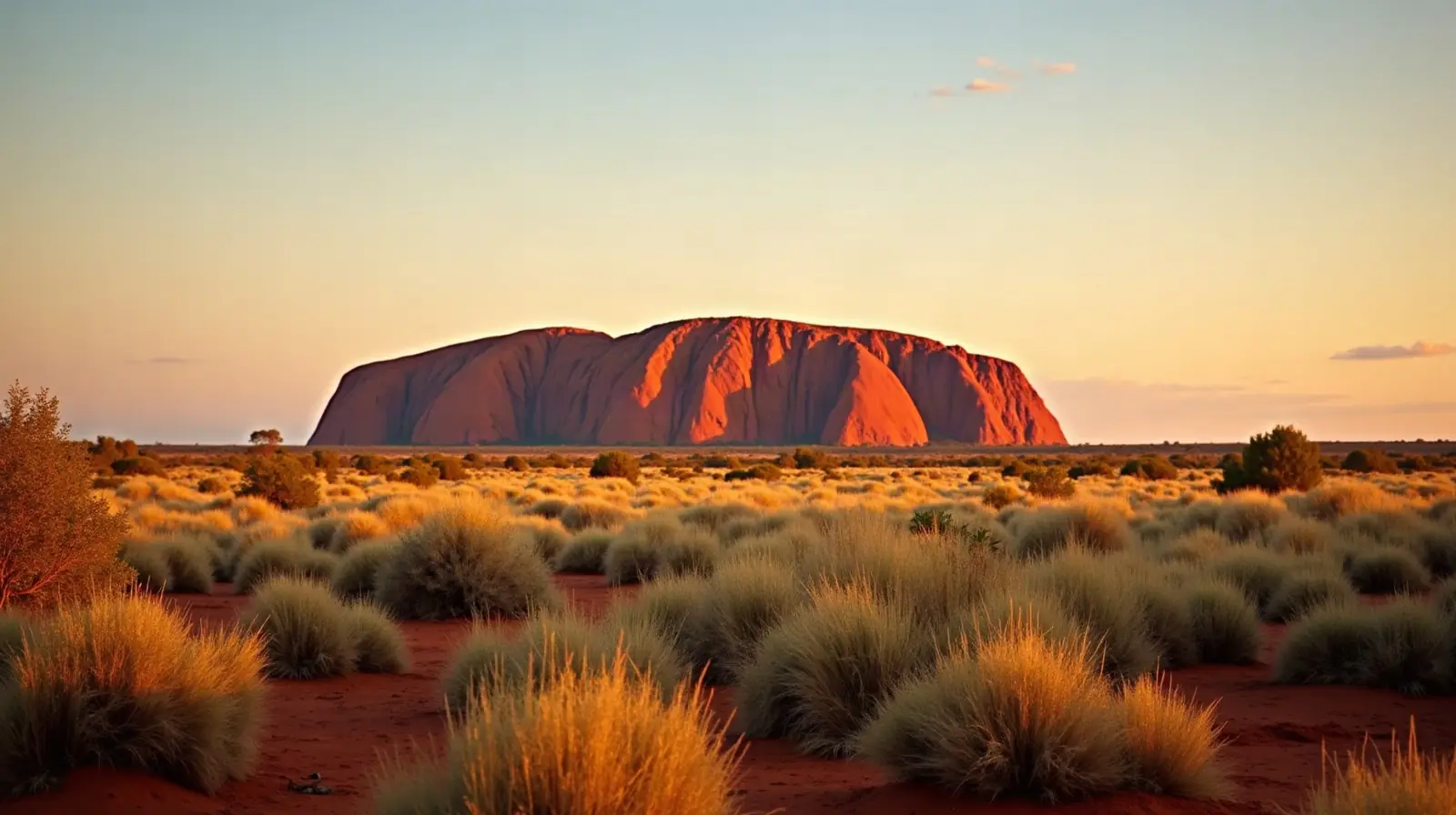
Australia is a country in Australia and New Zealand with its capital in Canberra. It has a population of 27.6 million (#55 in the world) and covers 7,741,220 km². The official language is English. The currency is the Australian dollar (AUD, $).
Where is Australia? Map of Australia
Oceania, continent between the Indian Ocean and the South Pacific Ocean.
- Region
- Australia and New Zealand
- Coordinates
- 27° S, 133° E
- Neighbours
- none (no land borders)
- Coastline
- 25,760 km
- Australia
- Capital
- Largest cities
Map of Australia showing Canberra (capital) and the largest cities: Sydney, Melbourne, Brisbane, Perth, Adelaide, Gold Coast, Newcastle and Sunshine Coast.
Travel requirements
What you need to travel to Australia
- Passport
The UK government says that to enter Australia your passport must be valid for the length of your planned stay, and that many countries require at least 6 months' validity remaining on your passport, even if you are jus…
- Visa or eTA
Depends on your passport: of 198 passports, 1 needs no visa, 33 need an eTA, 164 need an eVisa. Check yours or see Australia entry requirements for every passport.
- Return or onward ticket
No official requirement. For the Visitor visa (600), Home Affairs asks for proof you have enough money for your stay and to leave Australia.
- Proof of funds
Home Affairs says Visitor visa (600) applicants must have, or have access to, enough money to support themselves while in Australia, and asks for proof of enough money for the stay and to leave Australia.
- Travel insurance
No official requirement. Home Affairs says you are liable for all your healthcare costs while you are in Australia and strongly recommends adequate health insurance; Visitor visa (600) holders granted a visa valid for more than 12 months must a…
- Vaccinations
WHO's Annex 1 lists Australia as requiring proof of yellow fever vaccination from travellers aged 1 year or over arriving from countries at risk of yellow fever transmission, including travellers who have transited more…
- Arrival card
The Australian Border Force says an Incoming Passenger Card (IPC) is to be completed by passengers entering Australia, and that it includes declarations relating to customs and quarantine.
- Customs allowance
AUSTRAC says you must make a report if you enter or depart Australia with monetary instruments with a combined value of A$10,000 or more.
- Travel advice
Safe to visit — US and UK advice.
Entry rules: TravelRequirements.info — Entry Requirements Dataset (CC BY 4.0), each rule cited to an official government source. Always confirm with the airline and the official source before you travel.
Before you go
10 things to know before you travel to Australia
- Safety: Yes — Australia is generally safe to visit: the US State Department rates Australia Level 1 (“Exercise Normal Precautions”), and the UK Foreign Office has no warnings against travel there.
- Best time to go: November to February — when daytime highs in Canberra are around 23–29°C.
- Money: the Australian dollar (AUD) — 1 US dollar is about 1.4226 AUD.
- Plugs: type I, 230 V, 50 Hz — standard 220–240 V: devices from the US or Japan (110–120 V) need a converter unless they are dual voltage (100–240 V).
- Emergency numbers: Police 000, Ambulance 000, Fire 000.
- Language: English is official.
- Driving: on the left — speed limits are 50 km/h in built-up areas and 100 km/h outside built-up areas.
- Time zone: UTC+11 in Canberra.
- Capital: Canberra; the largest city is Melbourne. About 27.6 million people live in Australia.
- Australia is the 6th largest country in the world by area.
Key facts
Australia at a glance
Languages spoken: English 72%, Mandarin 2.7%, Arabic 1.4%, Vietnamese 1.3%, Cantonese 1.2%, other 15.7%, unspecified 5.7% (2021 est.)
Geography & history
About Australia
Aboriginal Australians arrived on the continent at least 60,000 years ago and developed complex hunter-gatherer societies and oral histories. Dutch navigators led by Abel TASMAN were the first Europeans to land in Australia in 1606, and they mapped the western and northern coasts. They named the continent New Holland but made no attempts to permanently settle it. In 1770, Englishman James COOK sailed to the east coast of Australia, named it New South Wales, and claimed it for Great Britain. In 1788 and 1825 respectively, Great Britain established New South Wales and then Tasmania as penal colonies. Great Britain and Ireland sent more than 150,000 convicts to Australia before ending the prac…
Read the full history
Aboriginal Australians arrived on the continent at least 60,000 years ago and developed complex hunter-gatherer societies and oral histories. Dutch navigators led by Abel TASMAN were the first Europeans to land in Australia in 1606, and they mapped the western and northern coasts. They named the continent New Holland but made no attempts to permanently settle it. In 1770, Englishman James COOK sailed to the east coast of Australia, named it New South Wales, and claimed it for Great Britain. In 1788 and 1825 respectively, Great Britain established New South Wales and then Tasmania as penal colonies. Great Britain and Ireland sent more than 150,000 convicts to Australia before ending the practice in 1868. As Europeans began settling areas away from the coasts, they came into more direct contact with Aboriginal Australians. Europeans also cleared land for agriculture, impacting Aboriginal Australians’ ways of life. These issues, along with disease and a policy in the 1900s that forcefully removed Aboriginal children from their parents, reduced the Aboriginal Australian population from more than 700,000 pre-European contact to a low of 74,000 in 1933. Four additional colonies were established in Australia in the mid-1800s: Western Australia (1829), South Australia (1836), Victoria (1851), and Queensland (1859). Gold rushes beginning in the 1850s brought thousands of new immigrants to New South Wales and Victoria, helping to reorient Australia away from its penal colony roots. In the second half of the 1800s, the colonies were all gradually granted self-government, and in 1901, they federated and became the Commonwealth of Australia. Australia contributed more than 400,000 troops to Allied efforts during World War I, and Australian troops played a large role in the defeat of Japanese troops in the Pacific in World War II. Australia severed most constitutional links with the UK in 1942 but remained part of the British Commonwealth. Australia’s post-war economy boomed and by the 1970s, racial policies that prevented most non-Whites from immigrating to Australia were removed, greatly increasing Asian immigration to the country. In recent decades, Australia has become an internationally competitive, advanced market economy due in large part to economic reforms adopted in the 1980s and its proximity to East and Southeast Asia. In the early 2000s, Australian politics became unstable with frequent attempts to oust party leaders, including five changes of prime minister between 2010 and 2018. As a result, both major parties instituted rules to make it harder to remove a party leader.
Location
Oceania, continent between the Indian Ocean and the South Pacific Ocean
Climate
generally arid to semiarid; temperate in south and east; tropical in north
Terrain
mostly low plateau with deserts; fertile plain in southeast
Highest point
Mount Kosciuszko 2,228 m
Natural resources
alumina, coal, iron ore, copper, lithium, tin, gold, silver, uranium, nickel, tungsten, rare earth elements, mineral sands, lead, zinc, diamonds, opals, natural gas, petroleum
Natural hazards
cyclones along the coast; severe droughts; forest fires volcanism: volcanic activity on Heard and McDonald Islands
National symbols
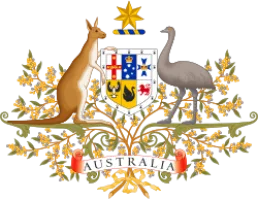
Commonwealth Star (seven-pointed Star of Federation), golden wattle tree (Acacia pycnantha), kangaroo, emu
Driving
Speed limits & road rules in Australia
The default speed limits in Australia are 50 km/h in built-up areas and 100 km/h outside built-up areas. The legal alcohol limit for drivers is 0.5‰. Posted signs always take priority over these defaults.
- 5050 km/hBuilt-up areasTowns and cities
- 100100 km/hOutside built-up areasCountry roads
- International Driving PermitRecognised: 1949 GenevaCarry the IDP together with your national licence
- Driving sideDrive on the leftOvertake on the right
- Alcohol limit0.5‰ blood alcohol (0.05% BAC)Zero tolerance for young / novice drivers
- Seat beltsRequired by law
- Child seatsRequired by law
- Motorcycle helmetsRequired for riders
- Road deaths (2021)4.5 per 100,000 peopleSafer than most countries (median 12.4)
Speed limits: OpenStreetMap wiki — Default speed limits (CC BY-SA 2.0). Road-safety laws: WHO Global Health Observatory. Compare speed limits and alcohol limits by country. Defaults for cars; local signs, weather and vehicle type can lower them.
Safety
Is Australia safe to visit?
Yes — Australia is generally safe to visit: the US State Department rates Australia Level 1 (“Exercise Normal Precautions”), and the UK Foreign Office has no warnings against travel there.
 US State Department
 UK Foreign Office (FCDO)
Latest update: Updated information about global travel impacts due to escalation in the Middle East (‘Warnings and insurance’ page).
Updated 19 Mar 2026 · Full travel advice
Sources: US Department of State travel advisories (public domain) and UK FCDO foreign travel advice (contains public sector information licensed under the Open Government Licence v3.0). Checked daily. Advice can change quickly — always read the official page before you travel.
Weather
Best time to visit Australia
The best time to visit Australia is November to February, when daytime highs in Canberra are around 23–29°C. March is also a good time to go. January is the warmest month (29°C by day), July the coldest (1°C at night), and February the wettest with about 92 mm of rain.
- Jan29°C13°C
- Feb26°C12°C
- Mar23°C10°C
- Apr19°C7°C
- May14°C4°C
- Jun11°C2°C
- Jul10°C1°C
- Aug11°C1°C
- Sep15°C3°C
- Oct19°C6°C
- Nov23°C9°C
- Dec25°C11°C
Best time Good Less ideal
Before you go
Plugs, voltage & emergency numbers in Australia
Plugs & sockets
230 V, 50 Hz · Standard 220–240 V: devices from the US or Japan (110–120 V) need a converter unless they are dual voltage (100–240 V).
Emergency numbers
Save the local numbers before you travel — 112 or 911 may not connect here. All countries →
Sources: Wikipedia — Mains electricity by country and List of emergency telephone numbers (CC BY-SA 4.0).
Ski resorts
16 ski resorts in Australia
- 286 km of slopes
- 145 lifts
- up to 2,037 m
Biggest: Perisher · Thredbo Resort · Mount Buller
National parks
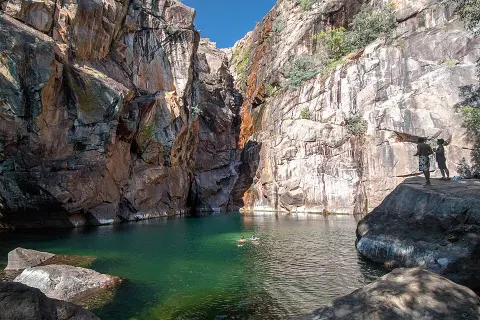
912 national parks in Australia
- 423,442 km² protected
- oldest from 1898
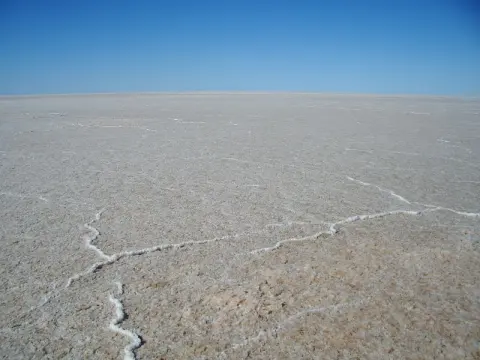
Largest: Munga-Thirri—Simpson Desert National Park · Kakadu National Park · Kati Thanda-Lake Eyre National Park
Currency · 26 October 2026
Australian dollar exchange rates today
Australia uses the Australian dollar (AUD, $). One US dollar buys 1.4226 AUD; over the last 30 days the AUD has gained 0.1% against the dollar.
What other currencies cost in AUD
Currency converter
Daily reference rates from the open-source currency-api (CC0), 26 Oct 2026. Banks and exchange offices add a margin.
World rankings
Where Australia ranks
How Australia compares with the rest of the world — open any card for the full ranking.
Airports
Airports in Australia
2,683 airports and airfields — 16 large, 177 medium and 2086 small, plus 400 heliports. 157 have scheduled passenger flights.
Borders
No land borders
Australia has no land borders with other countries. Coastline: 25,760 km.
Military
Australian armed forces
Australia ranks #16 of 145 in the Global Firepower military strength ranking, with a defence budget of $35.3 billion (2025).
People
Population & society
Religion
Largest cities: Melbourne (5.2 million), Sydney (5.1 million), Brisbane (2.5 million), Perth (2.1 million), Adelaide (1.4 million)
Economy
Economy
Main industries
mining, industrial and transportation equipment, food processing, chemicals, steel
Export partners
China 37%, Japan 16%, S. Korea 6%, India 5%, Taiwan 5% (2023)
Top exports
iron ore, coal, natural gas, gold, minerals (2023)
Travel tools
Handy before every trip to Australia
Next public holiday
Christmas Day — Friday, 25 December 2026. Then St. Stephen's Day (28 Dec).

Australian passport
Ranked #42: 112 countries visa-free, 42 with visa on arrival, 7 with an eTA and 23 with an eVisa.
Australian passport photo
Exact size, head position and background for Australia's passport and visa photos — make one free with AI checks.
Calling Australia
Dial +61 before the local number. Internet domain .au.
Climate footprint
386.7 million tonnes of CO₂ in 2024 — 14.48 t per person.
Entry requirements
Visa rules for every passport visiting Australia: visa-free stays, eVisas, visas on arrival and documents to bring.
News
Latest travel news about Australia

Dili, Timor-Leste: Visa on Arrival Rules and Flights Travellers Should Know
Timor-Leste receives fewer than 100,000 visitors a year and is now positioning itself as a sustainable tourism destination. Most international travel…

Nauruans Applying to Study in Australia Now Pay Less for Student Visas
Australia's Department of Home Affairs has confirmed a reduced Student visa (subclass 500) application charge for eligible citizens of 23 Pacific Isl…
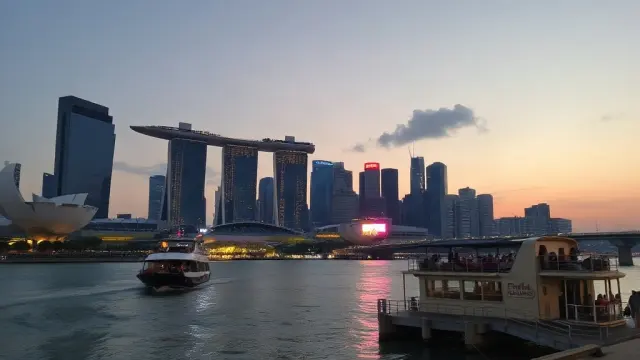
Singapore joins Visa Destinations in November with cardholder perks
Visa and the Singapore Tourism Board have signed a three-year agreement that brings the Visa Destinations travel programme to Singapore in November. …
Frequently asked questions about Australia
What do I need to travel to Australia?
How long must my passport be valid for Australia?
Where is Australia?
What is Australia known for?
What is the capital of Australia?
What language is spoken in Australia?
What currency does Australia use?
What is the calling code of Australia?
Does Australia have land borders?
How strong is the Australian passport?
What is the speed limit in Australia?
Is Australia safe to visit?
When is the best time to visit Australia?
What plug type does Australia use?
How many airports does Australia have?
Sources: CIA World Factbook (public domain); World Bank Open Data (CC BY 4.0); names, languages and currencies: mledoze/countries (ODbL); flag: flag-icons (MIT); coat of arms: Wikimedia Commons (file page); exchange rates: Daily reference rates from the open-source currency-api (CC0); airports: OurAirports.