
Central Europe · UN member

Czechia: Travel Guide & Requirements
Czech Republic · Česká republika · Česká republika
Czechia is a country in Central Europe with its capital in Prague. It has a population of 10.9 million (#88 in the world) and covers 78,867 km². The official languages are Czech and Slovak. The currency is the Czech koruna (CZK, Kč).
Where is Czechia? Map of Czechia
Central Europe, between Germany, Poland, Slovakia, and Austria.
- Region
- Central Europe
- Coordinates
- 49.75° N, 15.5° E
- Neighbours
- 4 — see list
- Coastline
- Landlocked
- Czechia
- Neighbours
- Capital
- Largest cities
Map of Czechia showing Prague (capital) and the largest cities: Brno, Ostrava, Pilsen, Liberec, Olomouc, České Budějovice, Hradec Králové and Ústí nad Labem.
Travel requirements
What you need to travel to Czechia
- Passport
The Schengen Borders Code requires a third-country national's travel document to be valid at least three months after the intended date of departure from the territory of the Member States and to have been issued within…
- Visa or eTA
Depends on your passport: of 198 passports, 93 need no visa, 105 need a visa from an embassy. Check yours or see Czechia entry requirements for every passport.
- Return or onward ticket
The Czech Foreign Ministry asks Schengen visa applicants for supporting documents on accommodation and a document proving intention to leave Schengen (mostly an air ticket reservation or other reservation, plus proof of…
- Proof of funds
The Schengen Borders Code requires third-country nationals to have sufficient means of subsistence for the intended stay and for the return or onward journey.
- Travel insurance
Schengen visa applicants need travel medical insurance valid throughout the territory of the Member States for the entire intended stay, with minimum coverage of EUR 30,000 (Visa Code, Article 15).
- Arrival card
The Czech Foreign Ministry says the EU Entry/Exit System (EES) registers the entry and exit of non-EU citizens travelling for short-term visits (up to 90 days) in and out of the Schengen Area.
- Customs allowance
If you enter or leave the EU with €10,000 in cash (or its equivalent in other currencies), you must declare it to customs in the EU country you are entering or leaving, according to the EU's Your Europe portal.
- Travel advice
Safe to visit — US and UK advice.
Entry rules: TravelRequirements.info — Entry Requirements Dataset (CC BY 4.0), each rule cited to an official government source. Always confirm with the airline and the official source before you travel.
Before you go
10 things to know before you travel to Czechia
- Safety: Yes — Czechia is generally safe to visit: the US State Department rates Czechia Level 1 (“Exercise Normal Precautions”), and the UK Foreign Office has no warnings against travel there.
- Best time to go: June to August — when daytime highs in Prague are around 23–26°C.
- Money: the Czech koruna (CZK) — 1 US dollar is about 21.6996 CZK.
- Plugs: type C and E, 230 V, 50 Hz — standard 220–240 V: devices from the US or Japan (110–120 V) need a converter unless they are dual voltage (100–240 V).
- Emergency numbers: Police 112 / 158, Ambulance 112 / 155, Fire 112 / 150.
- Language: Czech and Slovak are official.
- Driving: on the right — speed limits are 50 km/h in built-up areas, 90 km/h outside built-up areas, 110 km/h on expressways and 130 km/h on motorways.
- Time zone: UTC+1 in Prague.
- Capital: Prague. About 10.9 million people live in Czechia.
- Outdoors: 5 national parks and 283 ski areas.
Key facts
Czechia at a glance
Languages spoken: Czech (official) 88.4%, Slovak 1.5%, other 2.6%, unspecified 7.2% (2021 est.)
Geography & history
About Czechia
At the close of World War I, the Czechs and Slovaks of the former Austro-Hungarian Empire merged to form Czechoslovakia, a parliamentarian democracy. During the interwar years, having rejected a federal system, the new country's predominantly Czech leaders were frequently preoccupied with meeting the increasingly strident demands of other ethnic minorities within the republic, most notably the Slovaks, the Sudeten Germans, and the Ruthenians (Ukrainians). On the eve of World War II, Nazi Germany occupied the territory that today comprises Czechia, and Slovakia became an independent state allied with Germany. After the war, a reunited but truncated Czechoslovakia (less Ruthenia) fell within …
Read the full history
At the close of World War I, the Czechs and Slovaks of the former Austro-Hungarian Empire merged to form Czechoslovakia, a parliamentarian democracy. During the interwar years, having rejected a federal system, the new country's predominantly Czech leaders were frequently preoccupied with meeting the increasingly strident demands of other ethnic minorities within the republic, most notably the Slovaks, the Sudeten Germans, and the Ruthenians (Ukrainians). On the eve of World War II, Nazi Germany occupied the territory that today comprises Czechia, and Slovakia became an independent state allied with Germany. After the war, a reunited but truncated Czechoslovakia (less Ruthenia) fell within the Soviet sphere of influence when the pro-Soviet Communist party staged a coup in February 1948. In 1968, an invasion by fellow Warsaw Pact troops ended the efforts of the country's leaders to liberalize communist rule and create "socialism with a human face," ushering in a period of repression known as "normalization." The peaceful "Velvet Revolution" swept the Communist Party from power at the end of 1989 and inaugurated a return to democratic rule and a market economy. On 1 January 1993, the country underwent a nonviolent "velvet divorce" into its two national components, the Czech Republic and Slovakia. The Czech Republic joined NATO in 1999 and the European Union in 2004. The country formally added the short-form name Czechia in 2016, while also continuing to use the full form name, the Czech Republic.
Location
Central Europe, between Germany, Poland, Slovakia, and Austria
Climate
temperate; cool summers; cold, cloudy, humid winters
Terrain
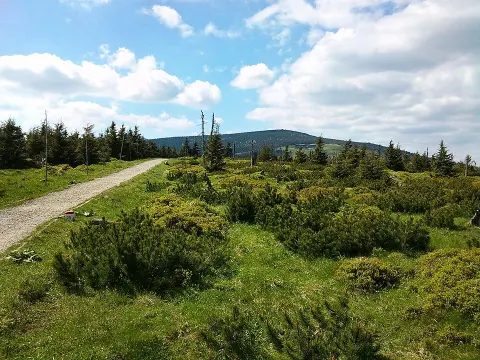
Bohemia in the west consists of rolling plains, hills, and plateaus surrounded by low mountains; Moravia in the east consists of very hilly country
Highest point
Snezka 1,602 m
Natural resources
hard coal, soft coal, kaolin, clay, graphite, timber, arable land
Natural hazards
flooding
National symbols
silver (or white) double-tailed rampant lion
Driving
Speed limits & road rules in Czechia
The default speed limits in Czechia are 50 km/h in built-up areas, 90 km/h outside built-up areas, 110 km/h on expressways and 130 km/h on motorways. The legal alcohol limit for drivers is 0.3‰. Posted signs always take priority over these defaults.
- 2020 km/hResidential zonesLiving streets & residential areas
- 5050 km/hBuilt-up areasTowns and cities
- 9090 km/hOutside built-up areasCountry roads
- 110110 km/hExpresswaysDual carriageways & expressways
- 130130 km/hMotorwaysMotorways / freeways
- International Driving PermitRecognised: 1968 Vienna, 1949 GenevaCarry the IDP together with your national licence
- Driving sideDrive on the rightOvertake on the left
- Alcohol limit0.3‰ blood alcohol (0.03% BAC)
- Seat beltsRequired by law
- Child seatsRequired by law
- Motorcycle helmetsRequired for riders
- Road deaths (2021)5.2 per 100,000 peopleSafer than most countries (median 12.4)
Speed limits: OpenStreetMap wiki — Default speed limits (CC BY-SA 2.0). Road-safety laws: WHO Global Health Observatory. Compare speed limits and alcohol limits by country. Defaults for cars; local signs, weather and vehicle type can lower them.
Safety
Is Czechia safe to visit?
Yes — Czechia is generally safe to visit: the US State Department rates Czechia Level 1 (“Exercise Normal Precautions”), and the UK Foreign Office has no warnings against travel there.
 US State Department
 UK Foreign Office (FCDO)
Latest update: Updated information on European Entry-Exit System (EES) (‘Entry requirements’ page).
Updated 11 Aug 2026 · Full travel advice
Sources: US Department of State travel advisories (public domain) and UK FCDO foreign travel advice (contains public sector information licensed under the Open Government Licence v3.0). Checked daily. Advice can change quickly — always read the official page before you travel.
Weather
Best time to visit Czechia
The best time to visit Czechia is June to August, when daytime highs in Prague are around 23–26°C. September is also a good time to go. July is the warmest month (26°C by day), January the coldest (-5°C at night), and August the wettest with about 81 mm of rain.
- Jan1°C-5°C
- Feb3°C-5°C
- Mar8°C-2°C
- Apr14°C3°C
- May19°C8°C
- Jun23°C12°C
- Jul26°C14°C
- Aug25°C14°C
- Sep20°C9°C
- Oct14°C4°C
- Nov7°C0°C
- Dec2°C-3°C
Best time Good Less ideal
Before you go
Plugs, voltage & emergency numbers in Czechia
Plugs & sockets
230 V, 50 Hz · Standard 220–240 V: devices from the US or Japan (110–120 V) need a converter unless they are dual voltage (100–240 V).
Sources: Wikipedia — Mains electricity by country and List of emergency telephone numbers (CC BY-SA 4.0).
Ski resorts
283 ski resorts in Czechia
- 565 km of slopes
- 817 lifts
- up to 1,441 m
Biggest: Skiresort Černá Hora-Pec · Skiareál Klínovec · Skiareál Špindlerův Mlýn - Medvědín
National parks
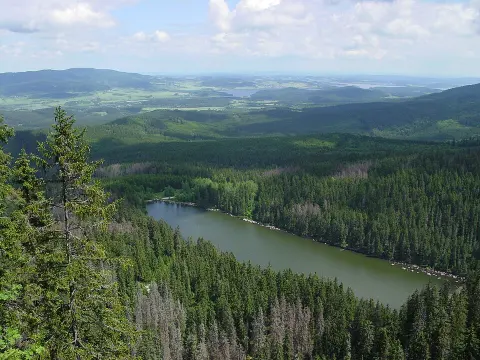
5 national parks in Czechia
- 1,190 km² protected
- oldest from 1963
Largest: Šumava National Park · Krkonoše National Park · České Švýcarsko National Park
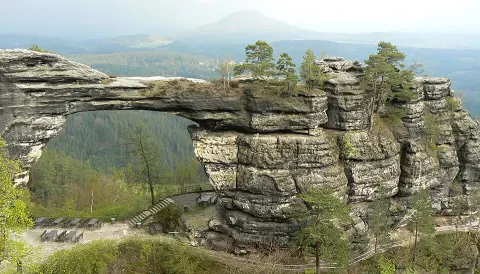
Currency · 26 October 2026
Czech koruna exchange rates today
Czechia uses the Czech koruna (CZK, Kč). One US dollar buys 21.6996 CZK; over the last 30 days the CZK has lost 1.4% against the dollar.
What other currencies cost in CZK
Currency converter
Daily reference rates from the open-source currency-api (CC0), 26 Oct 2026. Banks and exchange offices add a margin.
World rankings
Where Czechia ranks
How Czechia compares with the rest of the world — open any card for the full ranking.
Airports
Airports in Czechia
379 airports and airfields — 5 large, 9 medium and 251 small, plus 114 heliports. 6 have scheduled passenger flights.
Borders
Neighbouring countries
Czechia borders 4 countries along 2,046 km of land borders. It is landlocked.


Military
Czech armed forces
Czechia ranks #48 of 145 in the Global Firepower military strength ranking, with a defence budget of $7.1 billion (2025).
People
Population & society
Religion
Largest cities: Prague (1.3 million)
Economy
Economy
Main industries
motor vehicles, metallurgy, machinery and equipment, glass, armaments
Export partners
Germany 29%, Slovakia 7%, Poland 6%, France 5%, UK 5% (2023)
Top exports
cars, vehicle parts/accessories, broadcasting equipment, computers, plastic products (2023)
Travel tools
Handy before every trip to Czechia
Next public holiday
Independent Czechoslovak State Day — Wednesday, 28 October 2026. Then Struggle for Freedom and Democracy Day (17 Nov).

Czech passport
Ranked #21: 121 countries visa-free, 34 with visa on arrival, 8 with an eTA and 19 with an eVisa.
Czech passport photo
Exact size, head position and background for Czechia's passport and visa photos — make one free with AI checks.
Calling Czechia
Dial +420 before the local number. Internet domain .cz.
Climate footprint
75.6 million tonnes of CO₂ in 2024 — 7.04 t per person.
Entry requirements
Visa rules for every passport visiting Czechia: visa-free stays, eVisas, visas on arrival and documents to bring.
News
Latest travel news about Czechia
Czechia keeps current Russian visa rules, rejects EU-wide tightening for travellers
Czechia declined to support a Finnish initiative for tighter EU-wide visa restrictions on Russian travellers. Foreign Minister Petr Macinka said Czec…
Bosnia and Herzegovina workers: Czech work visa route stays open through 2028
The Czech government has extended its special work visa scheme for workers from Ukraine, Georgia, Bosnia and Herzegovina, Moldova and North Macedonia…
Travellers to Czechia from Philippines, India face planned quota rise from January
Czechia plans to increase recruitment quotas for workers from the Philippines and India, with the Filipino annual figure possibly rising to 12,000 fr…
Frequently asked questions about Czechia
What do I need to travel to Czechia?
How long must my passport be valid for Czechia?
Where is Czechia?
What is Czechia known for?
What is the capital of Czechia?
What language is spoken in Czechia?
What currency does Czechia use?
What is the calling code of Czechia?
Which countries border Czechia?
How strong is the Czech passport?
What is the speed limit in Czechia?
Is Czechia safe to visit?
When is the best time to visit Czechia?
What plug type does Czechia use?
How many airports does Czechia have?
Sources: CIA World Factbook (public domain); World Bank Open Data (CC BY 4.0); names, languages and currencies: mledoze/countries (ODbL); flag: flag-icons (MIT); coat of arms: Wikimedia Commons (file page); exchange rates: Daily reference rates from the open-source currency-api (CC0); airports: OurAirports.