

Northern Europe · UN member

Lithuania: Travel Guide & Requirements
Republic of Lithuania · Lietuvos Respublikos
Lithuania is a country in Northern Europe with its capital in Vilnius. It has a population of 2.9 million (#139 in the world) and covers 65,300 km². The official language is Lithuanian. The currency is the Euro (EUR, €).
Where is Lithuania? Map of Lithuania
Eastern Europe, bordering the Baltic Sea, between Latvia and Russia, west of Belarus.
- Region
- Northern Europe
- Coordinates
- 56° N, 24° E
- Neighbours
- 4 — see list
- Coastline
- 90 km
- Lithuania
- Neighbours
- Capital
- Largest cities
Map of Lithuania showing Vilnius (capital) and the largest cities: Kaunas, Klaipėda, Šiauliai, Panevėžys, Alytus, Marijampolė, Mazeikiai and Utena.
Travel requirements
What you need to travel to Lithuania
- Passport
The UK government says Lithuania follows Schengen area rules: your passport must have a date of issue less than 10 years before the date you arrive and an expiry date at least 3 months after the day you plan to leave th…
- Visa or eTA
Depends on your passport: of 198 passports, 93 need no visa, 105 need a visa from an embassy. Check yours or see Lithuania entry requirements for every passport.
- Return or onward ticket
No official requirement. The UK government says that at Lithuanian border control British travellers may need to show a return or onward ticket and proof of accommodation.
- Proof of funds
The European Commission's table of reference amounts lists EUR 50 as the minimum amount per day and per person for Lithuania.
- Travel insurance
Under the Schengen Visa Code, visa applicants must hold travel medical insurance valid throughout the territory of the Member States and covering the entire period of the intended stay; the minimum coverage is EUR 30,00…
- Arrival card
The EU's Travel Europe site says that the first time you arrive at a border crossing point since the EES started, passport control officers will take a photo of your face and/or scan your fingerprints, and your passport…
- Customs allowance
The EU says that if you enter or leave the EU with EUR 10,000 in cash (or its equivalent in other currencies) you must declare it to the customs authorities of the EU country you are entering or leaving.
- Travel advice
Safe to visit — US and UK advice.
Entry rules: TravelRequirements.info — Entry Requirements Dataset (CC BY 4.0), each rule cited to an official government source. Always confirm with the airline and the official source before you travel.
Before you go
10 things to know before you travel to Lithuania
- Safety: Yes — Lithuania is generally safe to visit: the US State Department rates Lithuania Level 1 (“Exercise Normal Precautions”), and the UK Foreign Office has no warnings against travel there.
- Best time to go: June to August — when daytime highs in Vilnius are around 21–23°C.
- Money: the Euro (EUR) — 1 US dollar is about 0.8911 EUR.
- Plugs: type C and F, 230 V, 50 Hz — standard 220–240 V: devices from the US or Japan (110–120 V) need a converter unless they are dual voltage (100–240 V).
- Emergency numbers: Police 112, Ambulance 112, Fire 112.
- Language: Lithuanian is official.
- Driving: on the right — speed limits are 50 km/h in built-up areas, 90 km/h outside built-up areas, 120 km/h on expressways and 130 km/h on motorways.
- Time zone: UTC+2 in Vilnius.
- Capital: Vilnius. About 2.9 million people live in Lithuania.
- Outdoors: 5 national parks and 4 ski areas.
Key facts
Lithuania at a glance
Languages spoken: Lithuanian (official) 85.3%, Russian 6.8%, Polish 5.1%, other 1.1%, two mother tongues 1.7% (2021 est.)
Geography & history
About Lithuania
Lithuanian lands were united under MINDAUGAS in 1236; over the next century, Lithuania extended its territory through alliances and conquest to include most of present-day Belarus and Ukraine. By the end of the 14th century, Lithuania was the largest state in Europe. An alliance with Poland in 1386 led the two countries into a union through a common ruler. In 1569, Lithuania and Poland formally united into a single dual state, the Polish-Lithuanian Commonwealth. This entity survived until 1795 when surrounding countries partitioned its remnants. Lithuania regained its independence after World War I, but the USSR annexed it in 1940 -- an action never recognized by the US and many other count…
Read the full history
Lithuanian lands were united under MINDAUGAS in 1236; over the next century, Lithuania extended its territory through alliances and conquest to include most of present-day Belarus and Ukraine. By the end of the 14th century, Lithuania was the largest state in Europe. An alliance with Poland in 1386 led the two countries into a union through a common ruler. In 1569, Lithuania and Poland formally united into a single dual state, the Polish-Lithuanian Commonwealth. This entity survived until 1795 when surrounding countries partitioned its remnants. Lithuania regained its independence after World War I, but the USSR annexed it in 1940 -- an action never recognized by the US and many other countries. In 1990, Lithuania became the first of the Soviet republics to declare its independence, but Moscow did not recognize this proclamation until 1991. The last Russian troops withdrew in 1993. Lithuania subsequently restructured its economy for integration into West European institutions; it joined both NATO and the EU in 2004. In 2015, Lithuania joined the euro zone, and it joined the Organization for Economic Cooperation and Development in 2018.
Location
Eastern Europe, bordering the Baltic Sea, between Latvia and Russia, west of Belarus
Climate
transitional, between maritime and continental; wet, moderate winters and summers
Terrain
lowland, many scattered small lakes, fertile soil
Highest point
Aukstojas 294 m
Natural resources
peat, arable land, amber
Natural hazards
occasional floods, droughts
National symbols
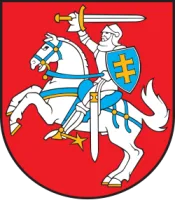
mounted knight known as Vytis (the Chaser), white stork
Driving
Speed limits & road rules in Lithuania
The default speed limits in Lithuania are 50 km/h in built-up areas, 90 km/h outside built-up areas, 120 km/h on expressways and 130 km/h on motorways. The legal alcohol limit for drivers is 0.4‰. Posted signs always take priority over these defaults.
- 2020 km/hResidential zonesLiving streets & residential areas
- 5050 km/hBuilt-up areasTowns and cities
- 9090 km/hOutside built-up areasCountry roads
- 120120 km/hExpresswaysDual carriageways & expresswaysWith a trailer: 90 km/h
- 130130 km/hMotorwaysMotorways / freewaysWith a trailer: 90 km/h
- International Driving PermitRecognised: 1968 Vienna, 1949 GenevaCarry the IDP together with your national licence
- Driving sideDrive on the rightOvertake on the left
- Alcohol limit0.4‰ blood alcohol (0.04% BAC)Zero tolerance for young / novice drivers
- Seat beltsRequired by law
- Child seatsRequired by law
- Motorcycle helmetsRequired for riders
- Road deaths (2021)6.3 per 100,000 peopleSafer than most countries (median 12.4)
Speed limits: OpenStreetMap wiki — Default speed limits (CC BY-SA 2.0). Road-safety laws: WHO Global Health Observatory. Compare speed limits and alcohol limits by country. Defaults for cars; local signs, weather and vehicle type can lower them.
Safety
Is Lithuania safe to visit?
Yes — Lithuania is generally safe to visit: the US State Department rates Lithuania Level 1 (“Exercise Normal Precautions”), and the UK Foreign Office has no warnings against travel there.
 US State Department
 UK Foreign Office (FCDO)
Latest update: Updated information on European Entry-Exit System (EES) (‘Entry requirements’ page).
Updated 11 Aug 2026 · Full travel advice
Sources: US Department of State travel advisories (public domain) and UK FCDO foreign travel advice (contains public sector information licensed under the Open Government Licence v3.0). Checked daily. Advice can change quickly — always read the official page before you travel.
Weather
Best time to visit Lithuania
The best time to visit Lithuania is June to August, when daytime highs in Vilnius are around 21–23°C. September is also a good time to go. July is the warmest month (23°C by day), January the coldest (-10°C at night), and July the wettest with about 102 mm of rain.
- Jan-4°C-10°C
- Feb-3°C-9°C
- Mar3°C-5°C
- Apr11°C1°C
- May18°C7°C
- Jun21°C11°C
- Jul23°C14°C
- Aug23°C13°C
- Sep17°C8°C
- Oct10°C3°C
- Nov3°C-1°C
- Dec-2°C-6°C
Best time Good Less ideal
Before you go
Plugs, voltage & emergency numbers in Lithuania
Plugs & sockets
230 V, 50 Hz · Standard 220–240 V: devices from the US or Japan (110–120 V) need a converter unless they are dual voltage (100–240 V).
Emergency numbers
112 works from any mobile phone, even without a SIM card in most networks. All countries →
Sources: Wikipedia — Mains electricity by country and List of emergency telephone numbers (CC BY-SA 4.0).
Ski resorts
4 ski resorts in Lithuania
- 2 km of slopes
- 16 lifts
- up to 230 m
Biggest: Liepkalnis · Kalita Kalnas · Mortos Kalns
National parks
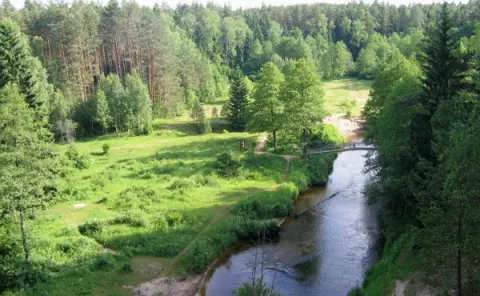
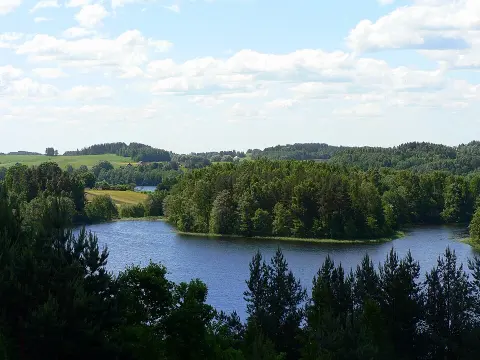
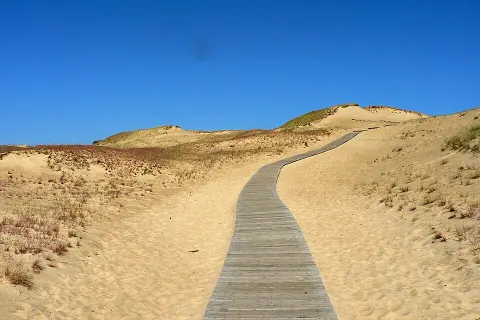
5 national parks in Lithuania
- 1,555 km² protected
- oldest from 1974
Largest: Dzūkija National Park · Aukštaitija National Park · Curonian Spit National Park
Currency · 26 October 2026
Euro exchange rates today
Lithuania uses the Euro (EUR, €). One US dollar buys 0.8911 EUR; over the last 30 days the EUR has lost 1.5% against the dollar.
What other currencies cost in EUR
Currency converter
Daily reference rates from the open-source currency-api (CC0), 26 Oct 2026. Banks and exchange offices add a margin.
World rankings
Where Lithuania ranks
How Lithuania compares with the rest of the world — open any card for the full ranking.
Airports
Airports in Lithuania
65 airports and airfields — 3 large, 4 medium and 56 small, plus 2 heliports. 3 have scheduled passenger flights.
Borders
Neighbouring countries
Lithuania borders 4 countries along 1,545 km of land borders. Coastline: 90 km.


Military
Lithuanian armed forces
Lithuania ranks #93 of 145 in the Global Firepower military strength ranking, with a defence budget of $3.0 billion (2025).
People
Population & society
Religion
Largest cities: Vilnius (541,000)
Economy
Economy
Main industries
metal-cutting machine tools, electric motors, televisions, refrigerators and freezers, petroleum refining, shipbuilding (small ships), furniture, textiles, food processing, fertilizer, agricultural machinery, optical eq…
Export partners
Latvia 11%, Poland 8%, Germany 7%, Netherlands 6%, Russia 6% (2023)
Top exports
refined petroleum, furniture, plastic products, wheat, cars (2023)
Travel tools
Handy before every trip to Lithuania
Next public holiday
All Saints' Day — Sunday, 1 November 2026. Then All Souls' Day (2 Nov).
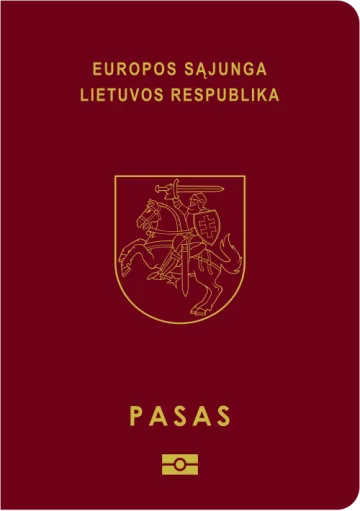
Lithuanian passport
Ranked #32: 117 countries visa-free, 34 with visa on arrival, 9 with an eTA and 21 with an eVisa.
Lithuanian passport photo
Exact size, head position and background for Lithuania's passport and visa photos — make one free with AI checks.
Calling Lithuania
Dial +370 before the local number. Internet domain .lt.
Climate footprint
12.5 million tonnes of CO₂ in 2024 — 4.39 t per person.
Entry requirements
Visa rules for every passport visiting Lithuania: visa-free stays, eVisas, visas on arrival and documents to bring.
News
Latest travel news about Lithuania
Pakistani passport holders must apply for Lithuania visas as before
Lithuania's Foreign Ministry has rejected reports that it eased visa requirements for Pakistani citizens, calling the claims an attempt to manipulate…
Denmark Ranks High in Work Visa Access Amid Hiring Challenges
Denmark leads the EU in work visa accessibility according to the Atlas HXM Workforce Index, but faces challenges in hiring ease. This highlights the …
Belarus Passport Center in Vilnius Suspends Operations Amid Restructuring
The Belarus Passport Center in Vilnius has ceased operations as part of a restructuring process, with no plans for permanent centers in Poland or oth…
Frequently asked questions about Lithuania
What do I need to travel to Lithuania?
How long must my passport be valid for Lithuania?
Where is Lithuania?
What is Lithuania known for?
What is the capital of Lithuania?
What language is spoken in Lithuania?
What currency does Lithuania use?
What is the calling code of Lithuania?
Which countries border Lithuania?
How strong is the Lithuanian passport?
What is the speed limit in Lithuania?
Is Lithuania safe to visit?
When is the best time to visit Lithuania?
What plug type does Lithuania use?
How many airports does Lithuania have?
Sources: CIA World Factbook (public domain); World Bank Open Data (CC BY 4.0); names, languages and currencies: mledoze/countries (ODbL); flag: flag-icons (MIT); coat of arms: Wikimedia Commons (file page); exchange rates: Daily reference rates from the open-source currency-api (CC0); airports: OurAirports.