
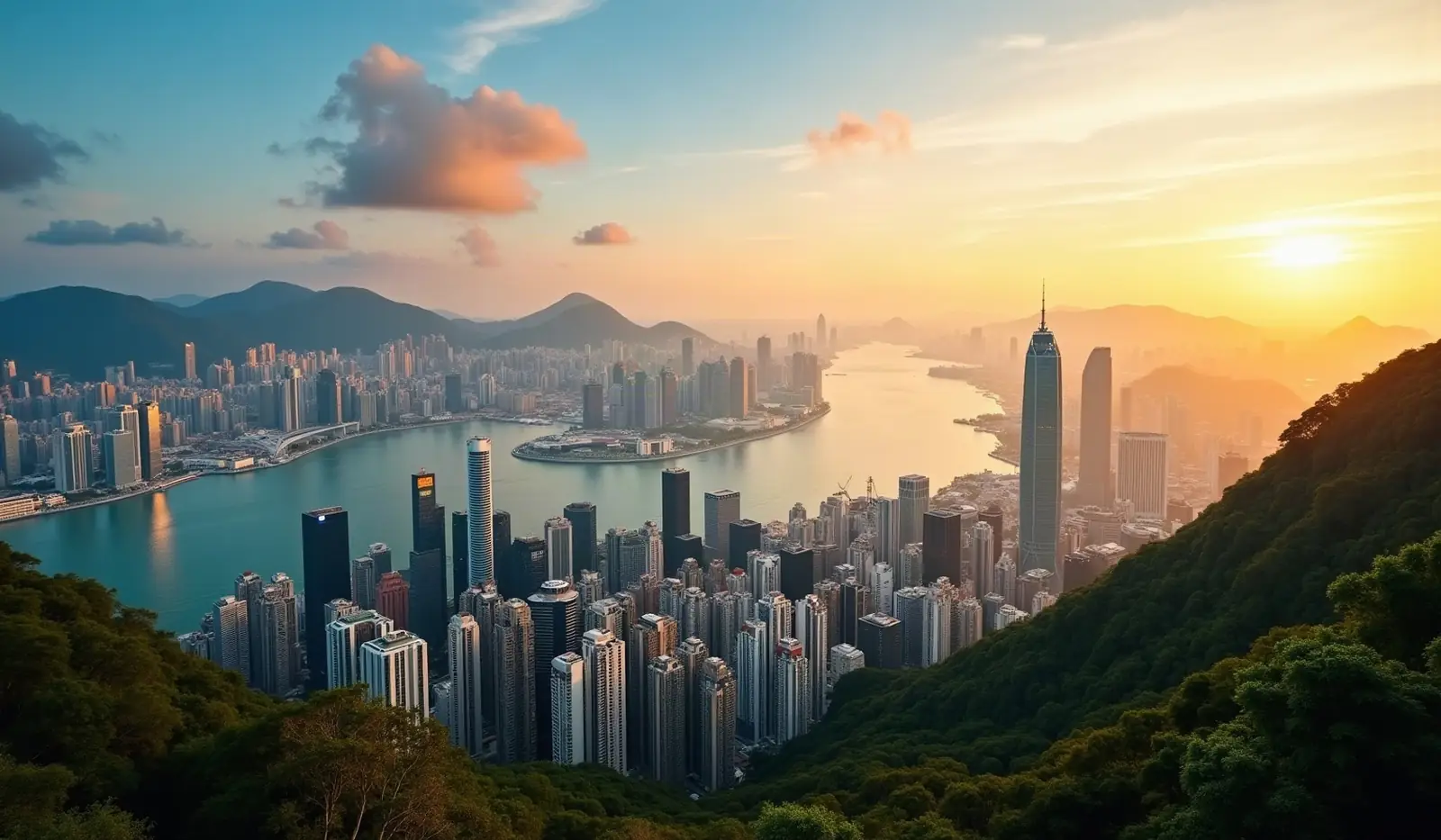
Eastern Asia

Hong Kong: Travel Guide & Requirements
Hong Kong Special Administrative Region of the People's Republic of China · 中华人民共和国香港特别行政区
Hong Kong is a country in Eastern Asia. It has a population of 7.5 million (#104 in the world) and covers 1,108 km². The official languages are English and Chinese. The currency is the Hong Kong dollar (HKD, $).
Where is Hong Kong? Map of Hong Kong
Eastern Asia, bordering the South China Sea and China.
- Region
- Eastern Asia
- Coordinates
- 22.267° N, 114.188° E
- Neighbours
- none (no land borders)
- Coastline
- 733 km
- Hong Kong
Travel requirements
What you need to travel to Hong Kong
- Passport
The UK Foreign Office says your passport must be valid for at least one month after the date you plan to leave Hong Kong.
- Visa or eTA
Depends on your passport: of 198 passports, 148 need no visa, 2 need an eTA, 47 need a visa from an embassy. Check yours or see Hong Kong entry requirements for every passport.
- Return or onward ticket
Hong Kong's Immigration Department says visitors must hold onward or return tickets, unless in transit to the Chinese Mainland or Macao.
- Proof of funds
Hong Kong's Immigration Department says visitors are required to have adequate funds to cover the duration of their stay without working.
- Travel insurance
No official requirement. The UK government tells travellers to check before they travel that they have appropriate travel insurance for local treatment or unexpected medical evacuation, and says medical treatment for uninsured foreign visitors …
- Customs allowance
Hong Kong Customs says any person arriving at a specified control point with currency and bearer negotiable instruments of a total value of more than HKD 120,000 must make a declaration to a Customs officer, using the R…
- Travel advice
Some caution needed — US and UK advice.
Entry rules: TravelRequirements.info — Entry Requirements Dataset (CC BY 4.0), each rule cited to an official government source. Always confirm with the airline and the official source before you travel.
Before you go
8 things to know before you travel to Hong Kong
- Safety: Hong Kong is generally safe for travellers, but some caution is needed: the US State Department rates Hong Kong Level 2 (“Exercise Increased Caution”), and the UK Foreign Office has no warnings against travel there.
- Best time to go: November — when daytime highs in the capital are around 25°C.
- Money: the Hong Kong dollar (HKD) — 1 US dollar is about 7.8438 HKD.
- Plugs: type D, G and M, 220 V, 50 Hz — standard 220–240 V: devices from the US or Japan (110–120 V) need a converter unless they are dual voltage (100–240 V).
- Emergency numbers: Police 999, Ambulance 999, Fire 999.
- Language: English and Chinese are official.
- Driving: on the left — speed limits are 50 km/h outside built-up areas.
- Time zone: Asia/Hong_Kong.
Key facts
Hong Kong at a glance
Languages spoken: Cantonese (official) 85.4%, English (official) 4.5%, Putonghua (official) 2.2%, other Chinese dialects 2.8%, other 2%, persons under 5 or mute 3.2% (2021 est.)
Geography & history
About Hong Kong
The UK seized Hong Kong in 1841, and China formally ceded it the following year at the end of the First Opium War. The Kowloon Peninsula was added in 1860 at the end of the Second Opium War, and the UK obtained a 99-year lease of the New Territories in 1898. Pursuant to a UK-China agreement in 1984, Hong Kong became the Hong Kong Special Administrative Region (HKSAR) of the People's Republic of China as of 1 July 1997. In this agreement, China promised that, under its "one country, two systems" formula, China's socialist economic and strict political system would not be imposed on Hong Kong and that Hong Kong would enjoy a "high degree of autonomy" in all matters except foreign and defense …
Read the full history
The UK seized Hong Kong in 1841, and China formally ceded it the following year at the end of the First Opium War. The Kowloon Peninsula was added in 1860 at the end of the Second Opium War, and the UK obtained a 99-year lease of the New Territories in 1898. Pursuant to a UK-China agreement in 1984, Hong Kong became the Hong Kong Special Administrative Region (HKSAR) of the People's Republic of China as of 1 July 1997. In this agreement, China promised that, under its "one country, two systems" formula, China's socialist economic and strict political system would not be imposed on Hong Kong and that Hong Kong would enjoy a "high degree of autonomy" in all matters except foreign and defense affairs for the next 50 years. After the handover, Hong Kong continued to enjoy success as an international financial center. However, growing Chinese political influence and dissatisfaction with the Hong Kong Government in the 2010s became central issues and led to considerable civil unrest, including large-scale pro-democracy demonstrations in 2019 after the HKSAR attempted to revise a local ordinance to allow extraditions to mainland China. In response to the protests, the governments of the HKSAR and China reduced the city's autonomy and placed new restrictions on the rights of Hong Kong residents, moves that were widely criticized as contravening obligations under the Hong Kong Basic Law and the Sino-British Joint Declaration. Democratic lawmakers and political figures were arrested in a widespread crackdown, while others fled abroad. At the same time, dozens of civil society groups and several independent media outlets were closed or disbanded. In 2021, Beijing imposed a more restrictive electoral system, restructuring the Legislative Council (LegCo) and allowing only government-approved candidates to run for office. The changes ensured that virtually all seats in the 2021 LegCo election went to pro-establishment candidates and effectively ended political opposition to Beijing. In 2024, the LegCo passed a new national security law (Article 23 of the Basic Law) further expanding the Hong Kong Government's power to curb dissent.
Location
Eastern Asia, bordering the South China Sea and China
Climate
subtropical monsoon; cool and humid in winter, hot and rainy from spring through summer, warm and sunny in fall
Terrain
hilly to mountainous with steep slopes; lowlands in north
Highest point
Tai Mo Shan 958 m
Natural resources
outstanding deepwater harbor, feldspar
Natural hazards
occasional typhoons
National symbols
bauhinia flower
Driving
Speed limits & road rules in Hong Kong
The default speed limits in Hong Kong are 50 km/h outside built-up areas. Posted signs always take priority over these defaults.
- 5050 km/hOutside built-up areasCountry roads
- International Driving PermitRecognised: 1949 GenevaCarry the IDP together with your national licence
- Driving sideDrive on the leftOvertake on the right
- Road deaths (2021)0.0 per 100,000 peopleSafer than most countries (median 12.4)
Speed limits: OpenStreetMap wiki — Default speed limits (CC BY-SA 2.0). Road-safety laws: WHO Global Health Observatory. Compare speed limits and alcohol limits by country. Defaults for cars; local signs, weather and vehicle type can lower them.
Safety
Is Hong Kong safe to visit?
Hong Kong is generally safe for travellers, but some caution is needed: the US State Department rates Hong Kong Level 2 (“Exercise Increased Caution”), and the UK Foreign Office has no warnings against travel there.
 US State Department
 UK Foreign Office (FCDO)
Latest update: Updated information on dual Chinese-British nationality, E-cigarettes and illegal drugs including CBD (cannabidiol) (‘Warnings and insurance’, ‘Entry requirements’ and ‘Safety and security’ pages).
Updated 1 Apr 2026 · Full travel advice
Sources: US Department of State travel advisories (public domain) and UK FCDO foreign travel advice (contains public sector information licensed under the Open Government Licence v3.0). Checked daily. Advice can change quickly — always read the official page before you travel.
Weather
Best time to visit Hong Kong
The best time to visit Hong Kong is November, when daytime highs in the capital are around 25°C. February to April, October and December are also a good time to go. July is the warmest month (30°C by day), January the coldest (12°C at night), and June the wettest with about 282 mm of rain.
- Jan20°C12°C
- Feb21°C15°C
- Mar23°C17°C
- Apr26°C21°C
- May29°C24°C
- Jun30°C26°C
- Jul30°C27°C
- Aug30°C27°C
- Sep30°C26°C
- Oct28°C22°C
- Nov25°C18°C
- Dec21°C13°C
Best time Good Less ideal
Before you go
Plugs, voltage & emergency numbers in Hong Kong
Plugs & sockets
- Type Dthree large round pins in a triangle
- Type Gthree rectangular pins in a triangle
- Type Mthree large round pins in a triangle
220 V, 50 Hz · Standard 220–240 V: devices from the US or Japan (110–120 V) need a converter unless they are dual voltage (100–240 V).
Emergency numbers
Save the local numbers before you travel — 112 or 911 may not connect here. All countries →
Sources: Wikipedia — Mains electricity by country and List of emergency telephone numbers (CC BY-SA 4.0).
Currency · 26 October 2026
Hong Kong dollar exchange rates today
Hong Kong uses the Hong Kong dollar (HKD, $). One US dollar buys 7.8438 HKD; over the last 30 days the HKD has gained 0.0% against the dollar.
What other currencies cost in HKD
Currency converter
Daily reference rates from the open-source currency-api (CC0), 26 Oct 2026. Banks and exchange offices add a margin.
World rankings
Where Hong Kong ranks
How Hong Kong compares with the rest of the world — open any card for the full ranking.
Airports
Airports in Hong Kong
144 airports and airfields — 1 large, 1 medium and 0 small, plus 142 heliports. 2 have scheduled passenger flights.
Borders
No land borders
Hong Kong has no land borders with other countries. Coastline: 733 km.
People
Population & society
Religion
Largest cities: Hong Kong (7.7 million)
Economy
Economy
Main industries
trading and logistics, financial services, professional services, tourism, cultural and creative, clothing and textiles, shipping, electronics, toys, clocks and watches
Export partners
China 22%, Vietnam 12%, S. Korea 8%, Netherlands 5%, Switzerland 4% (2023)
Top exports
gold, integrated circuits, gas turbines, broadcasting equipment, jewelry (2023)
Travel tools
Handy before every trip to Hong Kong
Next public holiday
Christmas Day — Friday, 25 December 2026. Then Boxing Day (26 Dec).

Chinese/Hong Kong passport
Ranked #39: 114 countries visa-free, 31 with visa on arrival, 8 with an eTA and 20 with an eVisa.
Chinese/Hong Kong passport photo
Exact size, head position and background for Hong Kong's passport and visa photos — make one free with AI checks.
Calling Hong Kong
Dial +852 before the local number. Internet domain .hk.
Climate footprint
33.3 million tonnes of CO₂ in 2024 — 4.49 t per person.
Entry requirements
Visa rules for every passport visiting Hong Kong: visa-free stays, eVisas, visas on arrival and documents to bring.
News
Latest travel news about Hong Kong
Japan turns away US comedian over entertainer visa before Tokyo shows
A Palestinian American comedian says Japan denied him entry and held him for nearly 24 hours because he lacked the visa needed to perform stand-up in…

Macau Departures: Indians Pay Less for Mainland China Visas Until Dec 2026
Indian passport holders still need an L tourist visa before travelling to mainland China. Reduced Chinese visa fees for Indian applicants now run unt…
US adds wrongful detention warning to its China travel advisory
The US State Department has added a "D" wrongful detention risk indicator to its Level 2 China travel advisory, citing arbitrary detention, exit bans…
Frequently asked questions about Hong Kong
What do I need to travel to Hong Kong?
How long must my passport be valid for Hong Kong?
Where is Hong Kong?
What is Hong Kong known for?
What language is spoken in Hong Kong?
What currency does Hong Kong use?
What is the calling code of Hong Kong?
Does Hong Kong have land borders?
How strong is the Chinese/Hong Kong passport?
What is the speed limit in Hong Kong?
Is Hong Kong safe to visit?
When is the best time to visit Hong Kong?
What plug type does Hong Kong use?
How many airports does Hong Kong have?
Sources: CIA World Factbook (public domain); World Bank Open Data (CC BY 4.0); names, languages and currencies: mledoze/countries (ODbL); flag: flag-icons (MIT); coat of arms: Wikimedia Commons (file page); exchange rates: Daily reference rates from the open-source currency-api (CC0); airports: OurAirports.