
South America · UN member

Guyana: Travel Guide & Requirements
Co-operative Republic of Guyana
Guyana is a country in South America with its capital in Georgetown. It has a population of 835,986 (#164 in the world) and covers 214,969 km². The official language is English. The currency is the Guyanese dollar (GYD, $).
Where is Guyana? Map of Guyana
Northern South America, bordering the North Atlantic Ocean, between Suriname and Venezuela.
- Region
- South America
- Coordinates
- 5° N, 59° W
- Neighbours
- 3 — see list
- Coastline
- 459 km
- Guyana
- Neighbours
- Capital
- Largest cities
Map of Guyana showing Georgetown (capital) and the largest cities: Linden and New Amsterdam.
Travel requirements
What you need to travel to Guyana
- Passport
The UK government says that to enter Guyana your passport must have an expiry date at least 6 months after the date you arrive.
- Visa or eTA
Depends on your passport: of 198 passports, 61 need no visa, 36 need an eVisa, 101 need a visa from an embassy. Check yours or see Guyana entry requirements for every passport.
- Return or onward ticket
No official requirement.
- Proof of funds
The Foreign Ministry's advisory says visitors who receive a visa on arrival must provide, on arrival, evidence of finances to cover expenses for 30 days and the name and address of their inviter or sponsor, or of their …
- Travel insurance
No official requirement. The UK government advises checking that you have appropriate travel insurance for local treatment or unexpected medical evacuation, and says medical facilities are very limited, even in Georgetown.
- Vaccinations
WHO lists Guyana as requiring proof of yellow fever vaccination from travellers aged 1 year or over arriving from countries at risk of yellow fever transmission, including travellers who transited more than 4 hours thro…
- Customs allowance
Guyana's Financial Intelligence Unit says travellers carrying foreign currency amounting to more than US$10,000 or its equivalent into or out of Guyana must make a foreign currency declaration, on forms available at all…
- Travel advice
High risk — US and UK advice.
Entry rules: TravelRequirements.info — Entry Requirements Dataset (CC BY 4.0), each rule cited to an official government source. Always confirm with the airline and the official source before you travel.
Before you go
10 things to know before you travel to Guyana
- Safety: Travel to Guyana carries a high risk: the US State Department rates Guyana Level 3 (“Reconsider Travel”), and the UK Foreign Office has no warnings against travel there.
- Best time to go: February to April and September to October — when daytime highs in Georgetown are around 27–29°C.
- Money: the Guyanese dollar (GYD) — 1 US dollar is about 208.9524 GYD.
- Plugs: type A, B, D and G, 190 V / 240 V, 60 Hz — mixed voltage: check the socket before you plug in. Dual-voltage chargers (100–240 V) work everywhere.
- Emergency numbers: Police 911, Ambulance 913, Fire 912.
- Language: English is official.
- Driving: on the left — speed limits are 30 mph in built-up areas and 40 mph outside built-up areas.
- Time zone: UTC-4 in Georgetown.
- Capital: Georgetown. About 835,986 people live in Guyana.
- Outdoors: 1 national park.
Key facts
Guyana at a glance
Languages spoken: English (official), Guyanese Creole, Amerindian languages (including Caribbean and Arawak languages), Indian languages (including Caribbean Hindustani, a dialect of Hindi), Chinese (2014 est.)
Geography & history
About Guyana
Originally a Dutch colony in the 17th century, by 1815 Guyana had become a British possession. The abolition of slavery led to former slaves settling urban areas and indentured servants being imported from India to work the sugar plantations. The resulting ethnocultural divide has persisted and has led to turbulent politics. Guyana achieved independence from the UK in 1966, and since then primarily socialist-oriented governments have ruled the country. In 1992, Cheddi JAGAN was elected president in what is considered the country's first free and fair election since independence. After his death five years later, his wife, Janet JAGAN, became president but resigned in 1999 due to poor health…
Read the full history
Originally a Dutch colony in the 17th century, by 1815 Guyana had become a British possession. The abolition of slavery led to former slaves settling urban areas and indentured servants being imported from India to work the sugar plantations. The resulting ethnocultural divide has persisted and has led to turbulent politics. Guyana achieved independence from the UK in 1966, and since then primarily socialist-oriented governments have ruled the country. In 1992, Cheddi JAGAN was elected president in what is considered the country's first free and fair election since independence. After his death five years later, his wife, Janet JAGAN, became president but resigned in 1999 due to poor health. Her successor, Bharrat JAGDEO, was elected in 2001 and again in 2006. Donald RAMOTAR won in 2011, but early elections held in 2015 resulted in the first change in governing party, and David GRANGER took office. After a 2018 no-confidence vote against the GRANGER government, the administration ignored a constitutional requirement to hold elections and remained in place until the 2020 elections, when Irfaan ALI became president. The discovery of massive offshore oil reserves in 2015 has been Guyana's primary economic and political focus, with many hoping the reserves will transform one of the poorest countries in the region. Guyana is the only English-speaking country in South America and shares cultural and historical bonds with the Anglophone Caribbean.
Location
Northern South America, bordering the North Atlantic Ocean, between Suriname and Venezuela
Climate
tropical; hot, humid, moderated by northeast trade winds; two rainy seasons (May to August, November to January)
Terrain
mostly rolling highlands; low coastal plain; savanna in south
Highest point
Laberintos del Norte on Mount Roraima 2,775 m
Natural resources
bauxite, gold, diamonds, hardwood timber, shrimp, fish
Natural hazards
flash flood threat during rainy seasons
National symbols
Canje pheasant (hoatzin), jaguar, Victoria Regia water lily
Driving
Speed limits & road rules in Guyana
The default speed limits in Guyana are 30 mph in built-up areas and 40 mph outside built-up areas. The legal alcohol limit for drivers is 0.8‰. Posted signs always take priority over these defaults.
- SPEED
LIMIT3030 mphBuilt-up areasTowns and cities - SPEED
LIMIT4040 mphOutside built-up areasCountry roads
- International Driving PermitRecognised: 1968 ViennaCarry the IDP together with your national licence
- Driving sideDrive on the leftOvertake on the right
- Alcohol limit0.8‰ blood alcohol (0.08% BAC)
- Seat beltsRequired by law
- Child seatsRequired by law
- Road deaths (2021)15.2 per 100,000 peopleHigher than most countries (median 12.4)
Speed limits: OpenStreetMap wiki — Default speed limits (CC BY-SA 2.0). Road-safety laws: WHO Global Health Observatory. Compare speed limits and alcohol limits by country. Defaults for cars; local signs, weather and vehicle type can lower them.
Safety
Is Guyana safe to visit?
Travel to Guyana carries a high risk: the US State Department rates Guyana Level 3 (“Reconsider Travel”), and the UK Foreign Office has no warnings against travel there.
 US State Department
 UK Foreign Office (FCDO)
Latest update: Updated information on health risks and healthcare in Guyana (‘Health’ page).
Updated 30 Dec 2025 · Full travel advice
Sources: US Department of State travel advisories (public domain) and UK FCDO foreign travel advice (contains public sector information licensed under the Open Government Licence v3.0). Checked daily. Advice can change quickly — always read the official page before you travel.
Weather
Best time to visit Guyana
The best time to visit Guyana is February to April and September to October, when daytime highs in Georgetown are around 27–29°C. November to January and May to August are also a good time to go. September is the warmest month (29°C by day), February the coldest (25°C at night), and May the wettest with about 315 mm of rain.
- Jan27°C25°C
- Feb27°C25°C
- Mar28°C26°C
- Apr28°C26°C
- May28°C26°C
- Jun28°C26°C
- Jul28°C26°C
- Aug28°C27°C
- Sep29°C27°C
- Oct29°C27°C
- Nov28°C27°C
- Dec28°C26°C
Best time Good Less ideal
Before you go
Plugs, voltage & emergency numbers in Guyana
Plugs & sockets
- Type Atwo flat parallel pins
- Type Btwo flat parallel pins and a round earth pin
- Type Dthree large round pins in a triangle
- Type Gthree rectangular pins in a triangle
190 V / 240 V, 60 Hz · Mixed voltage: check the socket before you plug in. Dual-voltage chargers (100–240 V) work everywhere.
Emergency numbers
Save the local numbers before you travel — 112 or 911 may not connect here. All countries →
Sources: Wikipedia — Mains electricity by country and List of emergency telephone numbers (CC BY-SA 4.0).
National parks
1 national park in Guyana
- 627 km² protected
- oldest from 1929
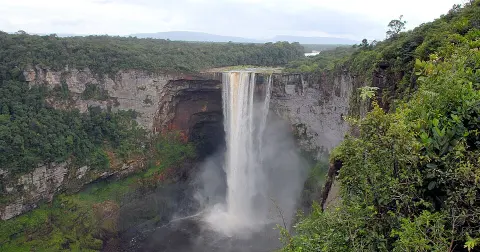
Largest: Kaieteur National Park
Currency · 26 October 2026
Guyanese dollar exchange rates today
Guyana uses the Guyanese dollar (GYD, $). One US dollar buys 208.9524 GYD; over the last 30 days the GYD has lost 0.1% against the dollar.
What other currencies cost in GYD
Currency converter
Daily reference rates from the open-source currency-api (CC0), 26 Oct 2026. Banks and exchange offices add a margin.
World rankings
Where Guyana ranks
How Guyana compares with the rest of the world — open any card for the full ranking.
Airports
Airports in Guyana
59 airports and airfields — 1 large, 3 medium and 55 small, plus 0 heliports. 4 have scheduled passenger flights.
Borders
Neighbouring countries
Guyana borders 3 countries along 2,933 km of land borders. Coastline: 459 km.


People
Population & society
Religion
Largest cities: Georgetown (110,000)
Economy
Economy
Main industries
bauxite, sugar, rice milling, timber, textiles, gold mining
Export partners
USA 20%, Trinidad & Tobago 11%, Netherlands 10%, Singapore 10%, Germany 7% (2023)
Top exports
crude petroleum, railway cargo containers, gold, ships, rice (2023)
Travel tools
Handy before every trip to Guyana
Next public holiday
Christmas Day — Friday, 25 December 2026. Then Boxing Day (26 Dec).
Guyanese passport
Ranked #106: 48 countries visa-free, 29 with visa on arrival, 5 with an eTA and 37 with an eVisa.
Guyanese passport photo
Exact size, head position and background for Guyana's passport and visa photos — make one free with AI checks.
Calling Guyana
Dial +592 before the local number. Internet domain .gy.
Climate footprint
4.5 million tonnes of CO₂ in 2024 — 5.43 t per person.
Entry requirements
Visa rules for every passport visiting Guyana: visa-free stays, eVisas, visas on arrival and documents to bring.
News
Latest travel news about Guyana
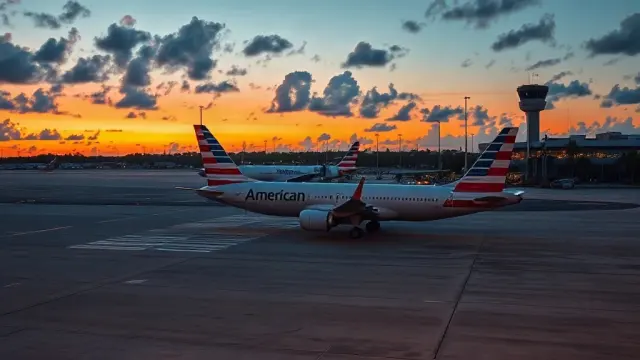
Guyana travellers delayed as Miami flight turns back over alleged crew threat
An American Airlines flight bound for Guyana returned to Miami International Airport on Thursday evening after a passenger allegedly threatened a fli…
Suriname charges a $25 entry fee for US travellers, plus travel basics
Travellers from the U.S. pay a $25 entry fee to enter Suriname, the article notes. Flights arrive mainly via Amsterdam, Georgetown, Panama City and B…

Yellow Fever Vaccination Advised for Travellers to Brazil From Age 9 Months
The US Centers for Disease Control and Prevention (CDC) recommends yellow fever vaccination for most travellers aged 9 months and older visiting at-r…
Frequently asked questions about Guyana
What do I need to travel to Guyana?
How long must my passport be valid for Guyana?
Where is Guyana?
What is Guyana known for?
What is the capital of Guyana?
What language is spoken in Guyana?
What currency does Guyana use?
What is the calling code of Guyana?
Which countries border Guyana?
How strong is the Guyanese passport?
What is the speed limit in Guyana?
Is Guyana safe to visit?
When is the best time to visit Guyana?
What plug type does Guyana use?
How many airports does Guyana have?
Sources: CIA World Factbook (public domain); World Bank Open Data (CC BY 4.0); names, languages and currencies: mledoze/countries (ODbL); flag: flag-icons (MIT); coat of arms: Wikimedia Commons (file page); exchange rates: Daily reference rates from the open-source currency-api (CC0); airports: OurAirports.