
Eastern Africa · UN member

Zimbabwe: Travel Guide & Requirements
Republic of Zimbabwe
Zimbabwe is a country in Eastern Africa with its capital in Harare. It has a population of 17.0 million (#73 in the world) and covers 390,757 km². The official languages are Chibarwe, English, Kalanga, Khoisan, Ndau, Northern Ndebele, Chewa, Shona, Sotho, Tonga, Tswana, Tsonga, Venda, Xhosa and Zimbabwean Sign Language. The currency is the Zimbabwean bonds (ZWB, $).
Where is Zimbabwe? Map of Zimbabwe
Southern Africa, between South Africa and Zambia.
- Region
- Eastern Africa
- Coordinates
- 20° S, 30° E
- Neighbours
- 4 — see list
- Coastline
- Landlocked
- Zimbabwe
- Neighbours
- Capital
- Largest cities
Map of Zimbabwe showing Harare (capital) and the largest cities: Bulawayo, Mutare, Gweru, Kwekwe, Kadoma, Chinhoyi, Masvingo and Marondera.
Travel requirements
What you need to travel to Zimbabwe
- Passport
The UK government tells British nationals that to enter Zimbabwe their passport must have an expiry date at least 6 months after the date they arrive, and 3 blank pages.
- Visa or eTA
Depends on your passport: of 198 passports, 41 need no visa, 53 need an eVisa, 104 get a visa on arrival. Check yours or see Zimbabwe entry requirements for every passport.
- Return or onward ticket
No official requirement.
- Proof of funds
No official requirement.
- Travel insurance
No official requirement.
- Vaccinations
The UK government says that to enter Zimbabwe you must have a certificate proving yellow fever vaccination if you are coming from a country listed as a transmission risk.
- Customs allowance
The UK government says to declare cash or travellers cheques if the value is USD 10,000 or more, that you will get a certified declaration to show you brought it in, and that it is illegal to leave Zimbabwe with cash wo…
- Travel advice
Some caution needed — US and UK advice.
Entry rules: TravelRequirements.info — Entry Requirements Dataset (CC BY 4.0), each rule cited to an official government source. Always confirm with the airline and the official source before you travel.
Before you go
10 things to know before you travel to Zimbabwe
- Safety: Zimbabwe is generally safe for travellers, but some caution is needed: the US State Department rates Zimbabwe Level 2 (“Exercise Increased Caution”), and the UK Foreign Office has no warnings against travel there.
- Best time to go: April to May and August — when daytime highs in Harare are around 24–25°C.
- Money: the Zimbabwean bonds (ZWB).
- Plugs: type D and G, 220 V, 50 Hz — standard 220–240 V: devices from the US or Japan (110–120 V) need a converter unless they are dual voltage (100–240 V).
- Emergency numbers: Police 999, Ambulance 999, Fire 999.
- Language: Chibarwe, English, Kalanga, Khoisan, Ndau, Northern Ndebele, Chewa, Shona, Sotho, Tonga, Tswana, Tsonga, Venda, Xhosa and Zimbabwean Sign Language are official.
- Driving: on the left — speed limits are 60 km/h in built-up areas and 80 km/h outside built-up areas.
- Time zone: UTC+2 in Harare.
- Capital: Harare. About 17.0 million people live in Zimbabwe.
- Outdoors: 13 national parks.
Key facts
Zimbabwe at a glance
Languages spoken: Shona (official, most widely spoken) 80.9%, Ndebele (official, second most widely spoken) 11.5%, English (official, traditionally used for official business) 0.3%, 13 minority languages (official; includes Chewa, Chibarwe, Kalanga, Koisan, Nambya, Ndau, Shangani, sign language, Sotho, Tonga, Tswana, Venda, and Xhosa) 7%, other 0.3% (2022 est.)
Geography & history
About Zimbabwe
The hunter-gatherer San people first inhabited the area that eventually became Zimbabwe. Farming communities migrated to the area around A.D. 500 during the Bantu expansion, and Shona-speaking societies began to develop in the Limpopo valley and Zimbabwean highlands around the 9th century. These societies traded with Arab merchants on the Indian Ocean coast and organized under the Kingdom of Mapungubwe in the 11th century. A series of powerful trade-oriented Shona states succeeded Mapungubwe, including the Kingdom of Zimbabwe (ca. 1220-1450), Kingdom of Mutapa (ca. 1450-1760), and the Rozwi Empire. The Rozwi Empire expelled Portuguese colonists from the Zimbabwean plateau, but the Ndebele c…
Read the full history
The hunter-gatherer San people first inhabited the area that eventually became Zimbabwe. Farming communities migrated to the area around A.D. 500 during the Bantu expansion, and Shona-speaking societies began to develop in the Limpopo valley and Zimbabwean highlands around the 9th century. These societies traded with Arab merchants on the Indian Ocean coast and organized under the Kingdom of Mapungubwe in the 11th century. A series of powerful trade-oriented Shona states succeeded Mapungubwe, including the Kingdom of Zimbabwe (ca. 1220-1450), Kingdom of Mutapa (ca. 1450-1760), and the Rozwi Empire. The Rozwi Empire expelled Portuguese colonists from the Zimbabwean plateau, but the Ndebele clan of Zulu King MZILIKAZI eventually conquered the area in 1838 during the era of conflict and population displacement known as the Mfecane. In the 1880s, colonists arrived with the British South Africa Company (BSAC) and obtained a written concession for mining rights from Ndebele King LOBENGULA. The king later disavowed the concession and accused the BSAC agents of deceit. The BSAC annexed Mashonaland and then conquered Matabeleland during the First Matabele War of 1893-1894, establishing company rule over the territory. In 1923, the UK annexed BSAC holdings south of the Zambezi River, which became the British colony of Southern Rhodesia. The 1930 Land Apportionment Act restricted Black land ownership and established rules that would favor the White minority for decades. A new constitution in 1961 further cemented White minority rule. In 1965, the government under White Prime Minister Ian SMITH unilaterally declared its independence from the UK. London did not recognize Rhodesia’s independence and demanded more voting rights for the Black majority in the country. International diplomacy and an uprising by Black Zimbabweans led to biracial elections in 1979 and independence (as Zimbabwe) in 1980. Robert MUGABE, who led the uprising and became the nation's first prime minister, was the country's only ruler (as president since 1987) from independence until 2017. In the mid-1980s, the government tortured and killed thousands of civilians in a crackdown on dissent known as the Gukurahundi campaign. Economic mismanagement and chaotic implementation of land redistribution policies periodically crippled the economy. General elections in 2002, 2008, and 2013 were severely flawed and widely condemned but allowed MUGABE to remain president. In 2017, Vice President Emmerson MNANGAGWA became president after a military intervention that forced MUGABE to resign, and MNANGAGWA cemented power by sidelining rival Grace MUGABE (Robert MUGABE’s wife). In 2018, MNANGAGWA won the presidential election, and he has maintained the government's longstanding practice of violently disrupting protests and politicizing institutions. Economic conditions remain dire under MNANGAGWA.
Location
Southern Africa, between South Africa and Zambia
Climate
tropical; moderated by altitude; rainy season (November to March)
Terrain
mostly high plateau with higher central plateau (high veld); mountains in east
Highest point
Inyangani 2,592 m
Natural resources
coal, chromium ore, asbestos, gold, nickel, copper, iron ore, vanadium, lithium, tin, platinum group metals
Natural hazards
recurring droughts; floods and severe storms are rare
National symbols
Zimbabwe bird symbol, African fish eagle, flame lily
Driving
Speed limits & road rules in Zimbabwe
The default speed limits in Zimbabwe are 60 km/h in built-up areas and 80 km/h outside built-up areas. The legal alcohol limit for drivers is 0.8‰. Posted signs always take priority over these defaults.
- 6060 km/hBuilt-up areasTowns and citiesWHO data (2017)
- 8080 km/hOutside built-up areasCountry roadsWHO data (2017)
- International Driving PermitRecognised: 1968 Vienna, 1949 GenevaCarry the IDP together with your national licence
- Driving sideDrive on the leftOvertake on the right
- Alcohol limit0.8‰ blood alcohol (0.08% BAC)
- Seat beltsRequired by law
- Child seatsNo national child-restraint law
- Motorcycle helmetsRequired for riders
- Road deaths (2021)29.9 per 100,000 peopleHigher than most countries (median 12.4)
Speed limits: OpenStreetMap wiki — Default speed limits (CC BY-SA 2.0) and WHO. Road-safety laws: WHO Global Health Observatory. Compare speed limits and alcohol limits by country. Defaults for cars; local signs, weather and vehicle type can lower them.
Safety
Is Zimbabwe safe to visit?
Zimbabwe is generally safe for travellers, but some caution is needed: the US State Department rates Zimbabwe Level 2 (“Exercise Increased Caution”), and the UK Foreign Office has no warnings against travel there.
 US State Department
 UK Foreign Office (FCDO)
Latest update: Addition of information about direct flights between London and Harare ('Safety and security' page).
Updated 15 Jul 2026 · Full travel advice
Sources: US Department of State travel advisories (public domain) and UK FCDO foreign travel advice (contains public sector information licensed under the Open Government Licence v3.0). Checked daily. Advice can change quickly — always read the official page before you travel.
Weather
Best time to visit Zimbabwe
The best time to visit Zimbabwe is April to May and August, when daytime highs in Harare are around 24–25°C. June to July and September are also a good time to go. October is the warmest month (31°C by day), July the coldest (6°C at night), and December the wettest with about 195 mm of rain.
- Jan27°C16°C
- Feb27°C15°C
- Mar26°C14°C
- Apr25°C12°C
- May24°C9°C
- Jun21°C7°C
- Jul21°C6°C
- Aug25°C8°C
- Sep29°C11°C
- Oct31°C14°C
- Nov30°C16°C
- Dec27°C16°C
Best time Good Less ideal
Before you go
Plugs, voltage & emergency numbers in Zimbabwe
Plugs & sockets
220 V, 50 Hz · Standard 220–240 V: devices from the US or Japan (110–120 V) need a converter unless they are dual voltage (100–240 V).
Emergency numbers
Save the local numbers before you travel — 112 or 911 may not connect here. All countries →
Sources: Wikipedia — Mains electricity by country and List of emergency telephone numbers (CC BY-SA 4.0).
National parks
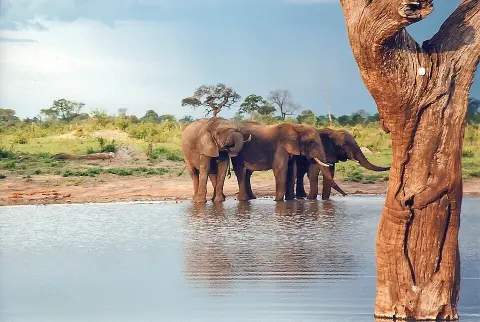
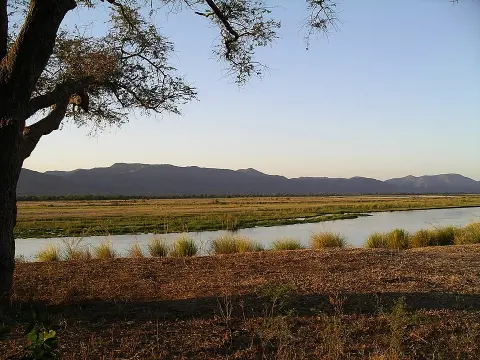
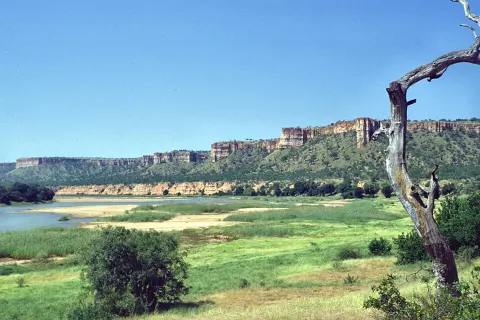
13 national parks in Zimbabwe
- 33,927 km² protected
- oldest from 1926
Largest: Hwange National Park · Mana Pools National Park, Sapi and Chewore Safari Areas · Gonarezhou National Park
World rankings
Where Zimbabwe ranks
How Zimbabwe compares with the rest of the world — open any card for the full ranking.
Airports
Airports in Zimbabwe
152 airports and airfields — 3 large, 6 medium and 138 small, plus 5 heliports. 4 have scheduled passenger flights.
Borders
Neighbouring countries
Zimbabwe borders 4 countries along 3,229 km of land borders. It is landlocked.


Military
Zimbabwean armed forces
Zimbabwe ranks #98 of 145 in the Global Firepower military strength ranking, with a defence budget of $160 million (2025).
People
Population & society
Religion
Largest cities: Harare (1.6 million)
Economy
Economy
Main industries
mining (coal, gold, platinum, copper, nickel, tin, diamonds, clay, numerous metallic and nonmetallic ores), steel, wood products, cement, chemicals, fertilizer, clothing and footwear, foodstuffs, beverages
Export partners
UAE 45%, China 18%, South Africa 15%, Mozambique 4%, Hong Kong 2% (2023)
Top exports
gold, tobacco, nickel, minerals, diamonds (2023)
Travel tools
Handy before every trip to Zimbabwe
Next public holiday
Unity Day — Tuesday, 22 December 2026. Then Christmas Day (25 Dec).
Zimbabwean passport
Ranked #129: 37 countries visa-free, 22 with visa on arrival, 3 with an eTA and 35 with an eVisa.
Zimbabwean passport photo
Exact size, head position and background for Zimbabwe's passport and visa photos — make one free with AI checks.
Calling Zimbabwe
Dial +263 before the local number. Internet domain .zw.
Climate footprint
13.7 million tonnes of CO₂ in 2024 — 0.82 t per person.
Entry requirements
Visa rules for every passport visiting Zimbabwe: visa-free stays, eVisas, visas on arrival and documents to bring.
News
Latest travel news about Zimbabwe
UK care worker visa rules squeeze Nigerians and Zimbabweans in the sector
Nigerian and Zimbabwean nationals received a combined 120,692 UK Health and Care Worker visa extensions in the year to March 2026, Home Office figure…
US visa refusals keep Zimbabwe, Nepal and Pakistan fellows out of Utah event
Visa applications from religious freedom fellows in Nepal, Pakistan, Kenya, Nigeria and Zimbabwe were turned down by US officials, leaving only nine …
New UK Passport Rules Impact Dual Nationals in Zimbabwe
Recent changes to UK passport regulations require dual nationals, including those born in Zimbabwe, to hold a British passport for entry, complicatin…
Frequently asked questions about Zimbabwe
What do I need to travel to Zimbabwe?
How long must my passport be valid for Zimbabwe?
Where is Zimbabwe?
What is Zimbabwe known for?
What is the capital of Zimbabwe?
What language is spoken in Zimbabwe?
What currency does Zimbabwe use?
What is the calling code of Zimbabwe?
Which countries border Zimbabwe?
How strong is the Zimbabwean passport?
What is the speed limit in Zimbabwe?
Is Zimbabwe safe to visit?
When is the best time to visit Zimbabwe?
What plug type does Zimbabwe use?
How many airports does Zimbabwe have?
Sources: CIA World Factbook (public domain); World Bank Open Data (CC BY 4.0); names, languages and currencies: mledoze/countries (ODbL); flag: flag-icons (MIT); coat of arms: Wikimedia Commons (file page); exchange rates: Daily reference rates from the open-source currency-api (CC0); airports: OurAirports.