
Middle Africa · UN member

Gabon: Travel Guide & Requirements
Gabonese Republic
Gabon is a country in Middle Africa with its capital in Libreville. It has a population of 2.6 million (#142 in the world) and covers 267,667 km². The official language is French. The currency is the Central African CFA franc (XAF, Fr).
Where is Gabon? Map of Gabon
Central Africa, bordering the Atlantic Ocean at the Equator, between Republic of the Congo and Equatorial Guinea.
- Region
- Middle Africa
- Coordinates
- 1° S, 11.75° E
- Neighbours
- 3 — see list
- Coastline
- 885 km
- Gabon
- Neighbours
- Capital
- Largest cities
Map of Gabon showing Libreville (capital) and the largest cities: Port-Gentil, Franceville, Oyem, Lambaréné, Mouila, Tchibanga, Bitam and Koulamoutou.
Travel requirements
What you need to travel to Gabon
- Passport
The DGDI e-Visa portal says the application must include a copy of the passport data page with a validity of at least six months.
- Visa or eTA
Depends on your passport: of 198 passports, 8 need no visa, 188 need an eVisa, 1 needs a visa from an embassy. Check yours or see Gabon entry requirements for every passport.
- Return or onward ticket
No official requirement. The UK Foreign Office tells British travellers that for tourist travel they must provide a hotel booking or a letter from their hotel confirming their stay.
- Proof of funds
No official requirement.
- Travel insurance
No official requirement. Canada's travel advice says to make sure you get travel insurance that includes coverage for medical evacuation and hospital stays.
- Vaccinations
The UK government's travel advice says that to enter Gabon you must have a certificate to prove you have had a yellow fever vaccination.
- Travel advice
Some caution needed — US and UK advice.
Entry rules: TravelRequirements.info — Entry Requirements Dataset (CC BY 4.0), each rule cited to an official government source. Always confirm with the airline and the official source before you travel.
Before you go
10 things to know before you travel to Gabon
- Safety: Gabon is generally safe for travellers, but some caution is needed: the US State Department rates Gabon Level 2 (“Exercise Increased Caution”), and the UK Foreign Office has no warnings against travel there.
- Best time to go: June to August — when daytime highs in Libreville are around 26–27°C.
- Money: the Central African CFA franc (XAF) — 1 US dollar is about 584.5354 XAF.
- Plugs: type C and E, 220 V, 50 Hz — standard 220–240 V: devices from the US or Japan (110–120 V) need a converter unless they are dual voltage (100–240 V).
- Emergency numbers: Police 1730, Ambulance 1300, Fire 18.
- Language: French is official.
- Driving: on the right — speed limits are 60 km/h in built-up areas and 110 km/h outside built-up areas.
- Time zone: UTC+1 in Libreville.
- Capital: Libreville. About 2.6 million people live in Gabon.
- Outdoors: 13 national parks.
Key facts
Gabon at a glance
Languages spoken: French (official), Fang, Myene, Nzebi, Bapounou/Eschira, Bandjabi
Geography & history
About Gabon
Gabon, a sparsely populated country known for its dense rainforests and vast petroleum reserves, is one of the most prosperous and stable countries in central Africa. Approximately 40 ethnic groups are represented, the largest of which is the Fang, a group that covers the northern third of Gabon and expands north into Equatorial Guinea and Cameroon. From about the early 1300s, various kingdoms emerged in present-day Gabon and the surrounding area, including the Kingdoms of Loango and Orungu. Because most early Bantu languages spoken in these kingdoms did not have a written form, much of Gabon's early history was lost over time. Portuguese traders who arrived in the mid-1400s gave the area i…
Read the full history
Gabon, a sparsely populated country known for its dense rainforests and vast petroleum reserves, is one of the most prosperous and stable countries in central Africa. Approximately 40 ethnic groups are represented, the largest of which is the Fang, a group that covers the northern third of Gabon and expands north into Equatorial Guinea and Cameroon. From about the early 1300s, various kingdoms emerged in present-day Gabon and the surrounding area, including the Kingdoms of Loango and Orungu. Because most early Bantu languages spoken in these kingdoms did not have a written form, much of Gabon's early history was lost over time. Portuguese traders who arrived in the mid-1400s gave the area its name of Gabon. At that time, indigenous trade networks began to engage with European traders, exchanging goods such as ivory and wood. For a century beginning in the 1760s, trade came to focus mostly on enslaved people. While many groups in Gabon participated in the slave trade, the Fang were a notable exception. As the slave trade declined in the late 1800s, France colonized the country and directed a widespread extraction of Gabonese resources. Anti-colonial rhetoric by Gabon’s educated elites increased significantly in the early 1900s, but no widespread rebellion materialized. French decolonization after World War II led to the country’s independence in 1960. Within a year of independence, the government changed from a parliamentary to a presidential system, and Leon M’BA won the first presidential election in 1961. El Hadj Omar BONGO Ondimba was M’BA’s vice president and assumed the presidency after M’BA’s death in 1967. BONGO went on to dominate the country's political scene for four decades (1967-2009). In 1968, he declared Gabon a single-party state and created the still-dominant Parti Democratique Gabonais (PDG). In the early 1990s, he reintroduced a multiparty system under a new constitution in response to growing political opposition. He was reelected by wide margins in 1995, 1998, 2002, and 2005 against a divided opposition and amidst allegations of fraud. After BONGO's death in 2009, a new election brought his son, Ali BONGO Ondimba, to power, and he was reelected in 2016. He won a third term in the August 2023 election but was overthrown in a military coup a few days later. Gen. Brice OLIGUI Nguema led a military group called the Committee for the Transition and Restoration of Institutions that arrested BONGO, canceled the election results, and dissolved state institutions. In September 2023, OLIGUI was sworn in as transitional president of Gabon.
Location
Central Africa, bordering the Atlantic Ocean at the Equator, between Republic of the Congo and Equatorial Guinea
Climate
tropical; always hot, humid
Terrain
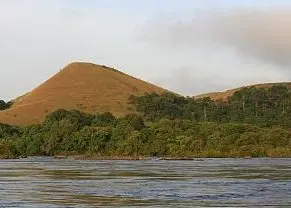
narrow coastal plain; hilly interior; savanna in east and south
Highest point
Mont Bengoue 1,050 m
Natural resources
petroleum, natural gas, diamond, niobium, manganese, uranium, gold, timber, iron ore, hydropower
Natural hazards
none
National symbols
black panther
Driving
Speed limits & road rules in Gabon
The default speed limits in Gabon are 60 km/h in built-up areas and 110 km/h outside built-up areas. The legal alcohol limit for drivers is 0.8‰. Posted signs always take priority over these defaults.
- 6060 km/hBuilt-up areasTowns and cities
- 110110 km/hOutside built-up areasCountry roads
- International Driving PermitNot a party to the IDP conventionsCheck with the embassy whether your licence is accepted
- Driving sideDrive on the rightOvertake on the left
- Alcohol limit0.8‰ blood alcohol (0.08% BAC)
- Seat beltsRequired by law
- Child seatsNo national child-restraint law
- Motorcycle helmetsRequired for riders
- Road deaths (2021)12.5 per 100,000 peopleClose to the world median (12.4)
Speed limits: OpenStreetMap wiki — Default speed limits (CC BY-SA 2.0). Road-safety laws: WHO Global Health Observatory. Compare speed limits and alcohol limits by country. Defaults for cars; local signs, weather and vehicle type can lower them.
Safety
Is Gabon safe to visit?
Gabon is generally safe for travellers, but some caution is needed: the US State Department rates Gabon Level 2 (“Exercise Increased Caution”), and the UK Foreign Office has no warnings against travel there.
 US State Department
 UK Foreign Office (FCDO)
Latest update: New information about dual nationals returning to the UK (‘Entry requirements’ page).
Updated 10 Dec 2025 · Full travel advice
Sources: US Department of State travel advisories (public domain) and UK FCDO foreign travel advice (contains public sector information licensed under the Open Government Licence v3.0). Checked daily. Advice can change quickly — always read the official page before you travel.
Weather
Best time to visit Gabon
The best time to visit Gabon is June to August, when daytime highs in Libreville are around 26–27°C. September is also a good time to go. March is the warmest month (28°C by day), July the coldest (23°C at night), and November the wettest with about 391 mm of rain.
- Jan28°C26°C
- Feb28°C26°C
- Mar28°C26°C
- Apr28°C26°C
- May28°C26°C
- Jun27°C24°C
- Jul26°C23°C
- Aug26°C23°C
- Sep27°C24°C
- Oct27°C25°C
- Nov27°C25°C
- Dec28°C26°C
Best time Good Less ideal
Before you go
Plugs, voltage & emergency numbers in Gabon
Plugs & sockets
220 V, 50 Hz · Standard 220–240 V: devices from the US or Japan (110–120 V) need a converter unless they are dual voltage (100–240 V).
Emergency numbers
Save the local numbers before you travel — 112 or 911 may not connect here. All countries →
Sources: Wikipedia — Mains electricity by country and List of emergency telephone numbers (CC BY-SA 4.0).
National parks
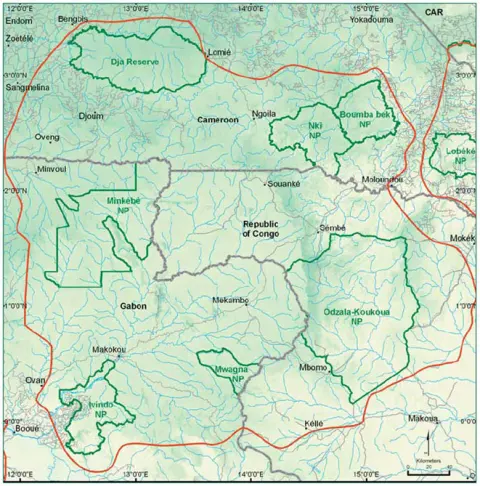
13 national parks in Gabon
- 28,833 km² protected
- oldest from 1994
Largest: Minkébé National Park · Lopé National Park · Moukalaba-Doudou National Park
Currency · 26 October 2026
Central African CFA franc exchange rates today
Gabon uses the Central African CFA franc (XAF, Fr). One US dollar buys 584.5354 XAF; over the last 30 days the XAF has lost 1.5% against the dollar.
What other currencies cost in XAF
Currency converter
Daily reference rates from the open-source currency-api (CC0), 26 Oct 2026. Banks and exchange offices add a margin.
World rankings
Where Gabon ranks
How Gabon compares with the rest of the world — open any card for the full ranking.
Airports
Airports in Gabon
43 airports and airfields — 2 large, 9 medium and 32 small, plus 0 heliports. 6 have scheduled passenger flights.
Borders
Neighbouring countries
Gabon borders 3 countries along 3,261 km of land borders. Coastline: 885 km.


Military
Gabonese armed forces
Gabon ranks #131 of 145 in the Global Firepower military strength ranking, with a defence budget of $356 million (2025).
People
Population & society
Religion
Largest cities: Libreville (870,000)
Economy
Economy
Main industries
petroleum extraction and refining; manganese, gold; chemicals, ship repair, food and beverages, textiles, lumbering and plywood, cement
Export partners
China 26%, Indonesia 8%, Spain 7%, Israel 6%, Congo, Republic of the 5% (2023)
Top exports
crude petroleum, ships, manganese ore, refined petroleum, wood (2023)
Travel tools
Handy before every trip to Gabon
Next public holiday
All Saints' Day — Sunday, 1 November 2026. Then Christmas Day (25 Dec).

Gabonese passport
Ranked #152: 27 countries visa-free, 28 with visa on arrival, 3 with an eTA and 42 with an eVisa.
Gabonese passport photo
Exact size, head position and background for Gabon's passport and visa photos — make one free with AI checks.
Calling Gabon
Dial +241 before the local number. Internet domain .ga.
Climate footprint
5.4 million tonnes of CO₂ in 2024 — 2.13 t per person.
Entry requirements
Visa rules for every passport visiting Gabon: visa-free stays, eVisas, visas on arrival and documents to bring.
News
Latest travel news about Gabon
Travellers in Gabon can use Facebook, TikTok, YouTube again after 8-month block
Gabon's High Communication Authority has lifted the social media ban introduced on 17 February, restoring access to platforms including Facebook, Tik…
Cameroon Border Arrest: French Tourist Held in Equatorial Guinea on Spy Claims
Authorities in Equatorial Guinea have detained a Frenchman holding a tourist e-Visa, accusing him of espionage and links to an exiled opposition grou…
Equatorial Guinea's Malaria Push Aims to Draw Tourists, but No Start Date Set
Equatorial Guinea is extending its Bioko Island malaria programme to the mainland and Annobon, backed by a $116 million investment. Health officials …
Frequently asked questions about Gabon
What do I need to travel to Gabon?
How long must my passport be valid for Gabon?
Where is Gabon?
What is Gabon known for?
What is the capital of Gabon?
What language is spoken in Gabon?
What currency does Gabon use?
What is the calling code of Gabon?
Which countries border Gabon?
How strong is the Gabonese passport?
What is the speed limit in Gabon?
Is Gabon safe to visit?
When is the best time to visit Gabon?
What plug type does Gabon use?
How many airports does Gabon have?
Sources: CIA World Factbook (public domain); World Bank Open Data (CC BY 4.0); names, languages and currencies: mledoze/countries (ODbL); flag: flag-icons (MIT); coat of arms: Wikimedia Commons (file page); exchange rates: Daily reference rates from the open-source currency-api (CC0); airports: OurAirports.