
Middle Africa · UN member

South Sudan: Travel Guide & Requirements
Republic of South Sudan
South Sudan is a country in Middle Africa with its capital in Juba. It has a population of 12.2 million (#80 in the world) and covers 644,329 km². The official language is English. The currency is the South Sudanese pound (SSP, £).
Where is South Sudan? Map of South Sudan
East-Central Africa; south of Sudan, north of Uganda and Kenya, west of Ethiopia.
- Region
- Middle Africa
- Coordinates
- 7° N, 30° E
- Neighbours
- 6 — see list
- Coastline
- Landlocked
- South Sudan
- Neighbours
- Capital
- Largest cities
Map of South Sudan showing Juba (capital) and the largest cities: Winejok, Yei, Malakal, Wau, Kuacjok, Pajok, Yambio and Rumbek.
Travel requirements
What you need to travel to South Sudan
- Passport
The UK Foreign Office tells British nationals that to enter South Sudan their passport must have an expiry date at least 6 months after the day they arrive and at least 2 blank pages.
- Visa or eTA
Depends on your passport: of 198 passports, 1 needs no visa, 197 need an eVisa. Check yours or see South Sudan entry requirements for every passport.
- Return or onward ticket
No official requirement.
- Proof of funds
No official requirement.
- Travel insurance
No official requirement. The UK Foreign Office says health facilities are extremely limited throughout the country and many medical problems need evacuation to Nairobi or Kampala, and advises adequate travel health insurance and accessible fund…
- Vaccinations
WHO's country list says proof of vaccination against yellow fever is required for all travellers aged 9 months or over.
- Arrival card
The UK Foreign Office says you must register at a local police station if you are in South Sudan for 5 days or more.
- Customs allowance
No official requirement. The UK Foreign Office says you must declare anything that may be prohibited or subject to tax or duty, and to contact the South Sudanese Embassy for information.
- Travel advice
Avoid travel — US and UK advice.
Entry rules: TravelRequirements.info — Entry Requirements Dataset (CC BY 4.0), each rule cited to an official government source. Always confirm with the airline and the official source before you travel.
Before you go
9 things to know before you travel to South Sudan
- Safety: Governments advise against travel to South Sudan: the US State Department rates South Sudan Level 4 (“Do Not Travel”), and the UK Foreign Office advises against all travel to the whole country.
- Best time to go: June to December — when daytime highs in Juba are around 31–36°C.
- Money: the South Sudanese pound (SSP) — 1 US dollar is about 5,745.2 SSP.
- Emergency numbers: Police 999, Ambulance 999, Fire 999.
- Language: English is official.
- Driving: on the right — speed limits are 45 km/h in built-up areas.
- Time zone: UTC+2 in Juba.
- Capital: Juba. About 12.2 million people live in South Sudan.
- Outdoors: 6 national parks.
Key facts
South Sudan at a glance
Languages spoken: English (official), Arabic (includes Juba and Sudanese variants), ethnic languages include Dinka, Nuer, Bari, Zande, Shilluk
Geography & history
About South Sudan
South Sudan, which gained independence from Sudan in 2011, is the world’s newest country. Home to a diverse array of mainly Nilotic ethnolinguistic groups that settled in the territory in the 15th through 19th centuries, South Sudanese society is heavily dependent on seasonal migration and seasonal fluctuations in precipitation. Modern-day South Sudan was conquered first by Egypt and later ruled jointly by Egyptian-British colonial administrators in the late 19th century. Christian missionaries helped spread the English language and Christianity in the area, leading to significant cultural differences with the northern part of Sudan, where Arabic and Islam are dominant. When Sudan gained it…
Read the full history
South Sudan, which gained independence from Sudan in 2011, is the world’s newest country. Home to a diverse array of mainly Nilotic ethnolinguistic groups that settled in the territory in the 15th through 19th centuries, South Sudanese society is heavily dependent on seasonal migration and seasonal fluctuations in precipitation. Modern-day South Sudan was conquered first by Egypt and later ruled jointly by Egyptian-British colonial administrators in the late 19th century. Christian missionaries helped spread the English language and Christianity in the area, leading to significant cultural differences with the northern part of Sudan, where Arabic and Islam are dominant. When Sudan gained its independence in 1956, the southern region received assurances that it would participate fully in the political system. However, the Arab government in Khartoum reneged on its promises, prompting two periods of civil war (1955-1972 and 1983-2005) in which as many as 2.5 million people died -- mostly civilians -- due largely to starvation and drought. The second Sudanese civil war was one of the deadliest since WWII and left southern Sudanese society devastated. Peace talks resulted in a US-backed Comprehensive Peace Agreement in 2005, which granted the South six years of autonomy followed by a referendum on final status. The result of this referendum, held in 2011, was a vote of 98% in favor of secession. Since independence, South Sudan has struggled to form a viable governing system and has been plagued by widespread corruption, political conflict, and communal violence. In 2013, conflict erupted between forces loyal to President Salva KIIR, a Dinka, and forces loyal to Vice President Riek MACHAR, a Nuer. The conflict quickly spread through the country along ethnic lines, killing tens of thousands and creating a humanitarian crisis with millions of South Sudanese displaced. KIIR and MACHAR signed a peace agreement in 2015 that created a Transitional Government of National Unity the next year. However, renewed fighting broke out in Juba between KIIR and MACHAR’s forces, plunging the country back into conflict and drawing in additional armed opposition groups. A "revitalized" peace agreement was signed in 2018, mostly ending the fighting and laying the groundwork for a unified national army, a transitional government, and elections. The transitional government was formed in 2020, when MACHAR returned to Juba as first vice president. Since 2020, implementation of the peace agreement has been stalled amid wrangling over power-sharing, which has contributed to an uptick in communal violence and the country’s worst food crisis since independence, with 7 of 11 million South Sudanese citizens in need of humanitarian assistance. The transitional period was extended an additional two years in 2022, pushing elections to late 2024.
Location
East-Central Africa; south of Sudan, north of Uganda and Kenya, west of Ethiopia
Climate
hot with seasonal rainfall influenced by the annual shift of the Inter-Tropical Convergence Zone; rainfall heaviest in upland areas of the south and diminishes to the north
Terrain
plains in the north and center rise to southern highlands along the border with Uganda and Kenya; the White Nile, flowing north out of the uplands of Central Africa, is the major geographic feature of the country; The Sudd (a name derived from floating vegeta…
Highest point
Kinyeti 3,187 m
Natural resources
hydropower, fertile agricultural land, gold, diamonds, petroleum, hardwoods, limestone, iron ore, copper, chromium ore, zinc, tungsten, mica, silver
National symbols
African fish eagle
Driving
Speed limits & road rules in South Sudan
The default speed limits in South Sudan are 45 km/h in built-up areas. Posted signs always take priority over these defaults.
- 4545 km/hBuilt-up areasTowns and cities
- International Driving PermitNot a party to the IDP conventionsCheck with the embassy whether your licence is accepted
- Driving sideDrive on the rightOvertake on the left
- Seat beltsNo national seat-belt law
- Child seatsNo national child-restraint law
- Road deaths (2021)23.3 per 100,000 peopleHigher than most countries (median 12.4)
Speed limits: OpenStreetMap wiki — Default speed limits (CC BY-SA 2.0). Road-safety laws: WHO Global Health Observatory. Compare speed limits and alcohol limits by country. Defaults for cars; local signs, weather and vehicle type can lower them.
Safety
Is South Sudan safe to visit?
Governments advise against travel to South Sudan: the US State Department rates South Sudan Level 4 (“Do Not Travel”), and the UK Foreign Office advises against all travel to the whole country.
 US State Department
 UK Foreign Office (FCDO)
Latest update: Updated information about Ebola ('Entry requirements' page).
Updated 25 Aug 2026 · Full travel advice
Sources: US Department of State travel advisories (public domain) and UK FCDO foreign travel advice (contains public sector information licensed under the Open Government Licence v3.0). Checked daily. Advice can change quickly — always read the official page before you travel.
Weather
Best time to visit South Sudan
The best time to visit South Sudan is June to December, when daytime highs in Juba are around 31–36°C. February is the warmest month (39°C by day), August the coldest (22°C at night), and August the wettest with about 144 mm of rain.
- Jan37°C23°C
- Feb39°C25°C
- Mar38°C26°C
- Apr36°C25°C
- May33°C23°C
- Jun32°C23°C
- Jul31°C22°C
- Aug31°C22°C
- Sep32°C22°C
- Oct33°C22°C
- Nov33°C22°C
- Dec36°C22°C
Best time Good Less ideal
Before you go
Plugs, voltage & emergency numbers in South Sudan
Emergency numbers
Save the local numbers before you travel — 112 or 911 may not connect here. All countries →
Sources: Wikipedia — Mains electricity by country and List of emergency telephone numbers (CC BY-SA 4.0).
National parks
6 national parks in South Sudan
- 57,390 km² protected
- oldest from 1939
Largest: Boma National Park · Southern National Park · Bandingilo National Park
Currency · 26 October 2026
South Sudanese pound exchange rates today
South Sudan uses the South Sudanese pound (SSP, £). One US dollar buys 5,745.2 SSP; over the last 30 days the SSP has lost 0.6% against the dollar.
What other currencies cost in SSP
Currency converter
Daily reference rates from the open-source currency-api (CC0), 26 Oct 2026. Banks and exchange offices add a margin.
World rankings
Where South Sudan ranks
How South Sudan compares with the rest of the world — open any card for the full ranking.
Airports
Airports in South Sudan
101 airports and airfields — 1 large, 3 medium and 93 small, plus 4 heliports. 3 have scheduled passenger flights.
Borders
Neighbouring countries
South Sudan borders 6 countries along 6,018 km of land borders. It is landlocked.


Military
South Sudanese armed forces
South Sudan ranks #116 of 145 in the Global Firepower military strength ranking, with a defence budget of $178 million (2025).
People
Population & society
Religion
Largest cities: Juba (459,000)
Economy
Economy
Export partners
China 51%, Singapore 29%, UAE 10%, Germany 4%, Uganda 3% (2023)
Top exports
crude petroleum, refined petroleum, forage crops, gold, scrap iron (2023)
Travel tools
Handy before every trip to South Sudan
Next public holiday
Christmas Eve — Thursday, 24 December 2026. Then Christmas Day (25 Dec).
South Sudanese passport
Ranked #176: 18 countries visa-free, 24 with visa on arrival, 2 with an eTA and 40 with an eVisa.
South Sudanese passport photo
Exact size, head position and background for South Sudan's passport and visa photos — make one free with AI checks.
Calling South Sudan
Dial +211 before the local number. Internet domain .ss.
Climate footprint
1.7 million tonnes of CO₂ in 2024 — 0.14 t per person.
Entry requirements
Visa rules for every passport visiting South Sudan: visa-free stays, eVisas, visas on arrival and documents to bring.
News
Latest travel news about South Sudan
US-bound air travellers face new Ebola attestation from 3 November
All airline passengers flying to the United States must file a digital or paper attestation from 3 November confirming they have not been in the Demo…
Entebbe Airport Ebola Probe Focuses on Travelers Who Left Uganda on Oct. 3
Africa CDC is investigating whether Nigeria's first Bundibugyo Ebola patient and Kenya's deceased index case crossed paths at Entebbe Airport on 3 Oc…
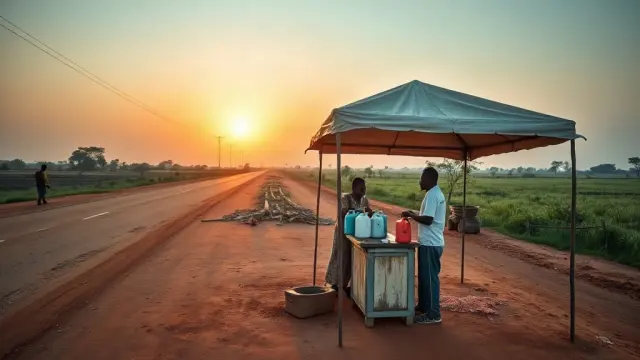
Travellers to or from South Sudan face Ebola screening at border points near Aba
Health authorities in the Democratic Republic of the Congo and South Sudan, supported by WHO, are jointly strengthening Ebola surveillance at border …
Frequently asked questions about South Sudan
What do I need to travel to South Sudan?
How long must my passport be valid for South Sudan?
Where is South Sudan?
What is South Sudan known for?
What is the capital of South Sudan?
What language is spoken in South Sudan?
What currency does South Sudan use?
What is the calling code of South Sudan?
Which countries border South Sudan?
How strong is the South Sudanese passport?
What is the speed limit in South Sudan?
Is South Sudan safe to visit?
When is the best time to visit South Sudan?
How many airports does South Sudan have?
Sources: CIA World Factbook (public domain); World Bank Open Data (CC BY 4.0); names, languages and currencies: mledoze/countries (ODbL); flag: flag-icons (MIT); coat of arms: Wikimedia Commons (file page); exchange rates: Daily reference rates from the open-source currency-api (CC0); airports: OurAirports.