

Eastern Africa · UN member

Uganda: Travel Guide & Requirements
Republic of Uganda
Uganda is a country in Eastern Africa with its capital in Kampala. It has a population of 51.4 million (#31 in the world) and covers 241,038 km². The official languages are English and Swahili. The currency is the Ugandan shilling (UGX, Sh).
Where is Uganda? Map of Uganda
East-Central Africa, west of Kenya, east of the Democratic Republic of the Congo.
- Region
- Eastern Africa
- Coordinates
- 1° N, 32° E
- Neighbours
- 5 — see list
- Coastline
- Landlocked
- Uganda
- Neighbours
- Capital
- Largest cities
Map of Uganda showing Kampala (capital) and the largest cities: Mbarara, Njeru, Gulu, Hoima, Mubende, Lira, Ibanda and Masaka.
Travel requirements
What you need to travel to Uganda
- Passport
Uganda's immigration service asks visa applicants for a passport with at least 6 months' validity, and the UK government says your passport must have an expiry date at least 6 months after the date you arrive.
- Visa or eTA
Depends on your passport: of 198 passports, 40 need no visa, 158 need an eVisa. Check yours or see Uganda entry requirements for every passport.
- Return or onward ticket
Uganda's immigration service lists a return ticket among the attachments for the East African Tourist Visa, and a travel itinerary or booking for a single-entry tourism visa.
- Proof of funds
No official source we could read sets a proof-of-funds requirement or amount for visitors; Uganda's tourist visa page lists the documents to upload, and money is not among them.
- Travel insurance
No official requirement. The UK government says medical facilities are limited, especially outside Kampala, that many popular tourist attractions have poor medical facilities, and that if you are seriously ill or have an accident you may need a…
- Vaccinations
No longer required for entry: Uganda's immigration service announced on 2 October 2026 that travellers do not need a yellow fever vaccination certificate for entry.
- Customs allowance
Uganda's Financial Intelligence Authority says anyone carrying domestic cash, foreign currency or negotiable bearer instruments equivalent to or exceeding UGX 30,000,000 into or out of Uganda must notify the Uganda Reve…
- Travel advice
Avoid travel — US and UK advice.
Entry rules: TravelRequirements.info — Entry Requirements Dataset (CC BY 4.0), each rule cited to an official government source. Always confirm with the airline and the official source before you travel.
Before you go
10 things to know before you travel to Uganda
- Safety: Governments advise against travel to Uganda: the US State Department rates Uganda Level 4 (“Do Not Travel”), and the UK Foreign Office has no warnings against travel there.
- Best time to go: June to August — when daytime highs in Kampala are around 25–27°C.
- Money: the Ugandan shilling (UGX) — 1 US dollar is about 4,427.7 UGX.
- Plugs: type G, 240 V, 50 Hz — standard 220–240 V: devices from the US or Japan (110–120 V) need a converter unless they are dual voltage (100–240 V).
- Emergency numbers: Police 112, Ambulance 911, Fire 112.
- Language: English and Swahili are official.
- Driving: on the left — speed limits are 50 km/h in built-up areas and 80 km/h outside built-up areas.
- Time zone: UTC+3 in Kampala.
- Capital: Kampala. About 51.4 million people live in Uganda.
- Outdoors: 11 national parks.
Key facts
Uganda at a glance
Languages spoken: English (official), Ganda or Luganda (most widely used of the Niger-Congo languages and the language used most often in the capital), other Niger-Congo languages, Nilo-Saharan languages, Swahili (official), Arabic
Geography & history
About Uganda
An ancient crossroads for various migrations, Uganda has as many as 65 ethnic groups that speak languages from three of Africa’s four major linguistic families. As early as 1200, fertile soils and regular rainfall in the south fostered the formation of several large, centralized kingdoms, including Buganda, from which the country derives its name. Muslim traders from Egypt reached northern Uganda in the 1820s, and Swahili merchants from the Indian Ocean coast arrived in the south by the 1840s. The area attracted the attention of British explorers seeking the source of the Nile River in the 1860s, and this influence expanded in subsequent decades with the arrival of Christian missionaries an…
Read the full history
An ancient crossroads for various migrations, Uganda has as many as 65 ethnic groups that speak languages from three of Africa’s four major linguistic families. As early as 1200, fertile soils and regular rainfall in the south fostered the formation of several large, centralized kingdoms, including Buganda, from which the country derives its name. Muslim traders from Egypt reached northern Uganda in the 1820s, and Swahili merchants from the Indian Ocean coast arrived in the south by the 1840s. The area attracted the attention of British explorers seeking the source of the Nile River in the 1860s, and this influence expanded in subsequent decades with the arrival of Christian missionaries and trade agreements; Uganda was declared a British protectorate in 1894. Buganda and other southern kingdoms negotiated agreements with Britain to secure privileges and a level of autonomy that were rare during the colonial period in Africa. Uganda's colonial boundaries grouped together a wide range of ethnic groups with different political systems and cultures, and the disparities between how Britain governed southern and northern areas compounded these differences, complicating efforts to establish a cohesive independent country. Uganda gained independence in 1962 with one of the more developed economies and one of the strongest education systems in Sub-Saharan Africa, but it descended within a few years into political turmoil and internal conflict that lasted more than two decades. In 1966, Prime Minister Milton OBOTE suspended the constitution and violently deposed President Edward MUTESA, who was also the king of Buganda. Idi AMIN seized power in 1971 through a military coup and led the country into economic ruin and rampant mass atrocities that killed as many as 500,000 civilians. AMIN’s annexation of Tanzanian territory in 1979 provoked Tanzania to invade Uganda, depose AMIN, and install a coalition government. In the aftermath, Uganda continued to experience atrocities, looting, and political instability and had four different heads of state between 1979 and 1980. OBOTE regained the presidency in 1980 through a controversial election that sparked renewed guerrilla warfare, killing as an estimated 300,000 civilians. Gen. Tito OKELLO seized power in a coup in 1985, but his rule was short-lived, with Yoweri MUSEVENI becoming president in 1986 after his insurgency captured the capital. MUSEVENI is widely credited with restoring relative stability and economic growth to Uganda but has resisted calls to leave office. In 2017, parliament removed presidential age limits, making it possible for MUSEVENI to remain in office for life.
Location
East-Central Africa, west of Kenya, east of the Democratic Republic of the Congo
Climate
tropical; generally rainy with two dry seasons (December to February, June to August); semiarid in northeast
Terrain
mostly plateau with rim of mountains
Highest point
Margherita Peak on Mount Stanley 5,110 m
Natural resources
copper, cobalt, hydropower, limestone, salt, arable land, gold
Natural hazards
droughts; floods; earthquakes; landslides; hailstorms
National symbols
grey crowned crane
Driving
Speed limits & road rules in Uganda
The default speed limits in Uganda are 50 km/h in built-up areas and 80 km/h outside built-up areas. The legal alcohol limit for drivers is 0.8‰. Posted signs always take priority over these defaults.
- 5050 km/hBuilt-up areasTowns and citiesWith a trailer: 60 km/h
- 8080 km/hOutside built-up areasCountry roadsWith a trailer: 60 km/h
- International Driving PermitRecognised: 1949 GenevaCarry the IDP together with your national licence
- Driving sideDrive on the leftOvertake on the right
- Alcohol limit0.8‰ blood alcohol (0.08% BAC)
- Seat beltsRequired by law
- Child seatsNo national child-restraint law
- Motorcycle helmetsRequired for riders
- Road deaths (2021)16.0 per 100,000 peopleHigher than most countries (median 12.4)
Speed limits: OpenStreetMap wiki — Default speed limits (CC BY-SA 2.0). Road-safety laws: WHO Global Health Observatory. Compare speed limits and alcohol limits by country. Defaults for cars; local signs, weather and vehicle type can lower them.
Safety
Is Uganda safe to visit?
Governments advise against travel to Uganda: the US State Department rates Uganda Level 4 (“Do Not Travel”), and the UK Foreign Office has no warnings against travel there.
 US State Department
 UK Foreign Office (FCDO)
Latest update: Removal of information about a yellow fever vaccination certificate requirement, as this is no longer mandatory for entry to Uganda ('Entry requirements' page).
Updated 8 Oct 2026 · Full travel advice
Sources: US Department of State travel advisories (public domain) and UK FCDO foreign travel advice (contains public sector information licensed under the Open Government Licence v3.0). Checked daily. Advice can change quickly — always read the official page before you travel.
Weather
Best time to visit Uganda
The best time to visit Uganda is June to August, when daytime highs in Kampala are around 25–27°C. September to February and May are also a good time to go. February is the warmest month (30°C by day), July the coldest (17°C at night), and April the wettest with about 194 mm of rain.
- Jan29°C18°C
- Feb30°C19°C
- Mar28°C19°C
- Apr26°C19°C
- May25°C18°C
- Jun25°C18°C
- Jul26°C17°C
- Aug27°C17°C
- Sep27°C18°C
- Oct26°C18°C
- Nov26°C18°C
- Dec28°C18°C
Best time Good Less ideal
Before you go
Plugs, voltage & emergency numbers in Uganda
Plugs & sockets
240 V, 50 Hz · Standard 220–240 V: devices from the US or Japan (110–120 V) need a converter unless they are dual voltage (100–240 V).
Emergency numbers
112 works from any mobile phone, even without a SIM card in most networks. All countries →
Sources: Wikipedia — Mains electricity by country and List of emergency telephone numbers (CC BY-SA 4.0).
National parks
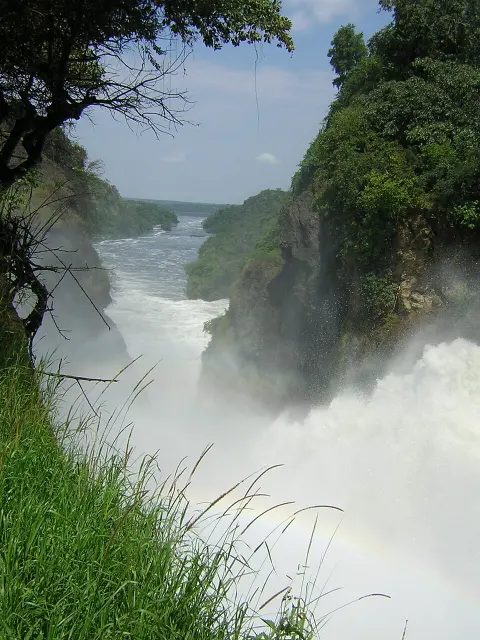
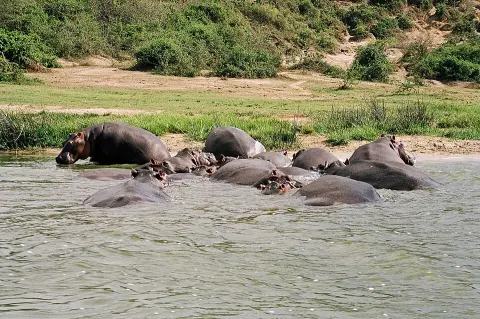
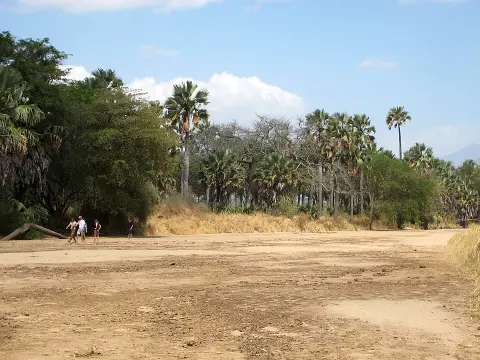
11 national parks in Uganda
- 10,143 km² protected
- oldest from 1932
Largest: Murchison Falls National Park · Queen Elizabeth National Park · Kidepo Valley National Park
Currency · 26 October 2026
Ugandan shilling exchange rates today
Uganda uses the Ugandan shilling (UGX, Sh). One US dollar buys 4,427.7 UGX; over the last 30 days the UGX has lost 11.6% against the dollar.
What other currencies cost in UGX
Currency converter
Daily reference rates from the open-source currency-api (CC0), 26 Oct 2026. Banks and exchange offices add a margin.
World rankings
Where Uganda ranks
How Uganda compares with the rest of the world — open any card for the full ranking.
Airports
Airports in Uganda
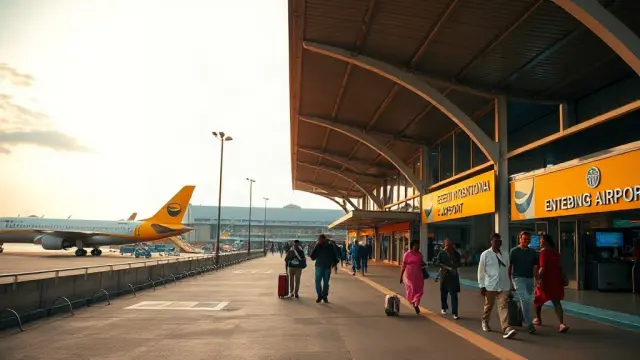
40 airports and airfields — 1 large, 4 medium and 35 small, plus 0 heliports. 6 have scheduled passenger flights.
Borders
Neighbouring countries
Uganda borders 5 countries along 2,729 km of land borders. It is landlocked.


Military
Ugandan armed forces
Uganda ranks #83 of 145 in the Global Firepower military strength ranking, with a defence budget of $1.3 billion (2025).
People
Population & society
Religion
Largest cities: Kampala (3.8 million)
Economy
Economy
Main industries
sugar processing, brewing, tobacco, cotton textiles; cement, steel production
Export partners
India 21%, UAE 16%, Hong Kong 10%, South Sudan 8%, Kenya 6% (2023)
Top exports
gold, coffee, fish, refined petroleum, tobacco (2023)
Travel tools
Handy before every trip to Uganda
Next public holiday
Christmas Day — Friday, 25 December 2026. Then Boxing Day (26 Dec).

Ugandan passport
Ranked #132: 36 countries visa-free, 28 with visa on arrival, 2 with an eTA and 33 with an eVisa.
Ugandan passport photo
Exact size, head position and background for Uganda's passport and visa photos — make one free with AI checks.
Calling Uganda
Dial +256 before the local number. Internet domain .ug.
Climate footprint
6.3 million tonnes of CO₂ in 2024 — 0.13 t per person.
Entry requirements
Visa rules for every passport visiting Uganda: visa-free stays, eVisas, visas on arrival and documents to bring.
News
Latest travel news about Uganda
Recent DR Congo trips now trigger 21-day quarantine for returning Ugandans
Uganda will quarantine its own citizens for 21 days if they are returning with recent travel to the Democratic Republic of Congo, Health Minister Chr…

Nigeria's first Ebola case in over a decade probed for Uganda airport link
Nigeria has confirmed its first Ebola case in more than a decade — a woman who had travelled from Uganda — and health officials are checking whether …

US-bound air travellers face new Ebola attestation from 3 November
All airline passengers flying to the United States must file a digital or paper attestation from 3 November confirming they have not been in the Demo…
Frequently asked questions about Uganda
What do I need to travel to Uganda?
How long must my passport be valid for Uganda?
Where is Uganda?
What is Uganda known for?
What is the capital of Uganda?
What language is spoken in Uganda?
What currency does Uganda use?
What is the calling code of Uganda?
Which countries border Uganda?
How strong is the Ugandan passport?
What is the speed limit in Uganda?
Is Uganda safe to visit?
When is the best time to visit Uganda?
What plug type does Uganda use?
How many airports does Uganda have?
Sources: CIA World Factbook (public domain); World Bank Open Data (CC BY 4.0); names, languages and currencies: mledoze/countries (ODbL); flag: flag-icons (MIT); coat of arms: Wikimedia Commons (file page); exchange rates: Daily reference rates from the open-source currency-api (CC0); airports: OurAirports.