
Northern Europe · UN member

Ireland: Travel Guide & Requirements
Republic of Ireland · Poblacht na hÉireann
Ireland is a country in Northern Europe with its capital in Dublin. It has a population of 5.5 million (#121 in the world) and covers 70,273 km². The official languages are English and Irish. The currency is the Euro (EUR, €).
Where is Ireland? Map of Ireland
Western Europe, occupying five-sixths of the island of Ireland in the North Atlantic Ocean, west of Great Britain.
- Region
- Northern Europe
- Coordinates
- 53° N, 8° W
- Neighbours
- 1 — see list
- Coastline
- 1,448 km
- Ireland
- Neighbours
- Capital
- Largest cities
Map of Ireland showing Dublin (capital) and the largest cities: Cork, Limerick, Galway, Waterford, Drogheda, Carlow, Tralee and Athlone.
Travel requirements
What you need to travel to Ireland
- Passport
The Immigration Service says short stay ‘C’ visa applicants must submit a current passport valid for at least 6 months after the date they plan to leave Ireland.
- Visa or eTA
Depends on your passport: of 198 passports, 75 need no visa, 123 need a visa from an embassy. Check yours or see Ireland entry requirements for every passport.
- Return or onward ticket
No official requirement. The Immigration Service lists your passport, a visa if necessary and your boarding card as the minimum documents to present to the Immigration Officer, and a travel itinerary among other useful documents.
- Proof of funds
No official requirement. The Immigration Service lists proof of sufficient funds among other useful documents to present to the Immigration Officer.
- Travel insurance
The Immigration Service says that if your short stay ‘C’ visa is approved, you must have evidence of medical or travel insurance when you arrive at the port of entry and present it to the Immigration Officer on request.
- Customs allowance
Revenue says that if you enter or leave the EU at an Irish airport or port carrying cash of €10,000 or more, you must make a declaration to Customs.
- Travel advice
Safe to visit — US and UK advice.
Entry rules: TravelRequirements.info — Entry Requirements Dataset (CC BY 4.0), each rule cited to an official government source. Always confirm with the airline and the official source before you travel.
Before you go
10 things to know before you travel to Ireland
- Safety: Yes — Ireland is generally safe to visit: the US State Department rates Ireland Level 1 (“Exercise Normal Precautions”), and the UK Foreign Office has no warnings against travel there.
- Best time to go: June to September — when daytime highs in Dublin are around 16–18°C.
- Money: the Euro (EUR) — 1 US dollar is about 0.8911 EUR.
- Plugs: type G, 230 V, 50 Hz — standard 220–240 V: devices from the US or Japan (110–120 V) need a converter unless they are dual voltage (100–240 V).
- Emergency numbers: Police 112 / 999, Ambulance 112 / 999, Fire 112 / 999.
- Language: English and Irish are official.
- Driving: on the left — speed limits are 50 km/h in built-up areas, 80 km/h outside built-up areas and 120 km/h on motorways.
- Time zone: UTC0 in Dublin.
- Capital: Dublin. About 5.5 million people live in Ireland.
- Outdoors: 8 national parks and 1 ski area.
Key facts
Ireland at a glance
Languages spoken: English (official, the language generally used), Irish (Gaelic or Gaeilge) (official, spoken by approximately 37.7% of the population)
Geography & history
About Ireland
Celtic tribes arrived in Ireland between 600 and 150 B.C. Norse invasions that began in the late 8th century finally ended when King Brian BORU defeated the Danes in 1014. Norman invasions began in the 12th century and set off more than seven centuries of Anglo-Irish struggle marked by fierce rebellions and harsh repressions. The Irish famine of the mid-19th century caused an almost 25-percent decline in the island's population through starvation, disease, and emigration. The population of the island continued to fall until the 1960s, but over the last 50 years, Ireland's high birthrate has made it demographically one of the youngest populations in the EU. The modern Irish state traces its …
Read the full history
Celtic tribes arrived in Ireland between 600 and 150 B.C. Norse invasions that began in the late 8th century finally ended when King Brian BORU defeated the Danes in 1014. Norman invasions began in the 12th century and set off more than seven centuries of Anglo-Irish struggle marked by fierce rebellions and harsh repressions. The Irish famine of the mid-19th century caused an almost 25-percent decline in the island's population through starvation, disease, and emigration. The population of the island continued to fall until the 1960s, but over the last 50 years, Ireland's high birthrate has made it demographically one of the youngest populations in the EU. The modern Irish state traces its origins to the failed 1916 Easter Monday Uprising that galvanized nationalist sentiment. The ensuing guerrilla war led to independence from the UK in 1921 with the signing of the Anglo-Irish Treaty and the creation of the Irish Free State. The treaty was deeply controversial in Ireland, in part because it helped solidify the country's partition, with six of the 32 counties remaining in the UK as Northern Ireland. The split between pro-Treaty and anti-Treaty partisans led to the Irish Civil War (1922-23). The traditionally dominant political parties in Ireland, Fine Gael and Fianna Fail, are de facto descendants of the opposing sides of the treaty debate. Ireland declared itself a republic in 1949 and formally left the British Dominion. Beginning in the 1960s, deep sectarian divides between the Catholic and Protestant populations and systemic discrimination in Northern Ireland erupted into years of violence known as the Troubles. In 1998, the governments of Ireland and the UK, along with most political parties in Northern Ireland, reached the Belfast/Good Friday Agreement with the support of the US. This agreement helped end the Troubles and initiated a new phase of cooperation between the Irish and British Governments. Ireland was neutral in World War II and continues its policy of military neutrality. Ireland joined the European Community in 1973 and the euro-zone currency union in 1999. The economic boom years of the Celtic Tiger (1995-2007) saw rapid economic growth that came to an abrupt end in 2008 with the meltdown of the Irish banking system. As a small, open economy, Ireland has excelled at courting foreign direct investment, especially from US multi-nationals, which has helped the economy recover from the financial crisis and insulated it somewhat from the economic shocks of the COVID-19 pandemic.
Location
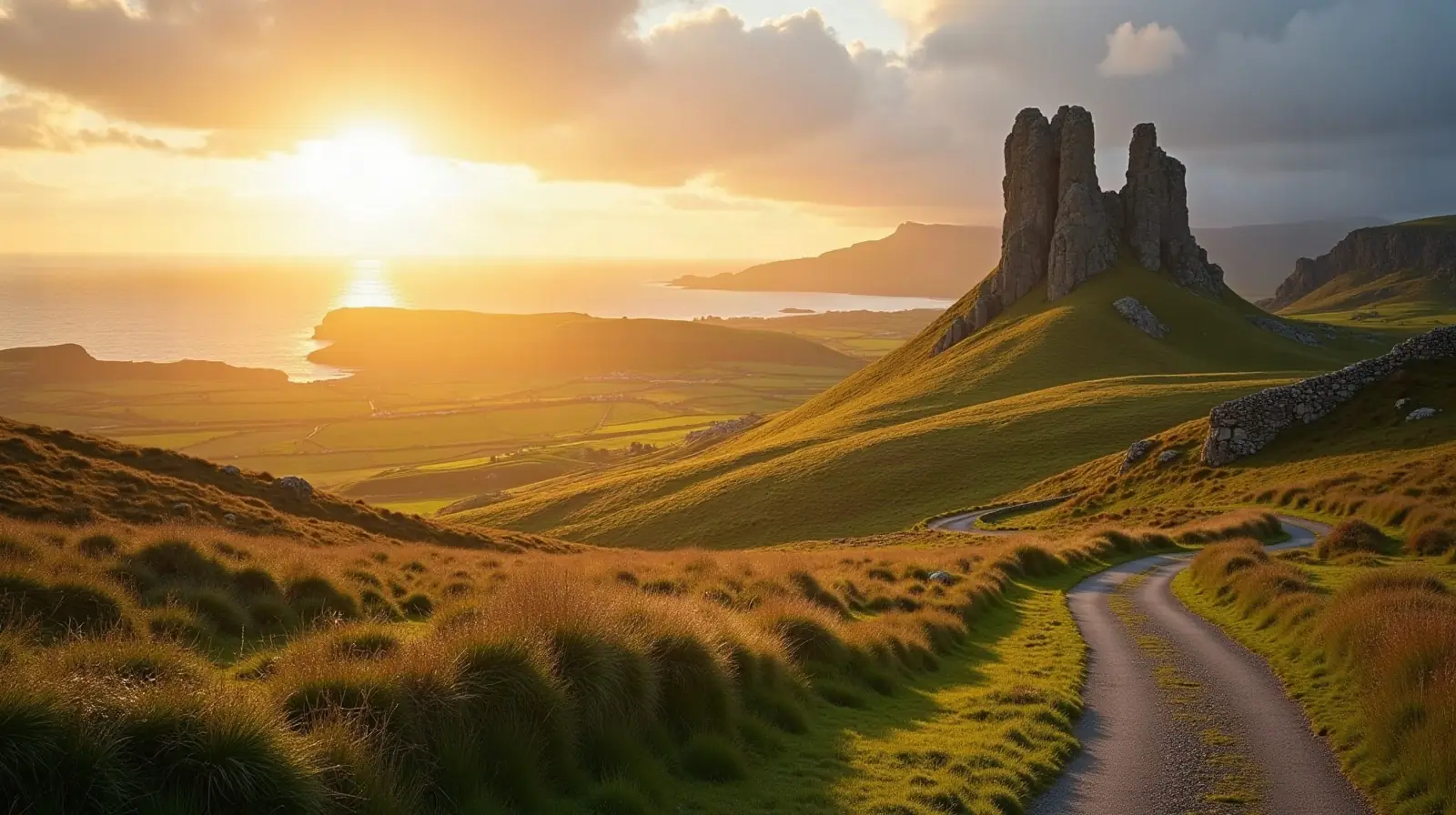
Western Europe, occupying five-sixths of the island of Ireland in the North Atlantic Ocean, west of Great Britain
Climate
temperate maritime; modified by North Atlantic Current; mild winters, cool summers; consistently humid; overcast about half the time
Terrain
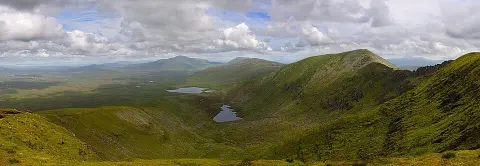
mostly flat to rolling interior plain surrounded by rugged hills and low mountains; sea cliffs on west coast
Highest point
Carrauntoohil 1,041 m
Natural resources
natural gas, peat, copper, lead, zinc, silver, barite, gypsum, limestone, dolomite
Natural hazards
rare extreme weather events
National symbols
harp, shamrock (trefoil)
Driving
Speed limits & road rules in Ireland
The default speed limits in Ireland are 50 km/h in built-up areas, 80 km/h outside built-up areas and 120 km/h on motorways. The legal alcohol limit for drivers is 0.5‰. Posted signs always take priority over these defaults.
- 5050 km/hBuilt-up areasTowns and citiesWith a trailer: 80 km/h
- 8080 km/hOutside built-up areasCountry roads
- 120120 km/hMotorwaysMotorways / freewaysWith a trailer: 80 km/h
- International Driving PermitRecognised: 1949 GenevaCarry the IDP together with your national licence
- Driving sideDrive on the leftOvertake on the right
- Alcohol limit0.5‰ blood alcohol (0.05% BAC)0.2‰ for young / novice drivers
- Seat beltsRequired by law
- Child seatsRequired by law
- Motorcycle helmetsRequired for riders
- Road deaths (2021)2.8 per 100,000 peopleSafer than most countries (median 12.4)
Speed limits: OpenStreetMap wiki — Default speed limits (CC BY-SA 2.0). Road-safety laws: WHO Global Health Observatory. Compare speed limits and alcohol limits by country. Defaults for cars; local signs, weather and vehicle type can lower them.
Safety
Is Ireland safe to visit?
Yes — Ireland is generally safe to visit: the US State Department rates Ireland Level 1 (“Exercise Normal Precautions”), and the UK Foreign Office has no warnings against travel there.
 US State Department
 UK Foreign Office (FCDO)
Latest update: Addition of information about ID requirements for travel between the UK and Ireland under the Common Travel Area (‘Entry requirements’ page).
Updated 4 Sep 2026 · Full travel advice
Sources: US Department of State travel advisories (public domain) and UK FCDO foreign travel advice (contains public sector information licensed under the Open Government Licence v3.0). Checked daily. Advice can change quickly — always read the official page before you travel.
Weather
Best time to visit Ireland
The best time to visit Ireland is June to September, when daytime highs in Dublin are around 16–18°C. July is the warmest month (18°C by day), February the coldest (4°C at night), and November the wettest with about 106 mm of rain.
- Jan8°C4°C
- Feb8°C4°C
- Mar9°C4°C
- Apr11°C6°C
- May14°C8°C
- Jun16°C11°C
- Jul18°C12°C
- Aug18°C12°C
- Sep16°C11°C
- Oct13°C9°C
- Nov10°C7°C
- Dec8°C5°C
Best time Good Less ideal
Before you go
Plugs, voltage & emergency numbers in Ireland
Plugs & sockets
230 V, 50 Hz · Standard 220–240 V: devices from the US or Japan (110–120 V) need a converter unless they are dual voltage (100–240 V).
Sources: Wikipedia — Mains electricity by country and List of emergency telephone numbers (CC BY-SA 4.0).
Ski resorts
1 ski resort in Ireland
- 4 lifts
- up to 208 m
Biggest: Ski Club Of Ireland
National parks
8 national parks in Ireland
- 640 km² protected
- oldest from 1932
Largest: Wicklow Mountains National Park · Glenveagh National Park · Wild Nephin National Park
Currency · 26 October 2026
Euro exchange rates today
Ireland uses the Euro (EUR, €). One US dollar buys 0.8911 EUR; over the last 30 days the EUR has lost 1.5% against the dollar.
What other currencies cost in EUR
Currency converter
Daily reference rates from the open-source currency-api (CC0), 26 Oct 2026. Banks and exchange offices add a margin.
World rankings
Where Ireland ranks
How Ireland compares with the rest of the world — open any card for the full ranking.
Airports
Airports in Ireland
116 airports and airfields — 4 large, 6 medium and 94 small, plus 11 heliports. 10 have scheduled passenger flights.
Borders
Neighbouring countries
Ireland borders 1 country along 490 km of land borders. Coastline: 1,448 km.
Military
Irish armed forces
Ireland ranks #90 of 145 in the Global Firepower military strength ranking, with a defence budget of $1.6 billion (2025).
People
Population & society
Religion
Largest cities: Dublin (1.3 million)
Economy
Economy
Main industries
pharmaceuticals, chemicals, computer hardware and software, food products, beverages and brewing; medical devices
Export partners
USA 28%, Germany 11%, UK 8%, Belgium 8%, China 7% (2023)
Top exports
vaccines, packaged medicine, nitrogen compounds, integrated circuits, hormones (2023)
Travel tools
Handy before every trip to Ireland
Next public holiday
Christmas Day — Friday, 25 December 2026. Then St. Stephen's Day (26 Dec).

Irish passport
Ranked #23: 120 countries visa-free, 37 with visa on arrival, 8 with an eTA and 19 with an eVisa.
Irish passport photo
Exact size, head position and background for Ireland's passport and visa photos — make one free with AI checks.
Calling Ireland
Dial +353 before the local number. Internet domain .ie.
Climate footprint
33.3 million tonnes of CO₂ in 2024 — 6.34 t per person.
Entry requirements
Visa rules for every passport visiting Ireland: visa-free stays, eVisas, visas on arrival and documents to bring.
News
Latest travel news about Ireland
UK and Ireland Visas and US Caution Advisory Tighten Around Saint Lucia
Saint Lucians now need visas for the United Kingdom and Ireland, while the United States has raised its Saint Lucia travel advisory to Level 2 and ad…
Bill C-3: Americans With Canadian Ancestors May Already Be Citizens
Canada's Bill C-3, in force since 15 December 2025, removed the first-generation limit on citizenship by descent. Americans with an unbroken line to …
Malaysia Student Visas for Myanmar Applicants Clear in as Little as Five Days
Malaysia is drawing Myanmar students as a study stepping stone, with student visas processed in as little as five days, while Germany and Ireland app…
Frequently asked questions about Ireland
What do I need to travel to Ireland?
How long must my passport be valid for Ireland?
Where is Ireland?
What is Ireland known for?
What is the capital of Ireland?
What language is spoken in Ireland?
What currency does Ireland use?
What is the calling code of Ireland?
Which countries border Ireland?
How strong is the Irish passport?
What is the speed limit in Ireland?
Is Ireland safe to visit?
When is the best time to visit Ireland?
What plug type does Ireland use?
How many airports does Ireland have?
Sources: CIA World Factbook (public domain); World Bank Open Data (CC BY 4.0); names, languages and currencies: mledoze/countries (ODbL); flag: flag-icons (MIT); coat of arms: Wikimedia Commons (file page); exchange rates: Daily reference rates from the open-source currency-api (CC0); airports: OurAirports.