
South-Eastern Asia · UN member

Vietnam: Travel Guide & Requirements
Socialist Republic of Vietnam · Cộng hòa xã hội chủ nghĩa Việt Nam
Vietnam is a country in South-Eastern Asia with its capital in Hanoi. It has a population of 101.6 million (#16 in the world) and covers 331,210 km². The official language is Vietnamese. The currency is the Vietnamese đồng (VND, ₫).
Where is Vietnam? Map of Vietnam
Southeastern Asia, bordering the Gulf of Thailand, Gulf of Tonkin, and South China Sea, as well as China, Laos, and Cambodia.
- Region
- South-Eastern Asia
- Coordinates
- 16.1667° N, 107.8333° E
- Neighbours
- 3 — see list
- Coastline
- 3,444 km
- Vietnam
- Neighbours
- Capital
- Largest cities
Map of Vietnam showing Hanoi (capital) and the largest cities: Ho Chi Minh City, Haiphong, Cần Thơ, Huế, Da Nang, Thanh Hóa, Vinh and Nha Trang.
Travel requirements
What you need to travel to Vietnam
- Passport
For an e-visa, the e-visa's validity must be at least 30 days shorter than your passport's.
- Visa or eTA
Depends on your passport: of 198 passports, 39 need no visa, 159 need an eVisa. Check yours or see Vietnam entry requirements for every passport.
- Return or onward ticket
No official requirement. The e-visa portal lists the conditions for an e-visa as holding a passport and not falling under the cases of suspension from entry in Article 21 of the entry law; an onward or return ticket is not among them.
- Proof of funds
No official requirement. The e-visa portal lists the conditions for an e-visa as holding a passport and not falling under the cases of suspension from entry in Article 21 of the entry law; proof of funds is not among them.
- Travel insurance
No official requirement. The e-visa portal lists the conditions for an e-visa as holding a passport and not falling under the cases of suspension from entry in Article 21 of the entry law; travel insurance is not among them.
- Vaccinations
WHO's country list records no yellow fever vaccination requirement at entry to Viet Nam.
- Arrival card
The Immigration Department highly recommends completing the pre-arrival form at prearrival.immigration.gov.vn before entering Vietnam, saying it saves time and makes entry swifter.
- Customs allowance
Vietnam Customs says travellers entering with foreign-currency cash over 5,000 USD (or the equivalent) or Vietnamese cash over 15,000,000 VND must declare it to customs at the border gate.
- Travel advice
Safe to visit — US and UK advice.
Entry rules: TravelRequirements.info — Entry Requirements Dataset (CC BY 4.0), each rule cited to an official government source. Always confirm with the airline and the official source before you travel.
Before you go
10 things to know before you travel to Vietnam
- Safety: Yes — Vietnam is generally safe to visit: the US State Department rates Vietnam Level 1 (“Exercise Normal Precautions”), and the UK Foreign Office has no warnings against travel there.
- Best time to go: February to March and November — when daytime highs in Hanoi are around 23–27°C.
- Money: the Vietnamese đồng (VND) — 1 US dollar is about 25,837.2 VND.
- Plugs: type A, B, C and F, 220 V, 50 Hz — standard 220–240 V: devices from the US or Japan (110–120 V) need a converter unless they are dual voltage (100–240 V).
- Emergency numbers: Police 113, Ambulance 115, Fire 114.
- Language: Vietnamese is official; English is also spoken.
- Driving: on the right — speed limits are 60 km/h in built-up areas, 80 km/h outside built-up areas, 90 km/h on expressways and 120 km/h on motorways.
- Time zone: UTC+7 in Hanoi.
- Capital: Hanoi; the largest city is Ho Chi Minh City. About 101.6 million people live in Vietnam.
- Outdoors: 34 national parks.
Key facts
Vietnam at a glance
Languages spoken: Vietnamese (official); English (often as a second language); some French, Chinese, and Khmer; mountain-area languages (including Mon-Khmer and Malayo-Polynesian)
Geography & history
About Vietnam
Vietnam's early history included periods of occupation by outside forces and eventual power consolidation under Vietnamese dynastic families. A succession of Han Chinese emperors ruled the area, which was centered on the Red River Valley, until approximately the 10th century. The Ly Dynasty (11th-13th century) created the first independent Vietnamese state, which was known as Dai Viet, and established their capital at Thang Long (Hanoi). Under the Tran Dynasty (13th-15th century), TRAN Hung Dao, one of Vietnam’s national heroes, led Dai Viet forces to fight off Mongol invaders in 1279. After a brief Chinese occupation in the early 1400s, Vietnamese resistance leader LE Thai To made himself …
Read the full history
Vietnam's early history included periods of occupation by outside forces and eventual power consolidation under Vietnamese dynastic families. A succession of Han Chinese emperors ruled the area, which was centered on the Red River Valley, until approximately the 10th century. The Ly Dynasty (11th-13th century) created the first independent Vietnamese state, which was known as Dai Viet, and established their capital at Thang Long (Hanoi). Under the Tran Dynasty (13th-15th century), TRAN Hung Dao, one of Vietnam’s national heroes, led Dai Viet forces to fight off Mongol invaders in 1279. After a brief Chinese occupation in the early 1400s, Vietnamese resistance leader LE Thai To made himself emperor and established the Le Dynasty, which lasted until the late 18th century despite decades of political turmoil, civil war, and division. During this period, Dai Viet expanded southward to the Central Highlands and Mekong Delta, reaching the approximate boundaries of modern-day Vietnam by the 1750s. Dai Viet suffered additional civil war and division in the latter half of the 18th century, but it was reunited and renamed Vietnam under Emperor NGUYEN Phuc Anh (aka Gia Long) in 1802. France began its conquest of Vietnam in 1858 and made Vietnam part of French Indochina in 1887. Vietnam declared independence after World War II, but the French continued to rule until communist forces under Ho Chi MINH defeated them in 1954. Under the Geneva Accords of 1954, Vietnam was divided into the communist North and anti-communist South. Fighting erupted between the two governments shortly afterwards with the North supporting communist rebels in the South and eventually committing thousands of combat troops. The US provided to the South significant economic and military assistance, including large numbers of US military forces, which reached a peak strength of over 500,000 troops in 1968. US combat forces were withdrawn following a cease-fire agreement in 1973. Two years later, North Vietnamese forces overran the South, reuniting the country under communist rule. The conflict, known as the Second Indochina War (1955-1975), devastated Vietnam, spilled over into the neighboring countries of Cambodia and Laos, and is estimated to have resulted in the deaths of up to 3 million Vietnamese civilians and soldiers. It also caused more than 58,000 US combat and non-combat deaths and created deep domestic divisions in the US. Despite the return of peace, the country experienced little economic growth for over a decade because of its diplomatic isolation, leadership policies, and the persecution and mass exodus of citizens, many of them successful South Vietnamese merchants. However, since the enactment of Vietnam's "doi moi" (renovation) policy in 1986, the economy has seen strong growth, particularly in agricultural and industrial production, construction, exports, foreign investment, and tourism. Nevertheless, the Communist Party maintains tight political and social control of the country, and Vietnam faces many related challenges, such as rising income inequality and corruption.
Location
Southeastern Asia, bordering the Gulf of Thailand, Gulf of Tonkin, and South China Sea, as well as China, Laos, and Cambodia
Climate
tropical in south; monsoonal in north with hot, rainy season (May to September) and warm, dry season (October to March)
Terrain
low, flat delta in south and north; central highlands; hilly, mountainous in far north and northwest
Highest point
Fan Si Pan 3,144 m
Natural resources
antimony, phosphates, coal, manganese, rare earth elements, bauxite, chromate, offshore oil and gas deposits, timber, hydropower, arable land
Natural hazards
occasional typhoons (May to January) with extensive flooding, especially in the Mekong River delta
National symbols
five-pointed yellow star on a red field, lotus blossom
Driving
Speed limits & road rules in Vietnam
The default speed limits in Vietnam are 60 km/h in built-up areas, 80 km/h outside built-up areas, 90 km/h on expressways and 120 km/h on motorways. Posted signs always take priority over these defaults.
- 6060 km/hBuilt-up areasTowns and citiesWHO data (2017)
- 8080 km/hOutside built-up areasCountry roadsWith a trailer: 50 km/h
- 9090 km/hExpresswaysDual carriageways & expresswaysWith a trailer: 60 km/h
- 120120 km/hMotorwaysMotorways / freeways
- International Driving PermitRecognised: 1968 ViennaCarry the IDP together with your national licence
- Driving sideDrive on the rightOvertake on the left
- Seat beltsRequired by law
- Child seatsNo national child-restraint law
- Motorcycle helmetsRequired for riders
- Road deaths (2021)17.7 per 100,000 peopleHigher than most countries (median 12.4)
Speed limits: OpenStreetMap wiki — Default speed limits (CC BY-SA 2.0) and WHO. Road-safety laws: WHO Global Health Observatory. Compare speed limits and alcohol limits by country. Defaults for cars; local signs, weather and vehicle type can lower them.
Safety
Is Vietnam safe to visit?
Yes — Vietnam is generally safe to visit: the US State Department rates Vietnam Level 1 (“Exercise Normal Precautions”), and the UK Foreign Office has no warnings against travel there.
 US State Department
 UK Foreign Office (FCDO)
Latest update: Addition of information about tropical storm season ('Warnings and insurance') page
Updated 21 Sep 2026 · Full travel advice
Sources: US Department of State travel advisories (public domain) and UK FCDO foreign travel advice (contains public sector information licensed under the Open Government Licence v3.0). Checked daily. Advice can change quickly — always read the official page before you travel.
Weather
Best time to visit Vietnam
The best time to visit Vietnam is February to March and November, when daytime highs in Hanoi are around 23–27°C. December to January and October are also a good time to go. June is the warmest month (32°C by day), January the coldest (11°C at night), and August the wettest with about 322 mm of rain.
- Jan20°C11°C
- Feb23°C13°C
- Mar27°C16°C
- Apr30°C20°C
- May32°C23°C
- Jun32°C25°C
- Jul32°C25°C
- Aug31°C25°C
- Sep30°C23°C
- Oct28°C20°C
- Nov25°C16°C
- Dec21°C11°C
Best time Good Less ideal
Before you go
Plugs, voltage & emergency numbers in Vietnam
Plugs & sockets
- Type Atwo flat parallel pins
- Type Btwo flat parallel pins and a round earth pin
- Type C (Europlug)two round pins
- Type F (Schuko)two round pins with earth clips on the sides
220 V, 50 Hz · Standard 220–240 V: devices from the US or Japan (110–120 V) need a converter unless they are dual voltage (100–240 V).
Emergency numbers
Save the local numbers before you travel — 112 or 911 may not connect here. All countries →
Sources: Wikipedia — Mains electricity by country and List of emergency telephone numbers (CC BY-SA 4.0).
National parks
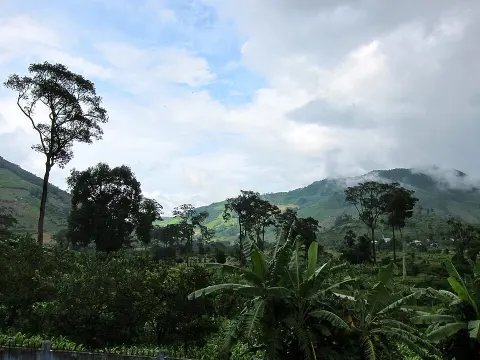
34 national parks in Vietnam
- 115,079 km² protected
- oldest from 1960
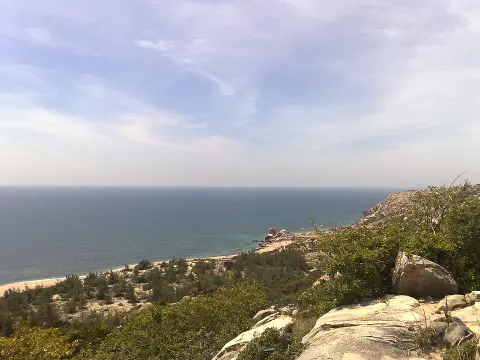
Largest: Nui Chua National Park · Bu Gia Map National Park · Phuoc Binh National Park
Currency · 26 October 2026
Vietnamese đồng exchange rates today
Vietnam uses the Vietnamese đồng (VND, ₫). One US dollar buys 25,837.2 VND; over the last 30 days the VND has gained 0.5% against the dollar.
What other currencies cost in VND
Currency converter
Daily reference rates from the open-source currency-api (CC0), 26 Oct 2026. Banks and exchange offices add a margin.
World rankings
Where Vietnam ranks
How Vietnam compares with the rest of the world — open any card for the full ranking.
Airports
Airports in Vietnam
71 airports and airfields — 9 large, 13 medium and 14 small, plus 34 heliports. 22 have scheduled passenger flights.
Borders
Neighbouring countries
Vietnam borders 3 countries along 4,616 km of land borders. Coastline: 3,444 km.


Military
Vietnamese armed forces
Vietnam ranks #19 of 145 in the Global Firepower military strength ranking, with a defence budget of $10.5 billion (2025).
People
Population & society
Religion
Largest cities: Ho Chi Minh City (9.3 million), Hanoi (5.3 million), Can Tho (1.9 million), Hai Phong (1.4 million), Da Nang (1.2 million)
Economy
Economy
Main industries
food processing, garments, shoes, machine-building; mining, coal, steel; cement, chemical fertilizer, glass, tires, oil, mobile phones
Export partners
USA 28%, China 20%, Japan 6%, Hong Kong 4%, Germany 3% (2023)
Top exports
broadcasting equipment, garments, integrated circuits, machine parts, footwear (2023)
Travel tools
Handy before every trip to Vietnam
Next public holiday
New Year's Day — Friday, 1 January 2027. Then Reunification Day (30 Apr).

Vietnamese passport
Ranked #160: 24 countries visa-free, 25 with visa on arrival, 5 with an eTA and 46 with an eVisa.
Vietnamese passport photo
Exact size, head position and background for Vietnam's passport and visa photos — make one free with AI checks.
Calling Vietnam
Dial +84 before the local number. Internet domain .vn.
Climate footprint
370.9 million tonnes of CO₂ in 2024 — 3.67 t per person.
Entry requirements
Visa rules for every passport visiting Vietnam: visa-free stays, eVisas, visas on arrival and documents to bring.
News
Latest travel news about Vietnam
Poland and Vietnam weigh easier visas and new Warsaw–Hanoi flights
Poland and Vietnam upgraded ties to a strategic partnership and discussed easing visas, with Vietnam saying it would consider visa-free travel for Po…
Sri Lanka Detains 1,000 Foreign Scam Suspects and Charges Visa Breaches
Sri Lankan police have detained more than 1,000 foreign suspects in cyber-scam raids this year but secured no successful prosecution. Most detainees …
Travellers to North Korea unaffected; South Korea counts 31,665 visa over-stayers
Justice Ministry data shows 31,665 foreign students on D-2 or D-4 visas were in South Korea without permission as of August. Language trainees accoun…
Frequently asked questions about Vietnam
What do I need to travel to Vietnam?
How long must my passport be valid for Vietnam?
Where is Vietnam?
What is Vietnam known for?
What is the capital of Vietnam?
What language is spoken in Vietnam?
What currency does Vietnam use?
What is the calling code of Vietnam?
Which countries border Vietnam?
How strong is the Vietnamese passport?
What is the speed limit in Vietnam?
Is Vietnam safe to visit?
When is the best time to visit Vietnam?
What plug type does Vietnam use?
How many airports does Vietnam have?
Sources: CIA World Factbook (public domain); World Bank Open Data (CC BY 4.0); names, languages and currencies: mledoze/countries (ODbL); flag: flag-icons (MIT); coat of arms: Wikimedia Commons (file page); exchange rates: Daily reference rates from the open-source currency-api (CC0); airports: OurAirports.