
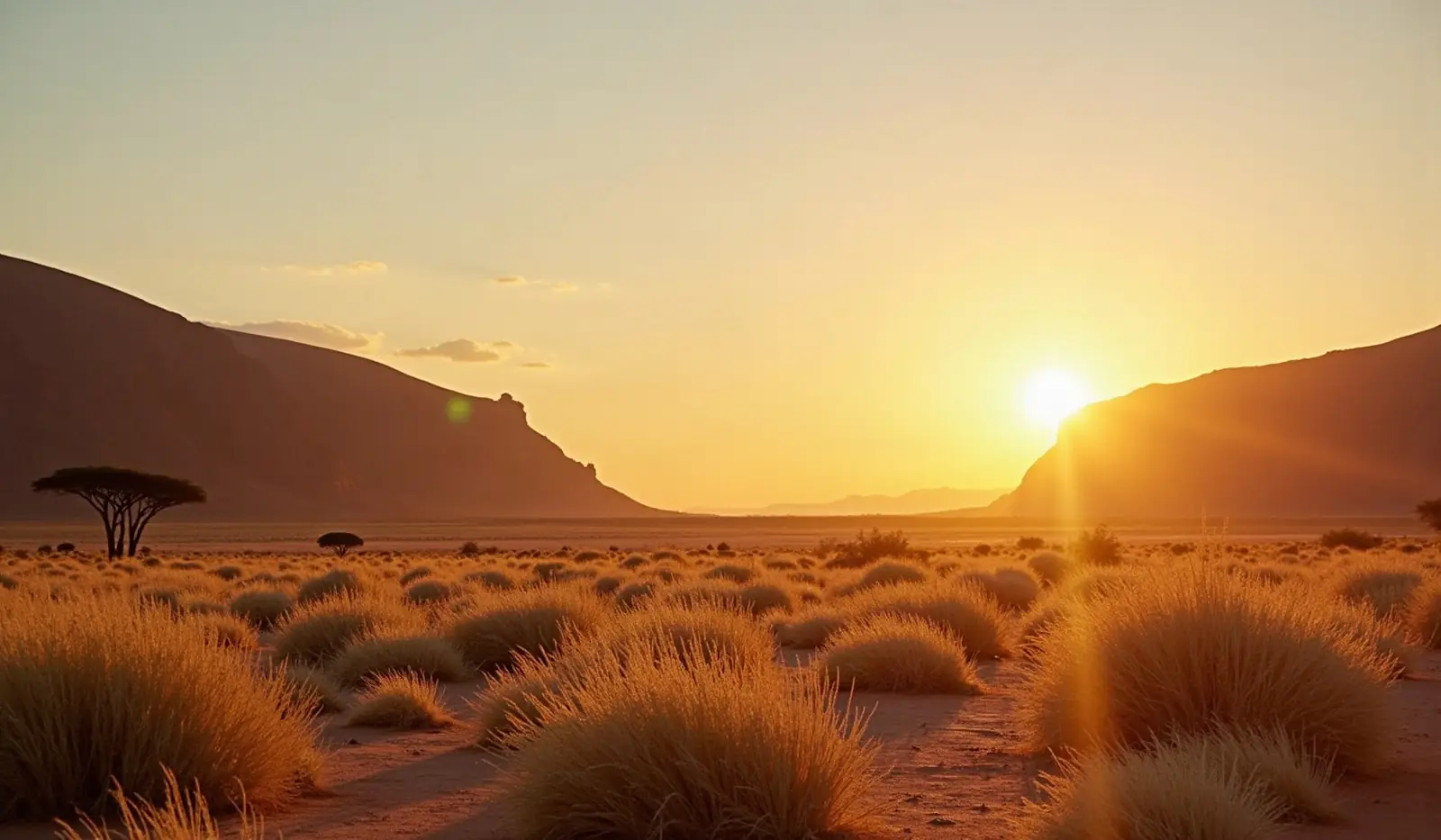
Southern Africa · UN member

Namibia: Travel Guide & Requirements
Republic of Namibia · Republiek van Namibië
Namibia is a country in Southern Africa with its capital in Windhoek. It has a population of 3.1 million (#136 in the world) and covers 824,292 km². The official languages are Afrikaans, German, English, Herero, Khoekhoe, Kwangali, Lozi, Ndonga and Tswana. The currency is the Namibian dollar (NAD, $).
Where is Namibia? Map of Namibia
Southern Africa, bordering the South Atlantic Ocean, between Angola and South Africa.
- Region
- Southern Africa
- Coordinates
- 22° S, 17° E
- Neighbours
- 4 — see list
- Coastline
- 1,572 km
- Namibia
- Neighbours
- Capital
- Largest cities
Map of Namibia showing Windhoek (capital) and the largest cities: Rundu, Walvis Bay, Oshakati, Rehoboth, Katima Mulilo, Otjiwarongo, Okahandja and Grootfontein.
Travel requirements
What you need to travel to Namibia
- Passport
The UK government says your passport must have an expiry date at least 6 months after the date you arrive in Namibia, and at least 3 blank pages.
- Visa or eTA
Depends on your passport: of 198 passports, 22 need no visa, 60 need an eVisa, 116 get a visa on arrival. Check yours or see Namibia entry requirements for every passport.
- Return or onward ticket
No official requirement. Canada's travel advice says customs officials may ask you to show a return or onward ticket.
- Proof of funds
Namibia's Ministry of Home Affairs fact sheet says a 90-day multiple-entry holiday visa may be granted if you meet the entry requirements, such as proving you have adequate funds for your stay; no amount is published.
- Travel insurance
No official requirement. Canada's travel advice says customs officials may ask you to show proof of health insurance coverage.
- Vaccinations
WHO's country list says proof of yellow fever vaccination is required for travellers aged 9 months or over arriving from countries with risk of yellow fever transmission, and for travellers who transited for more than 1…
- Customs allowance
Namibia's Financial Intelligence Centre says every person entering or departing Namibia carrying cash, bearer negotiable instruments, or both, equal to or exceeding N$100,000 (or the equivalent in foreign currency) must…
- Travel advice
Some caution needed — US and UK advice.
Entry rules: TravelRequirements.info — Entry Requirements Dataset (CC BY 4.0), each rule cited to an official government source. Always confirm with the airline and the official source before you travel.
Before you go
10 things to know before you travel to Namibia
- Safety: Namibia is generally safe for travellers, but some caution is needed: the US State Department rates Namibia Level 2 (“Exercise Increased Caution”), and the UK Foreign Office has no warnings against travel there.
- Best time to go: May and August — when daytime highs in Windhoek are around 23–24°C.
- Money: the Namibian dollar (NAD) — 1 US dollar is about 16.6040 NAD.
- Plugs: type D and M, 220 V, 50 Hz — standard 220–240 V: devices from the US or Japan (110–120 V) need a converter unless they are dual voltage (100–240 V).
- Emergency numbers: Police 10111.
- Language: Afrikaans, German, English, Herero, Khoekhoe, Kwangali, Lozi, Ndonga and Tswana are official.
- Driving: on the left — speed limits are 60 km/h in built-up areas, 100 km/h outside built-up areas and 120 km/h on motorways.
- Time zone: UTC+2 in Windhoek.
- Capital: Windhoek. About 3.1 million people live in Namibia.
- Outdoors: 9 national parks.
Key facts
Namibia at a glance
Languages spoken: Oshiwambo languages 49.7%, Nama/Damara 11%, Kavango languages 10.4%, Afrikaans 9.4%, Herero languages 9.2%, Zambezi languages 4.9%, English (official) 2.3%, other African languages 1.5%, other European languages 0.7%, other 1% (2016 est.)
Geography & history
About Namibia
Various ethnic groups occupied southwestern Africa prior to Germany establishing a colony over most of the territory in 1884. South Africa occupied the colony, then known as German South West Africa, in 1915 during World War I and administered it as a mandate until after World War II, when it annexed the territory. In 1966, the Marxist South-West Africa People's Organization (SWAPO) guerrilla group launched a war of independence for the area that became Namibia, but it was not until 1988 that South Africa agreed to end its administration in accordance with a UN peace plan for the entire region. Namibia gained independence in 1990, and SWAPO has governed it since, although the party has drop…
Read the full history
Various ethnic groups occupied southwestern Africa prior to Germany establishing a colony over most of the territory in 1884. South Africa occupied the colony, then known as German South West Africa, in 1915 during World War I and administered it as a mandate until after World War II, when it annexed the territory. In 1966, the Marxist South-West Africa People's Organization (SWAPO) guerrilla group launched a war of independence for the area that became Namibia, but it was not until 1988 that South Africa agreed to end its administration in accordance with a UN peace plan for the entire region. Namibia gained independence in 1990, and SWAPO has governed it since, although the party has dropped much of its Marxist ideology. President Hage GEINGOB was elected in 2014 in a landslide victory, replacing Hifikepunye POHAMBA, who stepped down after serving two terms. SWAPO retained its parliamentary super majority in the 2014 elections. In 2019 elections, GEINGOB was reelected but by a substantially reduced majority, and SWAPO narrowly lost its super majority in parliament.
Location
Southern Africa, bordering the South Atlantic Ocean, between Angola and South Africa
Climate
desert; hot, dry; rainfall sparse and erratic
Terrain
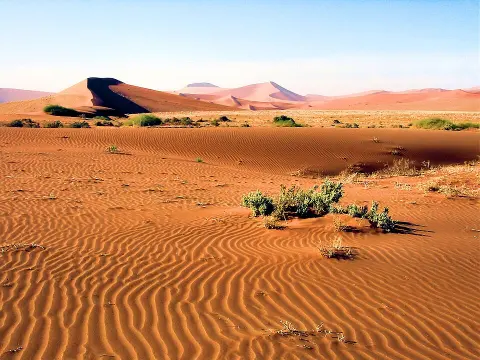
mostly high plateau; Namib Desert along coast; Kalahari Desert in east
Highest point
Konigstein on Brandberg 2,573 m
Natural resources
diamonds, copper, uranium, gold, silver, lead, tin, lithium, cadmium, tungsten, zinc, salt, hydropower, fish
Natural hazards
prolonged periods of drought
National symbols
oryx (antelope)
Driving
Speed limits & road rules in Namibia
The default speed limits in Namibia are 60 km/h in built-up areas, 100 km/h outside built-up areas and 120 km/h on motorways. The legal alcohol limit for drivers is 0.8‰. Posted signs always take priority over these defaults.
- 6060 km/hBuilt-up areasTowns and cities
- 100100 km/hOutside built-up areasCountry roads
- 120120 km/hMotorwaysMotorways / freeways
- International Driving PermitRecognised: 1949 GenevaCarry the IDP together with your national licence
- Driving sideDrive on the leftOvertake on the right
- Alcohol limit0.8‰ blood alcohol (0.079% BAC)
- Seat beltsRequired by law
- Child seatsNo national child-restraint law
- Motorcycle helmetsRequired for riders
- Road deaths (2021)22.0 per 100,000 peopleHigher than most countries (median 12.4)
Speed limits: OpenStreetMap wiki — Default speed limits (CC BY-SA 2.0). Road-safety laws: WHO Global Health Observatory. Compare speed limits and alcohol limits by country. Defaults for cars; local signs, weather and vehicle type can lower them.
Safety
Is Namibia safe to visit?
Namibia is generally safe for travellers, but some caution is needed: the US State Department rates Namibia Level 2 (“Exercise Increased Caution”), and the UK Foreign Office has no warnings against travel there.
 US State Department
 UK Foreign Office (FCDO)
Latest update: New information about dual nationals returning to the UK (‘Entry requirements’ page).
Updated 10 Dec 2025 · Full travel advice
Sources: US Department of State travel advisories (public domain) and UK FCDO foreign travel advice (contains public sector information licensed under the Open Government Licence v3.0). Checked daily. Advice can change quickly — always read the official page before you travel.
Weather
Best time to visit Namibia
The best time to visit Namibia is May and August, when daytime highs in Windhoek are around 23–24°C. April, June to July and September are also a good time to go. December is the warmest month (32°C by day), July the coldest (4°C at night), and February the wettest with about 91 mm of rain.
- Jan32°C17°C
- Feb30°C16°C
- Mar28°C15°C
- Apr26°C12°C
- May23°C8°C
- Jun21°C4°C
- Jul21°C4°C
- Aug24°C6°C
- Sep29°C10°C
- Oct31°C14°C
- Nov32°C15°C
- Dec32°C16°C
Best time Good Less ideal
Before you go
Plugs, voltage & emergency numbers in Namibia
Plugs & sockets
220 V, 50 Hz · Standard 220–240 V: devices from the US or Japan (110–120 V) need a converter unless they are dual voltage (100–240 V).
Emergency numbers
- Police10111
Save the local numbers before you travel — 112 or 911 may not connect here. All countries →
Sources: Wikipedia — Mains electricity by country and List of emergency telephone numbers (CC BY-SA 4.0).
National parks
9 national parks in Namibia
- 89,644 km² protected
- oldest from 1907
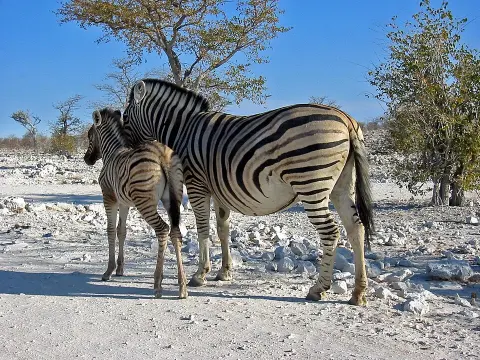
Largest: Namib-Naukluft National Park · Etosha National Park · Skeleton Coast National Park
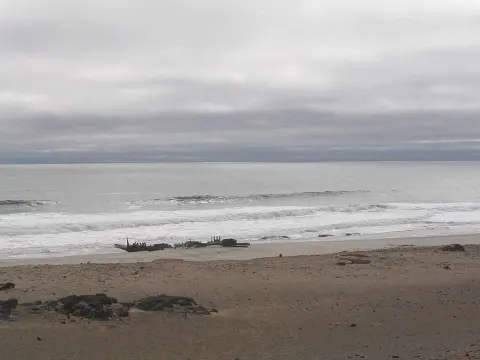
Currency · 26 October 2026
Namibian dollar exchange rates today
Namibia uses the Namibian dollar (NAD, $). One US dollar buys 16.6040 NAD; over the last 30 days the NAD has lost 1.8% against the dollar.
What other currencies cost in NAD
Currency converter
Daily reference rates from the open-source currency-api (CC0), 26 Oct 2026. Banks and exchange offices add a margin.
World rankings
Where Namibia ranks
How Namibia compares with the rest of the world — open any card for the full ranking.
Airports
Airports in Namibia
295 airports and airfields — 2 large, 12 medium and 280 small, plus 1 heliports. 11 have scheduled passenger flights.
Borders
Neighbouring countries
Namibia borders 4 countries along 4,220 km of land borders. Coastline: 1,572 km.


Military
Namibian armed forces
Namibia ranks #123 of 145 in the Global Firepower military strength ranking, with a defence budget of $411 million (2025).
People
Population & society
Religion
Largest cities: Windhoek (477,000)
Economy
Economy
Main industries
mining, tourism, fishing, agriculture
Export partners
South Africa 27%, China 12%, Botswana 8%, Belgium 7%, France 5% (2023)
Top exports
gold, diamonds, radioactive chemicals, fish, refined petroleum (2023)
Travel tools
Handy before every trip to Namibia
Next public holiday
Human Rights Day — Thursday, 10 December 2026. Then Christmas Day (25 Dec).
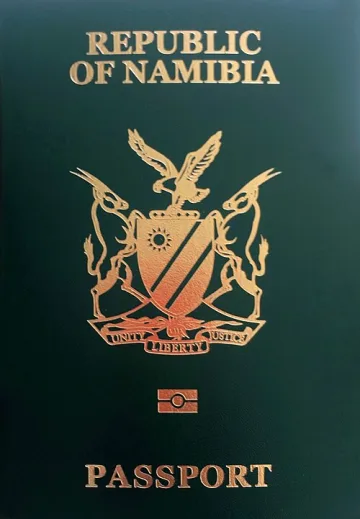
Namibian passport
Ranked #115: 43 countries visa-free, 26 with visa on arrival, 4 with an eTA and 34 with an eVisa.
Namibian passport photo
Exact size, head position and background for Namibia's passport and visa photos — make one free with AI checks.
Calling Namibia
Dial +264 before the local number. Internet domain .na.
Climate footprint
3.5 million tonnes of CO₂ in 2024 — 1.15 t per person.
Entry requirements
Visa rules for every passport visiting Namibia: visa-free stays, eVisas, visas on arrival and documents to bring.
News
Latest travel news about Namibia
Botswana Places Third in Africa for Remote Workers but Lacks a Nomad Visa
A new 2026 ranking puts Botswana third in Africa for remote workers on safety grounds, but the country has no digital nomad visa. Travellers working …
Angola agrees closer co-operation with UK after visa penalties threat
The UK Home Secretary threatened Eritrea with a visa ban unless it takes back its nationals without permission to stay. Angola, Namibia and the DR Co…
Journalists covering ILO Windhoek meeting need Namibia visa and work permit
Media covering the International Labour Organization's 15th African Regional Meeting in Windhoek from 2 to 4 December 2026 must get accreditation and…
Frequently asked questions about Namibia
What do I need to travel to Namibia?
How long must my passport be valid for Namibia?
Where is Namibia?
What is Namibia known for?
What is the capital of Namibia?
What language is spoken in Namibia?
What currency does Namibia use?
What is the calling code of Namibia?
Which countries border Namibia?
How strong is the Namibian passport?
What is the speed limit in Namibia?
Is Namibia safe to visit?
When is the best time to visit Namibia?
What plug type does Namibia use?
How many airports does Namibia have?
Sources: CIA World Factbook (public domain); World Bank Open Data (CC BY 4.0); names, languages and currencies: mledoze/countries (ODbL); flag: flag-icons (MIT); coat of arms: Wikimedia Commons (file page); exchange rates: Daily reference rates from the open-source currency-api (CC0); airports: OurAirports.