
Eastern Asia · UN member

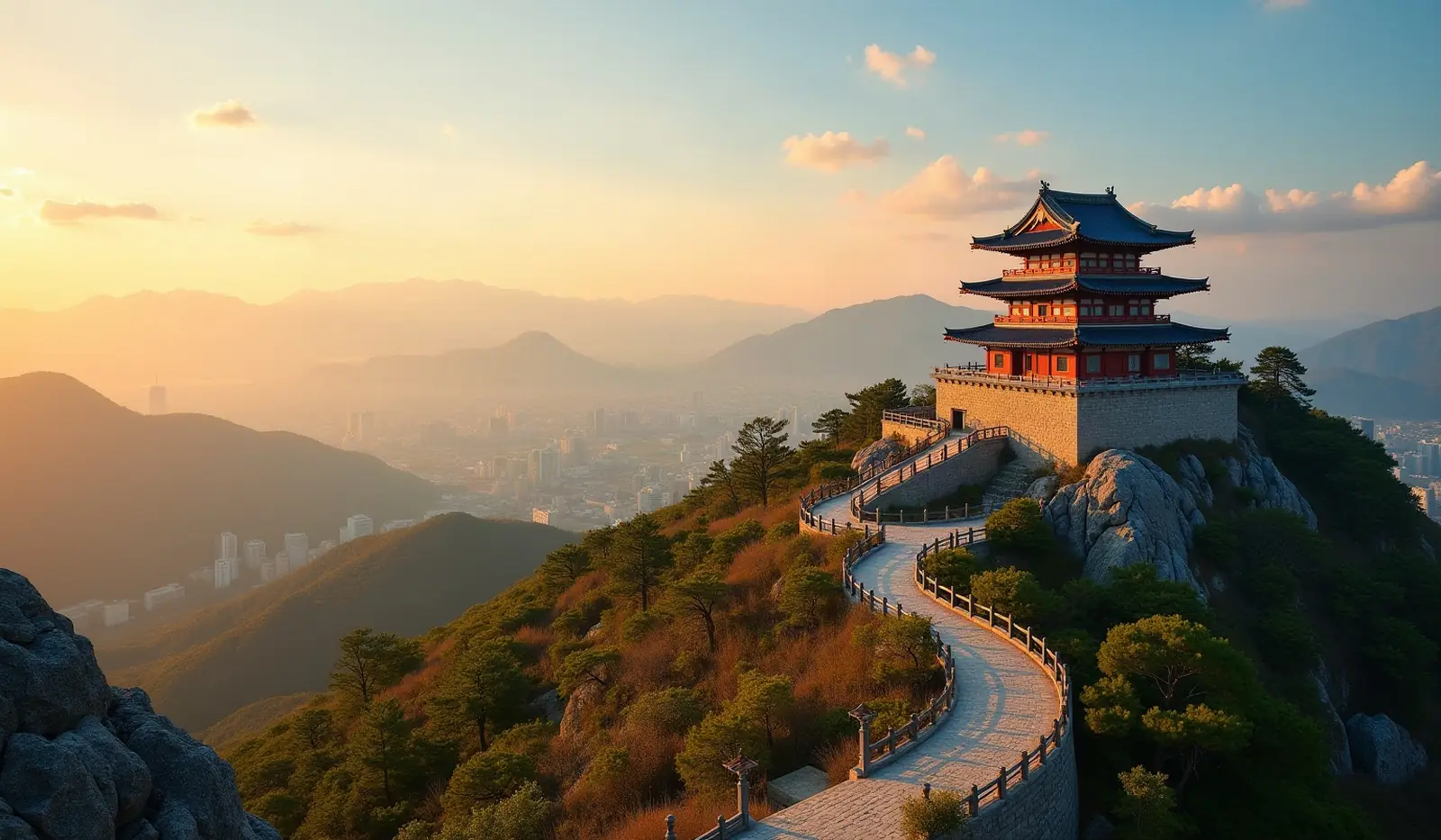
South Korea: Travel Guide & Requirements
Republic of Korea · 대한민국
South Korea is a country in Eastern Asia with its capital in Seoul. It has a population of 51.7 million (#29 in the world) and covers 99,720 km². The official language is Korean. The currency is the South Korean won (KRW, ₩).
Where is South Korea? Map of South Korea
Eastern Asia, southern half of the Korean Peninsula bordering the Sea of Japan and the Yellow Sea.
- Region
- Eastern Asia
- Coordinates
- 37° N, 127.5° E
- Neighbours
- 1 — see list
- Coastline
- 2,413 km
- South Korea
- Neighbours
- Capital
- Largest cities
Map of South Korea showing Seoul (capital) and the largest cities: Busan, Daegu, Daejeon, Gwangju, Ulsan, Cheonan, Jeonju and Pohang.
Travel requirements
What you need to travel to South Korea
- Passport
The UK government says that to enter South Korea as a tourist for up to 90 days your passport must have an expiry date after the date you are leaving South Korea, and that on a long-term visa it should have an expiry da…
- Visa or eTA
Depends on your passport: of 198 passports, 22 need no visa, 88 need an eTA, 1 needs an eVisa, 87 need a visa from an embassy. Check yours or see South Korea entry requirements for every passport.
- Return or onward ticket
The UK government tells British travellers that they can enter South Korea for up to 90 days for short-term business or tourism and must have an onward or return ticket.
- Proof of funds
No official requirement.
- Travel insurance
No official requirement. The UK government says medical and dental care is usually of a good standard but can be expensive, and advises adequate travel health insurance and accessible funds.
- Arrival card
Korea's e-Arrival Card site says the card is free, can be filed starting 3 days before arrival, and holds the same validity as the paper arrival card.
- Customs allowance
The Korea Customs Service says that if you enter with foreign currency, KRW notes or checks above USD 10,000 or the equivalent in total you must report it to customs, and that carrying means of payment of not more than …
- Travel advice
Safe to visit — US and UK advice.
Entry rules: TravelRequirements.info — Entry Requirements Dataset (CC BY 4.0), each rule cited to an official government source. Always confirm with the airline and the official source before you travel.
Before you go
10 things to know before you travel to South Korea
- Safety: Yes — South Korea is generally safe to visit: the US State Department rates South Korea Level 1 (“Exercise Normal Precautions”), and the UK Foreign Office has no warnings against travel there.
- Best time to go: June and September — when daytime highs in Seoul are around 24–25°C.
- Money: the South Korean won (KRW) — 1 US dollar is about 1,321.6 KRW.
- Plugs: type C and F, 220 V, 60 Hz — standard 220–240 V: devices from the US or Japan (110–120 V) need a converter unless they are dual voltage (100–240 V).
- Emergency numbers: Police 112, Ambulance 119, Fire 119.
- Language: Korean is official; English is also spoken.
- Driving: on the right — speed limits are 50 km/h in built-up areas, 60 km/h outside built-up areas, 100 km/h on expressways and 80 km/h on motorways.
- Time zone: UTC+9 in Seoul.
- Capital: Seoul. About 51.7 million people live in South Korea.
- Outdoors: 22 national parks and 18 ski areas.
Key facts
South Korea at a glance
Languages spoken: Korean, English
Geography & history
About South Korea
The first recorded kingdom (Choson) on the Korean Peninsula dates from approximately 2300 B.C. Over the subsequent centuries, three main kingdoms -- Kogoryo, Baekche, and Silla -- were established on the Peninsula. By the 5th century A.D., Kogoryo emerged as the most powerful, with control over much of the Peninsula and part of Manchuria (modern-day northeast China). However, Silla allied with the Chinese to create the first unified Korean state in 688. Following the collapse of Silla in the 9th century, Korea was unified under the Koryo (Goryeo; 918-1392) and the Chosen (Joseon; 1392-1910) dynasties. Korea became the object of intense imperialistic rivalry among the Chinese (its traditiona…
Read the full history
The first recorded kingdom (Choson) on the Korean Peninsula dates from approximately 2300 B.C. Over the subsequent centuries, three main kingdoms -- Kogoryo, Baekche, and Silla -- were established on the Peninsula. By the 5th century A.D., Kogoryo emerged as the most powerful, with control over much of the Peninsula and part of Manchuria (modern-day northeast China). However, Silla allied with the Chinese to create the first unified Korean state in 688. Following the collapse of Silla in the 9th century, Korea was unified under the Koryo (Goryeo; 918-1392) and the Chosen (Joseon; 1392-1910) dynasties. Korea became the object of intense imperialistic rivalry among the Chinese (its traditional benefactor), Japanese, and Russian empires in the latter half of the 19th and early 20th centuries. After the Sino-Japanese War (1894-95) and the Russo-Japanese War (1904-1905), Korea was occupied by Imperial Japan. In 1910, Japan formally annexed the entire Peninsula. Korea regained its independence after Japan's surrender to the US and its allies in 1945. A US-supported democratic government (Republic of Korea, ROK) was set up in the southern half of the Korean Peninsula, while a communist-style government backed by the Soviet Union was installed in the north (North Korea; aka Democratic People's Republic of Korea, DPRK). During the Korean War (1950-53), US troops and UN forces fought alongside ROK soldiers to defend South Korea from a North Korean invasion supported by communist China and the Soviet Union. After the 1953 armistice, the two Koreas were separated by a demilitarized zone. Syngman RHEE led the country as its first president from 1948 to 1960. PARK Chung-hee took over leadership of the country in a 1961 coup. During his controversial rule (1961-79), South Korea achieved rapid economic growth, with per capita income rising to roughly 17 times the level of North Korea by 1979. PARK was assassinated in 1979, and subsequent years were marked by political turmoil and continued military rule as the country's pro-democracy movement grew. South Korea held its first free presidential election under a revised democratic constitution in 1987, with former South Korean Army general ROH Tae-woo winning a close race. In 1993, KIM Young-sam became the first civilian president of South Korea's new democratic era. President KIM Dae-jung (1998-2003) won the Nobel Peace Prize in 2000 for his contributions to South Korean democracy and his "Sunshine Policy" of engagement with North Korea. President PARK Geun-hye, daughter of former South Korean President PARK Chung-hee, took office in 2013 as South Korea's first female leader. In 2016, the National Assembly passed an impeachment motion against PARK over her alleged involvement in a corruption and influence-peddling scandal, triggering an early presidential election in 2017 won by MOON Jae-in. In 2022, longtime prosecutor and political newcomer YOON Suk Yeol won the presidency by the slimmest margin in South Korean history. Discord and tensions with North Korea, punctuated by North Korean military provocations, missile launches, and nuclear tests, have permeated inter-Korean relations for years. Relations remained strained, despite a period of respite in 2018-2019 ushered in by North Korea's participation in the 2018 Winter Olympic and Paralympic Games in South Korea and high-level diplomatic meetings, including historic US-North Korea summits. In 2024, Pyongyang announced it was ending all economic cooperation with South Korea, a move that followed earlier proclamations that it was scrapping a 2018 military pact to de-escalate tensions along their militarized border, abandoning the country’s decades-long pursuit of peaceful unification with South Korea, and designating the South as North Korea’s “principal enemy.”
Location
Eastern Asia, southern half of the Korean Peninsula bordering the Sea of Japan and the Yellow Sea
Climate
temperate, with rainfall heavier in summer than winter; cold winters
Terrain
mostly hills and mountains; wide coastal plains in west and south
Highest point
Halla-san 1,950 m
Natural resources
coal, tungsten, graphite, molybdenum, lead, hydropower potential
Natural hazards
occasional typhoons bring high winds and floods; low-level seismic activity common in southwest volcanism: Halla (1,950 m) is considered historically active; it has not erupted in many centuries
National symbols
taegeuk (yin-yang symbol), Rose of Sharon (Hibiscus syriacus), Siberian tiger
Driving
Speed limits & road rules in South Korea
The default speed limits in South Korea are 50 km/h in built-up areas, 60 km/h outside built-up areas, 100 km/h on expressways and 80 km/h on motorways. The legal alcohol limit for drivers is 0.5‰. Posted signs always take priority over these defaults.
- 5050 km/hBuilt-up areasTowns and cities
- 6060 km/hOutside built-up areasCountry roads
- 100100 km/hExpresswaysDual carriageways & expressways
- 8080 km/hMotorwaysMotorways / freeways
- International Driving PermitRecognised: 1968 Vienna, 1949 GenevaCarry the IDP together with your national licence
- Driving sideDrive on the rightOvertake on the left
- Alcohol limit0.5‰ blood alcohol (0.05% BAC)
- Seat beltsRequired by law
- Child seatsNo national child-restraint law
- Motorcycle helmetsRequired for riders
- Road deaths (2021)6.9 per 100,000 peopleSafer than most countries (median 12.4)
Speed limits: OpenStreetMap wiki — Default speed limits (CC BY-SA 2.0). Road-safety laws: WHO Global Health Observatory. Compare speed limits and alcohol limits by country. Defaults for cars; local signs, weather and vehicle type can lower them.
Safety
Is South Korea safe to visit?
Yes — South Korea is generally safe to visit: the US State Department rates South Korea Level 1 (“Exercise Normal Precautions”), and the UK Foreign Office has no warnings against travel there.
 US State Department
 UK Foreign Office (FCDO)
Latest update: Updated information about submitting e-Arrivals cards when arriving in Korea (‘Entry requirements’ page).
Updated 14 May 2026 · Full travel advice
Sources: US Department of State travel advisories (public domain) and UK FCDO foreign travel advice (contains public sector information licensed under the Open Government Licence v3.0). Checked daily. Advice can change quickly — always read the official page before you travel.
Weather
Best time to visit South Korea
The best time to visit South Korea is June and September, when daytime highs in Seoul are around 24–25°C. May and October are also a good time to go. August is the warmest month (28°C by day), January the coldest (-7°C at night), and July the wettest with about 361 mm of rain.
- Jan1°C-7°C
- Feb3°C-5°C
- Mar9°C-1°C
- Apr15°C5°C
- May21°C11°C
- Jun25°C16°C
- Jul27°C21°C
- Aug28°C22°C
- Sep24°C16°C
- Oct18°C10°C
- Nov11°C3°C
- Dec3°C-5°C
Best time Good Less ideal
Before you go
Plugs, voltage & emergency numbers in South Korea
Plugs & sockets
220 V, 60 Hz · Standard 220–240 V: devices from the US or Japan (110–120 V) need a converter unless they are dual voltage (100–240 V).
Emergency numbers
112 works from any mobile phone, even without a SIM card in most networks. All countries →
Sources: Wikipedia — Mains electricity by country and List of emergency telephone numbers (CC BY-SA 4.0).
Ski resorts
18 ski resorts in South Korea
- 121 km of slopes
- 89 lifts
- up to 1,511 m
Biggest: 용평리조트 · 하이원스키장 · Muju
National parks
22 national parks in South Korea
- 7,949 km² protected
- oldest from 1967
Largest: Dadohaehaesang National Park · Gayasan National Park · Hallyeohaesang National Park
Currency · 26 October 2026
South Korean won exchange rates today
South Korea uses the South Korean won (KRW, ₩). One US dollar buys 1,321.6 KRW; over the last 30 days the KRW has gained 2.5% against the dollar.
What other currencies cost in KRW
Currency converter
Daily reference rates from the open-source currency-api (CC0), 26 Oct 2026. Banks and exchange offices add a margin.
World rankings
Where South Korea ranks
How South Korea compares with the rest of the world — open any card for the full ranking.
Airports
Airports in South Korea
1,384 airports and airfields — 8 large, 16 medium and 75 small, plus 1284 heliports. 18 have scheduled passenger flights.
Borders
Neighbouring countries
South Korea borders 1 country along 237 km of land borders. Coastline: 2,413 km.

Military
Korean armed forces
South Korea ranks #6 of 145 in the Global Firepower military strength ranking, with a defence budget of $47.8 billion (2025).
People
Population & society
Religion
Largest cities: Seoul (10.0 million), Busan (3.5 million), Incheon (2.8 million), Daegu (2.2 million), Daejon (1.6 million)
Economy
Economy
Main industries
electronics, telecommunications, automobile production, chemicals, shipbuilding, steel
Export partners
China 25%, USA 18%, Hong Kong 4%, Japan 4%, Taiwan 4% (2023)
Top exports
integrated circuits, cars, refined petroleum, plastics, machine parts (2023)
Travel tools
Handy before every trip to South Korea
Next public holiday
Christmas Day — Friday, 25 December 2026. Then New Year's Day (1 Jan).

Korean passport
Ranked #34: 116 countries visa-free, 41 with visa on arrival, 10 with an eTA and 17 with an eVisa.
Korean passport photo
Exact size, head position and background for South Korea's passport and visa photos — make one free with AI checks.
Calling South Korea
Dial +82 before the local number. Internet domain .kr.
Climate footprint
583.7 million tonnes of CO₂ in 2024 — 11.29 t per person.
Entry requirements
Visa rules for every passport visiting South Korea: visa-free stays, eVisas, visas on arrival and documents to bring.
News
Latest travel news about South Korea
South Koreans Face the Highest U.S. Visitor Visa Refusal Rate Among Allies
One in four South Korean applications for U.S. B1/B2 visitor visas was refused in 2025, a rate of 24.73% that is higher than those of Japan, Germany,…
Myanmar Keeps Visa on Arrival for Chinese, Indian, Japanese and Korean Tourists
Myanmar has extended its trial visa-on-arrival scheme for tourists flying in from China, India, Japan, South Korea and Macau by another year. The ext…
Travellers to Korea's border await clarity as Seoul proposes military talks
South Korea has proposed military talks with North Korea to confirm the Military Demarcation Line and restore communication lines as both sides reinf…
Frequently asked questions about South Korea
What do I need to travel to South Korea?
How long must my passport be valid for South Korea?
Where is South Korea?
What is South Korea known for?
What is the capital of South Korea?
What language is spoken in South Korea?
What currency does South Korea use?
What is the calling code of South Korea?
Which countries border South Korea?
How strong is the Korean passport?
What is the speed limit in South Korea?
Is South Korea safe to visit?
When is the best time to visit South Korea?
What plug type does South Korea use?
How many airports does South Korea have?
Sources: CIA World Factbook (public domain); World Bank Open Data (CC BY 4.0); names, languages and currencies: mledoze/countries (ODbL); flag: flag-icons (MIT); coat of arms: Wikimedia Commons (file page); exchange rates: Daily reference rates from the open-source currency-api (CC0); airports: OurAirports.