
South America · Territory

Falkland Islands (Islas Malvinas): Travel Guide & Requirements
Falkland Islands · Falkland Islands
The Falkland Islands (Islas Malvinas) is a territory in South America with its capital in Stanley. It covers 12,173 km². The official language is English. The currency is the Falkland Islands pound (FKP, £).
Where is the Falkland Islands (Islas Malvinas)? Map of the Falkland Islands (Islas Malvinas)
Southern South America, islands in the South Atlantic Ocean, about 500 km east of southern Argentina.
- Region
- South America
- Coordinates
- 51.75° S, 59° W
- Neighbours
- none (no land borders)
- Coastline
- 1,288 km
- Falkland Islands (Islas Malvinas)
- Capital
Travel requirements
What you need to travel to the Falkland Islands (Islas Malvinas)
- Passport
A passport valid for your whole stay (check the rules of the governing country).
- Travel advice
Safe to visit — US and UK advice.
Before you go
9 things to know before you travel to the Falkland Islands (Islas Malvinas)
- Safety: Yes — the Falkland Islands (Islas Malvinas) is generally safe to visit: the UK Foreign Office has no warnings against travel there.
- Best time to go: January to December — when daytime highs in Stanley are around 4–13°C.
- Money: the Falkland Islands pound (FKP) — 1 US dollar is about 0.7473 FKP.
- Plugs: type G, 240 V, 50 Hz — standard 220–240 V: devices from the US or Japan (110–120 V) need a converter unless they are dual voltage (100–240 V).
- Emergency numbers: Police 112 / 999, Ambulance 112 / 999, Fire 112 / 999.
- Language: English is official.
- Driving: on the left.
- Time zone: UTC-3 in Stanley.
- Capital: Stanley.
Key facts
Falkland Islands (Islas Malvinas) at a glance
Languages spoken: English 89%, Spanish 7.7%, other 3.3% (2006 est.)
Geography & history
About the Falkland Islands (Islas Malvinas)
Although first sighted by an English navigator in 1592, the first landing (English) did not occur until almost a century later in 1690, and the first settlement (French) was not established until 1764. The colony was turned over to Spain two years later, and the islands have since been the subject of a territorial dispute, first between Britain and Spain, then between Britain and Argentina. The UK asserted its claim to the islands by establishing a naval garrison there in 1833. Argentina invaded the islands in 1982. The British responded with an expeditionary force and after fierce fighting forced an Argentine surrender on 14 June 1982. With hostilities ended and Argentine forces withdrawn,…
Read the full history
Although first sighted by an English navigator in 1592, the first landing (English) did not occur until almost a century later in 1690, and the first settlement (French) was not established until 1764. The colony was turned over to Spain two years later, and the islands have since been the subject of a territorial dispute, first between Britain and Spain, then between Britain and Argentina. The UK asserted its claim to the islands by establishing a naval garrison there in 1833. Argentina invaded the islands in 1982. The British responded with an expeditionary force and after fierce fighting forced an Argentine surrender on 14 June 1982. With hostilities ended and Argentine forces withdrawn, UK administration resumed. In response to renewed calls from Argentina for Britain to relinquish control of the islands, a referendum was held in 2013 that resulted in 99.8% of the population voting to remain a part of the UK.
Location
Southern South America, islands in the South Atlantic Ocean, about 500 km east of southern Argentina
Climate
cold marine; strong westerly winds, cloudy, humid; rain occurs on more than half of days in year; average annual rainfall is 60 cm in Stanley; occasional snow all year, except in January and February, but typically does not accumulate
Terrain
rocky, hilly, mountainous with some boggy, undulating plains
Highest point
Mount Usborne 705 m
Natural resources
fish, squid, wildlife, calcified seaweed, sphagnum moss
Natural hazards
strong winds persist throughout the year
National symbols
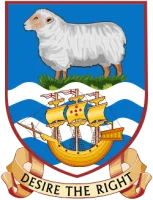
ram
Safety
Is the Falkland Islands (Islas Malvinas) safe to visit?
Yes — the Falkland Islands (Islas Malvinas) is generally safe to visit: the UK Foreign Office has no warnings against travel there.
 UK Foreign Office (FCDO)
Latest update: Addition of information about unauthorised photography at Mount Pleasant and updated information about money, air travel and healthcare in the Falkland Islands ('Safety and security' and 'Health' pages).
Updated 10 Aug 2026 · Full travel advice
Sources: US Department of State travel advisories (public domain) and UK FCDO foreign travel advice (contains public sector information licensed under the Open Government Licence v3.0). Checked daily. Advice can change quickly — always read the official page before you travel.
Weather
Best time to visit the Falkland Islands (Islas Malvinas)
The best time to visit the Falkland Islands (Islas Malvinas) is January to December, when daytime highs in Stanley are around 4–13°C. January is the warmest month (13°C by day), July the coldest (2°C at night), and April the wettest with about 68 mm of rain.
- Jan13°C8°C
- Feb13°C8°C
- Mar11°C7°C
- Apr9°C5°C
- May7°C4°C
- Jun5°C3°C
- Jul4°C2°C
- Aug5°C2°C
- Sep6°C2°C
- Oct8°C3°C
- Nov10°C5°C
- Dec12°C7°C
Best time Good Less ideal
Before you go
Plugs, voltage & emergency numbers in the Falkland Islands (Islas Malvinas)
Plugs & sockets
240 V, 50 Hz · Standard 220–240 V: devices from the US or Japan (110–120 V) need a converter unless they are dual voltage (100–240 V).
Sources: Wikipedia — Mains electricity by country and List of emergency telephone numbers (CC BY-SA 4.0).
Currency · 26 October 2026
Falkland Islands pound exchange rates today
The Falkland Islands (Islas Malvinas) uses the Falkland Islands pound (FKP, £). One US dollar buys 0.7473 FKP; over the last 30 days the FKP has gained 1.0% against the dollar.
What other currencies cost in FKP
Currency converter
Daily reference rates from the open-source currency-api (CC0), 26 Oct 2026. Banks and exchange offices add a margin.
World rankings
Where the Falkland Islands (Islas Malvinas) ranks
How the Falkland Islands (Islas Malvinas) compares with the rest of the world — open any card for the full ranking.
Airports
Airports in the Falkland Islands (Islas Malvinas)
35 airports and airfields — 0 large, 1 medium and 33 small, plus 1 heliports. 2 have scheduled passenger flights.
Borders
No land borders
The Falkland Islands (Islas Malvinas) has no land borders with other countries. Coastline: 1,288 km.
People
Population & society
Religion
Largest cities: Stanley (2,000)
Economy
Economy
Main industries
fish and wool processing; tourism
Export partners
Spain 68%, Morocco 10%, USA 8%, Namibia 3%, Germany 2% (2023)
Top exports
shellfish, fish, wool, sheep and goat meat (2023)
Travel tools
Handy before every trip to the Falkland Islands (Islas Malvinas)
Frequently asked questions about the Falkland Islands (Islas Malvinas)
What do I need to travel to the Falkland Islands (Islas Malvinas)?
Where is the Falkland Islands (Islas Malvinas)?
What is the capital of the Falkland Islands (Islas Malvinas)?
What language is spoken in the Falkland Islands (Islas Malvinas)?
What currency does the Falkland Islands (Islas Malvinas) use?
What is the calling code of the Falkland Islands (Islas Malvinas)?
Does the Falkland Islands (Islas Malvinas) have land borders?
Is the Falkland Islands (Islas Malvinas) safe to visit?
When is the best time to visit the Falkland Islands (Islas Malvinas)?
What plug type does the Falkland Islands (Islas Malvinas) use?
How many airports does the Falkland Islands (Islas Malvinas) have?
Sources: CIA World Factbook (public domain); World Bank Open Data (CC BY 4.0); names, languages and currencies: mledoze/countries (ODbL); flag: flag-icons (MIT); coat of arms: Wikimedia Commons (file page); exchange rates: Daily reference rates from the open-source currency-api (CC0); airports: OurAirports.