
North America · Territory

Greenland: Travel Guide & Requirements
· Kalaallit Nunaat
Greenland is a territory in North America with its capital in Nuuk. It has a population of 56,831 (#200 in the world) and covers 2,166,086 km². The official language is Greenlandic. The currency is the krone (DKK, kr.).
Where is Greenland? Map of Greenland
Northern North America, island between the Arctic Ocean and the North Atlantic Ocean, northeast of Canada.
- Region
- North America
- Coordinates
- 72° N, 40° W
- Neighbours
- none (no land borders)
- Coastline
- 44,087 km
- Greenland
- Capital
Travel requirements
What you need to travel to Greenland
- Passport
A passport valid for your whole stay (check the rules of the governing country).
- Travel advice
Some caution needed — US and UK advice.
Before you go
10 things to know before you travel to Greenland
- Safety: Greenland is generally safe for travellers, but some caution is needed: the US State Department rates Greenland Level 2 (“Exercise Increased Caution”).
- Best time to go: January to December — when daytime highs in Nuuk are around -6–8°C.
- Money: the krone (DKK) — 1 US dollar is about 6.6606 DKK.
- Plugs: type C, E, F and K, 230 V, 50 Hz — standard 220–240 V: devices from the US or Japan (110–120 V) need a converter unless they are dual voltage (100–240 V).
- Emergency numbers: Police 112, Ambulance 112, Fire 112.
- Language: Greenlandic is official; English is also spoken.
- Driving: on the right.
- Time zone: UTC-2 in Nuuk.
- Capital: Nuuk. About 56,831 people live in Greenland.
- Greenland is the 12th largest country in the world by area.
Key facts
Greenland at a glance
Languages spoken: Greenlandic, Danish, English
Geography & history
About Greenland
Greenland, the world's largest island, is about 80% ice capped. The Inuit came to Greenland from North America in a series of migrations that stretched from 2500 BC to the11th century. Vikings reached the island in the 10th century from Iceland; Danish colonization began in the 18th century, and Greenland became part of the Kingdom of Denmark in 1953. It joined the European Community (now the EU) with Denmark in 1973 but withdrew in 1985 over a dispute centered on stringent fishing quotas. Greenland remains a member of the EU's Overseas Countries and Territories Association. The Danish parliament granted Greenland home rule in 1979; the law went into effect the following year. Greenland vo…
Read the full history
Greenland, the world's largest island, is about 80% ice capped. The Inuit came to Greenland from North America in a series of migrations that stretched from 2500 BC to the11th century. Vikings reached the island in the 10th century from Iceland; Danish colonization began in the 18th century, and Greenland became part of the Kingdom of Denmark in 1953. It joined the European Community (now the EU) with Denmark in 1973 but withdrew in 1985 over a dispute centered on stringent fishing quotas. Greenland remains a member of the EU's Overseas Countries and Territories Association. The Danish parliament granted Greenland home rule in 1979; the law went into effect the following year. Greenland voted in favor of self-government in 2008 and acquired greater responsibility for internal affairs when the Act on Greenland Self-Government was signed into law in 2009. The Kingdom of Denmark, however, continues to exercise control over several policy areas on behalf of Greenland, including foreign affairs, security, and financial policy, in consultation with Greenland's Self-Rule Government.
Location
Northern North America, island between the Arctic Ocean and the North Atlantic Ocean, northeast of Canada
Climate
arctic to subarctic; cool summers, cold winters
Terrain
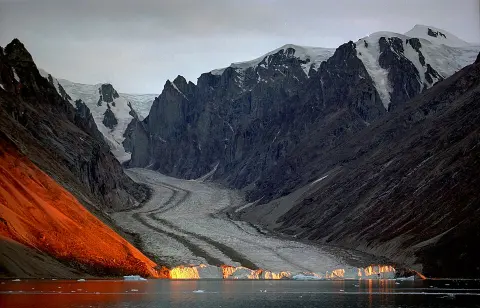
flat to gradually sloping icecap covers all but a narrow, mountainous, barren, rocky coast
Highest point
Gunnbjorn Fjeld 3,694 m
Natural resources
coal, iron ore, lead, zinc, molybdenum, diamonds, gold, platinum, niobium, tantalite, uranium, fish, seals, whales, hydropower, possible oil and gas
Natural hazards
continuous permafrost over northern two-thirds of the island
National symbols
polar bear
Safety
Is Greenland safe to visit?
Greenland is generally safe for travellers, but some caution is needed: the US State Department rates Greenland Level 2 (“Exercise Increased Caution”).
 US State Department
Sources: US Department of State travel advisories (public domain) and UK FCDO foreign travel advice (contains public sector information licensed under the Open Government Licence v3.0). Checked daily. Advice can change quickly — always read the official page before you travel.
Weather
Best time to visit Greenland
The best time to visit Greenland is January to December, when daytime highs in Nuuk are around -6–8°C. July is the warmest month (8°C by day), February the coldest (-10°C at night), and September the wettest with about 108 mm of rain.
- Jan-6°C-9°C
- Feb-6°C-10°C
- Mar-5°C-9°C
- Apr-2°C-5°C
- May2°C-1°C
- Jun6°C3°C
- Jul8°C5°C
- Aug8°C5°C
- Sep5°C2°C
- Oct1°C-2°C
- Nov-2°C-5°C
- Dec-4°C-7°C
Best time Good Less ideal
Before you go
Plugs, voltage & emergency numbers in Greenland
Plugs & sockets
- Type C (Europlug)two round pins
- Type Etwo round pins and a hole for the socket's earth pin
- Type F (Schuko)two round pins with earth clips on the sides
- Type Ktwo round pins and a half-round earth pin
230 V, 50 Hz · Standard 220–240 V: devices from the US or Japan (110–120 V) need a converter unless they are dual voltage (100–240 V).
Emergency numbers
112 works from any mobile phone, even without a SIM card in most networks. All countries →
Sources: Wikipedia — Mains electricity by country and List of emergency telephone numbers (CC BY-SA 4.0).
Ski resorts
3 ski resorts in Greenland
- 6 km of slopes
- 5 lifts
- up to 413 m
Biggest: Sisorarfiit Skiliften · Sisismut Solbakken · Tosebakken
National parks
2 national parks in Greenland
- 994,000 km² protected
- oldest from 1974
Largest: Northeast Greenland National Park · West Greenland national park
Currency · 26 October 2026
krone exchange rates today
Greenland uses the krone (DKK, kr.). One US dollar buys 6.6606 DKK; over the last 30 days the DKK has lost 1.5% against the dollar.
What other currencies cost in DKK
Currency converter
Daily reference rates from the open-source currency-api (CC0), 26 Oct 2026. Banks and exchange offices add a margin.
World rankings
Where Greenland ranks
How Greenland compares with the rest of the world — open any card for the full ranking.
Airports
Airports in Greenland
79 airports and airfields — 1 large, 9 medium and 15 small, plus 54 heliports. 59 have scheduled passenger flights.
Borders
No land borders
Greenland has no land borders with other countries. Coastline: 44,087 km.
People
Population & society
Largest cities: Nuuk (18,000)
Economy
Economy
Main industries
fish processing (mainly shrimp and Greenland halibut), anorthosite and ruby mining, handicrafts, hides and skins, small shipyards
Export partners
Denmark 50%, China 23%, UK 5%, Japan 5%, Germany 3% (2023)
Top exports
fish, shellfish, processed crustaceans, ships, precious stones (2023)
Frequently asked questions about Greenland
What do I need to travel to Greenland?
Where is Greenland?
What is Greenland known for?
What is the capital of Greenland?
What language is spoken in Greenland?
What currency does Greenland use?
What is the calling code of Greenland?
Does Greenland have land borders?
Is Greenland safe to visit?
When is the best time to visit Greenland?
What plug type does Greenland use?
How many airports does Greenland have?
Sources: CIA World Factbook (public domain); World Bank Open Data (CC BY 4.0); names, languages and currencies: mledoze/countries (ODbL); flag: flag-icons (MIT); coat of arms: Wikimedia Commons (file page); exchange rates: Daily reference rates from the open-source currency-api (CC0); airports: OurAirports.