
 North KoreaTravel
Dandong-Sinuiju road bridge opens between China and North Korea
A new four-lane bridge linking Dandong in China with Sinuiju in North Korea opened on 15 October 2026 after a delay of more than a decade. The source does not say whether travellers or passenger vehicles can use the crossing.
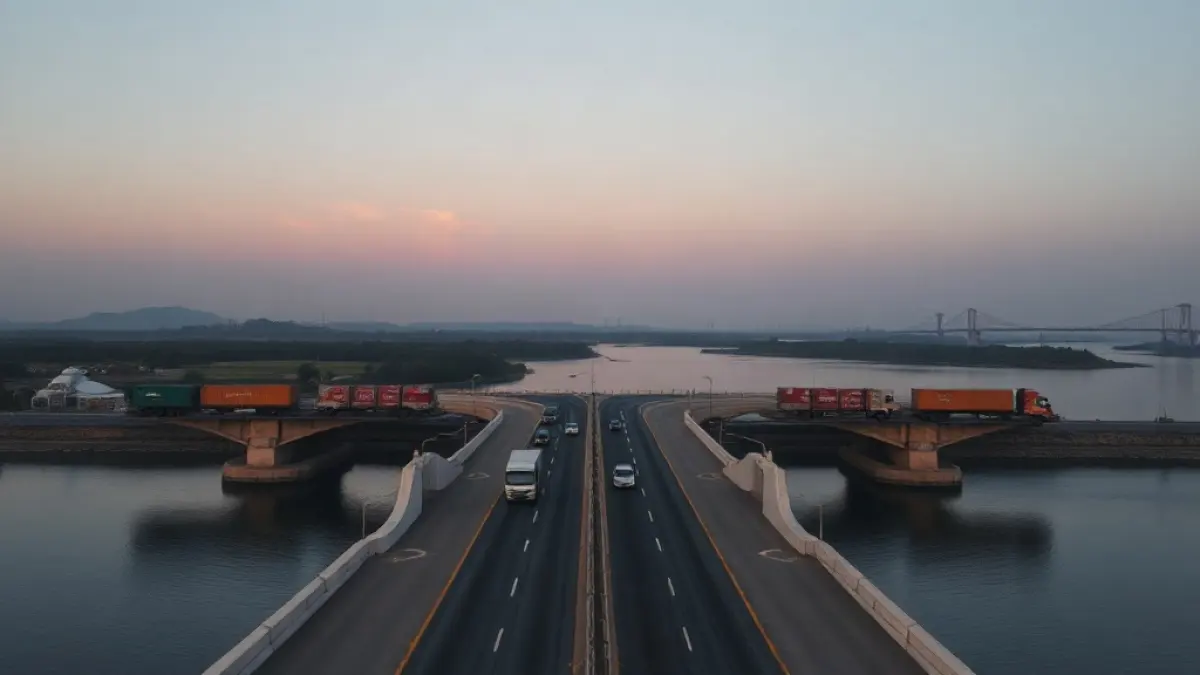
China and North Korea have opened a new road bridge across the Yalu River, more than a decade after it was first expected to come into use. Officials from both countries held a ribbon-cutting ceremony on Thursday, 15 October 2026, with trucks carrying Chinese and North Korean national flags waiting on the crossing.
Key facts
- What opened: the New Yalu River Bridge, a four-lane crossing stretching 3 kilometres (1.8 miles).
- Where: it connects Dandong in northeastern China with Sinuiju in North Korea.
- When: the opening ceremony took place on 15 October 2026.
- Delay: the bridge was initially expected to enter use in 2014, so it opened roughly 12 years late.
- Purpose stated by both countries: to promote economic, trade and people-to-people exchanges.
What has opened?
The New Yalu River Bridge is a four-lane, 3-kilometre (1.8-mile) road crossing between Dandong and Sinuiju. Chinese Premier Li Qiang and North Korean Premier Pak Thae Song both addressed the ceremony by video.
Li said the relations between China and North Korea had "entered a new stage, embarking on a new chapter", and described the crossing as a landmark symbolising the two nations' traditional friendship, according to China's official Xinhua News Agency. Pak said he was confident the bridge would accelerate prosperity and the well-being of the peoples of both countries, according to North Korea's official Korean Central News Agency.
Why did it take so long?
China appeared to have completed construction on its side of the bridge by 2014, but North Korea had not carried out corresponding work in Sinuiju at that time. The lack of progress fuelled speculation that Pyongyang was wary of greater economic dependence on China or unhappy with Beijing's support for United Nations resolutions tightening sanctions over the North's nuclear programme. Some observers also suggested the two sides disagreed about the bridge's location.
What changes at the border?
Observers cited in the report expect the new crossing to boost bilateral trade and improve logistics. It is expected to ease pressure on the older bridge on the same Dandong-Sinuiju route, which carries more than 70% of official trade between the two countries. That decades-old structure carries a railway line plus cars and trucks, but vehicle traffic can only move one way at a time.
The South Korean government said last year that at least 17 active road and rail links cross the North Korea-China border, which runs more than 1,400 kilometres (870 miles). About 98% of North Korea's external trade was with China in 2025.
What this means for travellers
The report describes the new bridge as a trade and logistics link and does not state whether tourists, passenger cars or buses are permitted to cross it, or what border procedures apply. It also gives no details of any change to entry rules on either side.
Anyone planning to cross the Dandong-Sinuiju border should check the current arrangements for that crossing before travelling, as the source provides no information on passenger access.
The bridge opened about a month after North Korea and Russia opened a road bridge between the two countries. No further announcements about the new Yalu River crossing are mentioned in the report.
Also about:  China